
With three major AI-related IPOs on the horizon – SpaceX, Anthropic, and OpenAI – it may feel like AI equities will rally for the foreseeable future. However, as we’ve seen in other high-flying industries of the past, these events can often mark market highs. Here’s what the Coinbase IPO can show us.
What the Coinbase IPO Taught Investors About Market Tops
On April 14, 2021, Coinbase went public via an IPO. This marked a notable milestone for the industry, signifying crypto’s entry into the mainstream. Notably, this was done via a direct listing rather than a traditional IPO mechanism, allowing insiders (namely, executives and VCs) to sell directly into the market with few limits. Market sentiment and excitement felt extremely positive and bullish, with new BTC highs being hit each day. The idea that the market could be at its apex seemed unlikely.
On day one, the stock opened at $381, rose to $429, and then fell to $328. Insiders sold shares for billions of dollars, while most new investors lost money on the day. The same day marked an all-time high for bitcoin, around $65,000. Bitcoin then fell about 76% from this price to a market bottom of $15,500. Coinbase stock also fell by about 80%. Obviously, a big IPO does not guarantee the continuation of a bull market.
How the SpaceX IPO Adds $1.77 Trillion in Market Cap
What, then, should investors be considering when assessing AI stocks? Ultimately, assets go up and down based on supply and demand. This is partly a matter of momentum and excitement, but unlike bitcoin, stocks also have earnings metrics that reflect the health of the business. When an IPO occurs, it adds a new supply of shares to the market. The money has to come from somewhere, either new cash flows entering public markets or money leaving other stocks to participate in the new ones.
In the case of SpaceX, with an IPO expected this Friday, June 12th, $75 billion worth of new stock will enter the public markets, a small fraction of the business’s total market cap. It will add $1.77 trillion of market cap to the total market cap in these markets. The most recent private valuation stood at $1.25 trillion. In a sense, this is merely a reallocation of market cap from private to public markets, except that real-time pricing is now in effect. Further, the stock touches multiple industries outside of AI, including space and communications. As a result, investors in the AI sector need to make their own deductions around how much impact this movement of capital will have on other stocks.
What Hyperliquid and Polymarket Are Pricing Into the SpaceX IPO
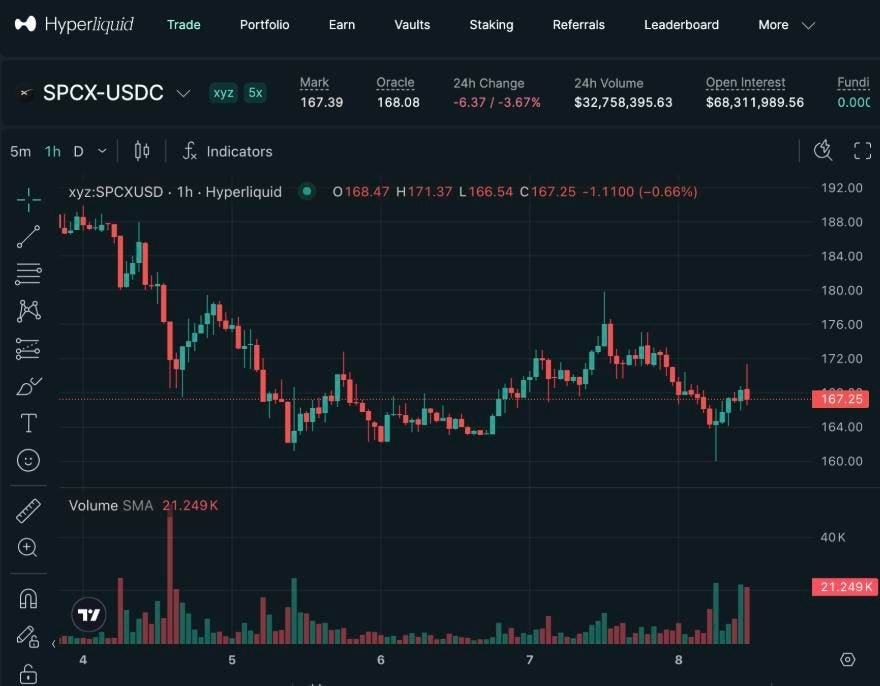
Crypto pre-IPO markets and prediction markets, especially Hyperliquid and Polymarket, also give some view into the market’s expectations for the stock’s price. Presently, the SpaceX futures on Hyperliquid are trading at $167, $32 above the IPO price of $135, or roughly a 25% increase. Notably, this has come down from as high as $215 since the market opened in mid-May.

SpaceX futures on Hyperliquid currently trade at $167 just days before the IPO
Hyperliquid
Polymarket offers a blended probabilistic view, with 47% of participants expecting the day one market cap to close above $2.2T, roughly a 25% increase on day 1 as well.
Users on Polymarket give a 47% chance to the stock closing day one at a market cap of $2.2T or higher
Polymarket
The largest risk stems from an unsuccessful outcome that pops the broader industry bubble. A signal that demand for these products has run dry could reverberate through other stocks, causing a cascade downwards as positions are sold to take profits.
Market mechanics matter a lot, too. In the case of Coinbase, a direct listing obscured the extent of sell pressure from insiders on day one. In the case of SpaceX, near-term inclusion in many major indexes and 30% of the IPO reserved for retail could provide tailwinds. SpaceX and Goldman Sachs have noted that demand for the IPO has outstripped the offering by at least 2x, though this is not uncommon and does not guarantee a positive opening in the first few days. The true interest from retail and the market on day one remains to be seen. Any hints of weakness could put the market on edge and create volatility in both directions. Stocks trading on momentum rather than fundamentals exhibit greater reflexivity, since conviction is based on technical indicators rather than the true quality of the business. Said another way, belief in the trade can fade quickly as people protect their positions and expect others to do the same.
Is the SpaceX IPO a Buy or a Bubble?
Economist John Maynard Keynes said, supposedly, “Markets can stay irrational longer than you can stay solvent.” Whether he did say this or not, the quote rings true. Even though SpaceX’s forward earnings are astronomically high and AI and space stocks have already reached way overbought territory, the momentum around these industries, as well as Musk’s cult of personality, may win the day. With the full weight of every brand-name investment bank in the world behind the deal, those looking to bet against SpaceX and Musk would be wise to do so with caution!