
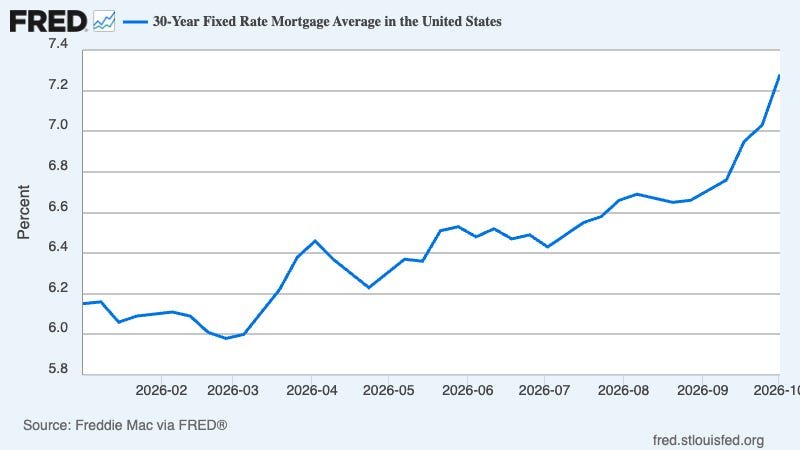
Chart 1
Modern economies run on borrowed money — as they should. Highly productive new business investments shouldn’t be limited by a company’s current cash flow. Families with solid incomes should be able to buy houses now without being forced to wait years to accumulate sufficient cash. Governments should be able to respond to emergencies such as a war or a deep recession in part by issuing debt.
However, there is a lot of debt in the economy today. In addition, interest rates have risen a lot in the past few weeks. An increase in interest rates, combined with a high debt load, translates into far higher costs of servicing that debt. And this can be disruptive to the economy as a whole. Chart 1 shows the year-to-date trajectory of one very important rate: The interest rate on a standard mortgage, the kind of loan many people take out to buy houses. The fixed 30-year mortgage rate was about 6 percent on the eve of the Iran war — itself a huge step up from the rates that prevailed for many years after the 2008 financial crisis. As of last week, those mortgage rates were almost 7.3 percent. For a $500,000 mortgage, that translates into an additional $431 in monthly payments, and an additional $155,000 in interest cost over the life of the mortgage.
There was an especially rapid rise in interest rates over the course of September. Because interest rates and the prices of bonds move in opposite directions, this has been widely described in the financial media as a “bond market rout.”
So what is going on?
In last week’s primer I covered the general principles of how the Federal Reserve sets short-term interest rates and how financial markets determine long-term interest rates. I also offered some preliminary observations on the possible causes of the recent spike in long-term rates. Today I will delve more deeply into potential explanations.
To preview: The current evidence does not support the view that rising long-term interest rates are being driven either by fears of a U.S. government default or by concerns about runaway inflation. It’s likely that the biggest source of the interest rate surge is the immense demand for funds created by the AI boom. Yet the Iran war appears to have had a triggering effect on financial markets, leading to a reset of market narratives about the future path of Federal Reserve policy. In addition, there are very recent indications of a balance-sheet deleveraging spiral that is also contributing to the sharp increase in long rates. I know that is a lot, and I will attempt to explain step-by-step the concepts and evidence that support my view of what is driving the current moves in interest rates.
Beyond the paywall I will address the following:
1. Why default risk doesn’t appear to be the cause of the surge in US interest rates
2. Why inflation concerns also don’t appear to be the cause
3. The singular importance of the AI boom in causing higher rates
4. Let’s talk about the Iran war and interest rates
5. What’s next in this series