

The financial landscape in 2026 has completely upended traditional narratives surrounding digital assets. For years, crypto proponents championed $Bitcoin as the ultimate “digital gold”—a safe-haven asset designed to thrive during macroeconomic instability and geopolitical turmoil. However, price action since the onset of the US-Iran war has told a starkly different story.
Data highlights a massive performance gap between the traditional technology sector and the cryptocurrency market, triggering a fundamental re-evaluation of how digital assets respond to global conflict.
The Great Decoupling: Crypto Sinks as Equities Soar
Since the outbreak of the US-Iran conflict, the performance divergence between major indexes and top digital assets has widened significantly:
- Nasdaq 100 (US 100 Index): Up +20%
- Bitcoin (BTC): Down -3%
- Ethereum (ETH): Down -13%
While Wall Street’s tech-heavy Nasdaq 100 benchmark surged to capture major gains—hovering near the 29,000 mark despite a minor 4.77% daily correction—the cryptocurrency market has faced a protracted liquidity squeeze. $Ethereum has borne the brunt of the risk-off sentiment among alternative layer-1 protocols, shedding more than a tenth of its value.
This decoupling challenges the long-held thesis that crypto markets move in lockstep with high-growth tech stocks during broader market expansions.
Why Big Tech Thrives While Crypto Capital Flees
The primary driver behind this divergence comes down to capital preservation and structural market differences. Tech giants inside the Nasdaq are heavily insulated by robust cash flows, corporate buybacks, and tangible infrastructure. During periods of war, institutional capital frequently rotates into high-liquidity, mega-cap defensive tech positions that can weather inflationary pressures.
Conversely, the crypto market remains a playground for high-leverage trading. When geopolitical risks escalate, derivatives markets experience immediate cascading liquidations. Rather than acting as a safe haven, digital assets are often used as “liquidity ATMs”—the first assets investors sell to cover margin calls and secure cash reserves in traditional brokerages.
Iran-Israel Escalation Triggers Short-Term Relief Rally
Despite the long-term downward trend since the war began, Bitcoin demonstrated its characteristic volatility over the past 24 hours. Following renewed weekend missile exchanges between Iran and Israel, digital assets initially plunged, wiping out billions in open interest.
However, as the week opened, Bitcoin managed a minor relief rally, reclaiming the $63,000 level—a modest 1.60% to 4.94% recovery from its localized weekend lows.
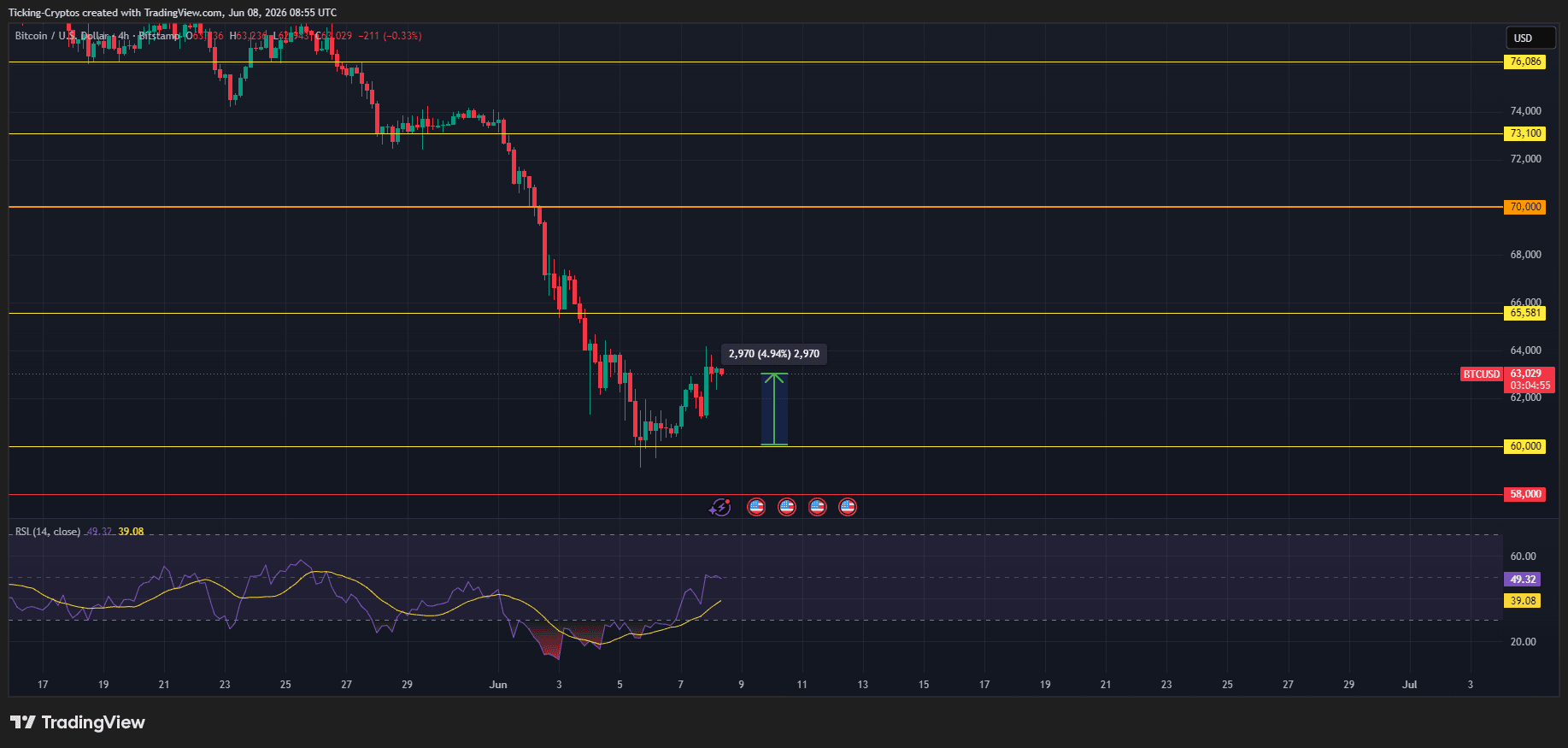
This short-term bounce occurred independently of traditional markets, which were closed when the initial strikes happened. This underscores another critical factor: crypto operates 24/7. Because digital assets absorb geopolitical shocks in real-time over weekends, they often experience dramatic “fear flushes” followed by sharp technical rebounds before traditional stock exchanges even open for Monday trading.
Crypto Markets Abandoning World Macro Trends
The disconnect between the Nasdaq’s historic gains and Bitcoin’s sluggish performance indicates that crypto markets are increasingly marching to their own beat, untethered from standard macroeconomic playbooks.
According to institutional tracking data from platforms like Investing.com, the crypto ecosystem is currently battling its own internal headwinds. Persistent outflows from spot Bitcoin ETFs—totaling over $1.7 billion in a single week—have stripped the market of the structural buying pressure it enjoyed in early 2026.
Fears of prolonged high interest rates, combined with institutional rotation away from speculative assets, mean that crypto is no longer a reliable proxy for macro liquidity. Until ETF inflows stabilize and geopolitical uncertainty subsides, Bitcoin’s path of least resistance remains a sideways-to-bearish consolidation within its established $60,000 to $65,500 trading range.