

Forecast Trend Report by Period


**

Major Coins
1. Bitcoin (BTC)

Bitcoin came under pressure this week as geopolitical risks in the Middle East shook risk appetite, briefly pushing the token below $73,000. As of May 29, Bitcoin was trading at $73,268.50 on Binance’s USDT market, down 1.3% from a day earlier.
The main driver of the decline was renewed concern over a broader military clash between the US and Iran. On May 27, US Central Command said it had carried out airstrikes on Iranian military targets. Washington described the operation as defensive. US forces also shot down four Iranian suicide drones and struck a drone-launch unit near Bandar Abbas, close to the Strait of Hormuz, according to reports.
Iran’s Islamic Revolutionary Guard Corps later said it had struck US military bases, further hurting investor sentiment. It also warned it would respond more forcefully if the US launched additional attacks. As tensions between the two sides escalated again, risk assets broadly came under pressure and Bitcoin fell below $73,000.
Ceasefire hopes later resurfaced. Axios reported on May 28 that US and Iranian negotiators had recently reached a tentative agreement on a 60-day ceasefire and a framework for nuclear talks. The proposal reportedly includes guarantees for freedom of navigation through the Strait of Hormuz and the resumption of nuclear negotiations. Final approval from US President Donald Trump is still pending.

The market is now reflecting both the risk of further escalation and hopes for a truce. On the same day, US Treasury Secretary Scott Bessent said Iran must accept denuclearization and guarantee free passage through the Strait of Hormuz, signaling that negotiations have not been fully wrapped up. That has kept markets cautious rather than sparking a strong relief rally.
In the short term, support around $74,000 will be critical. NewsBTC analyst Aayush Jindal said Bitcoin remains in a short-term bearish phase after falling below the $75,000 support level. A move below $74,000 would put the next support levels at $73,500 and $73,200, with further losses potentially opening the way to $72,000. Cointelegraph analyst Rakesh Upadhyay, by contrast, said a recovery above $77,431 could open the door to a rebound toward $82,000 and $84,000.
2. Ethereum (ETH)

Ethereum also extended its decline this week and at one point fell below the key psychological level of $2,000 for the first time in about two months. As of May 29, it was trading at $2,005.79 on Binance’s USDT market, down 0.42% from the previous day.
One factor weighing on sentiment was public selling by prominent Ethereum backers. David Hoffman, co-host of crypto podcast platform Bankless, recently said he had sold all of his Ethereum holdings. He described Ethereum as an influential open-source ecosystem, but said it was approaching stagnation as an investment asset. He also argued that while Layer 2 projects are growing, that progress has not translated sufficiently into a rebound in Ether’s price.
Eric Conner, a former core Ethereum developer, also said he had sharply reduced his Ether holdings over the past one to two years. He said Ethereum has underperformed the broader market for years, while other assets he added instead delivered higher returns.
Derivatives markets have also turned unfavorable. Ethereum futures open interest recently climbed to a record roughly $32.5 billion, while the spot price fell more than 4% and slipped below $2,000. BlockBeats said rising open interest alongside falling prices points to aggressive leveraged short positioning. That could add to near-term downside pressure.
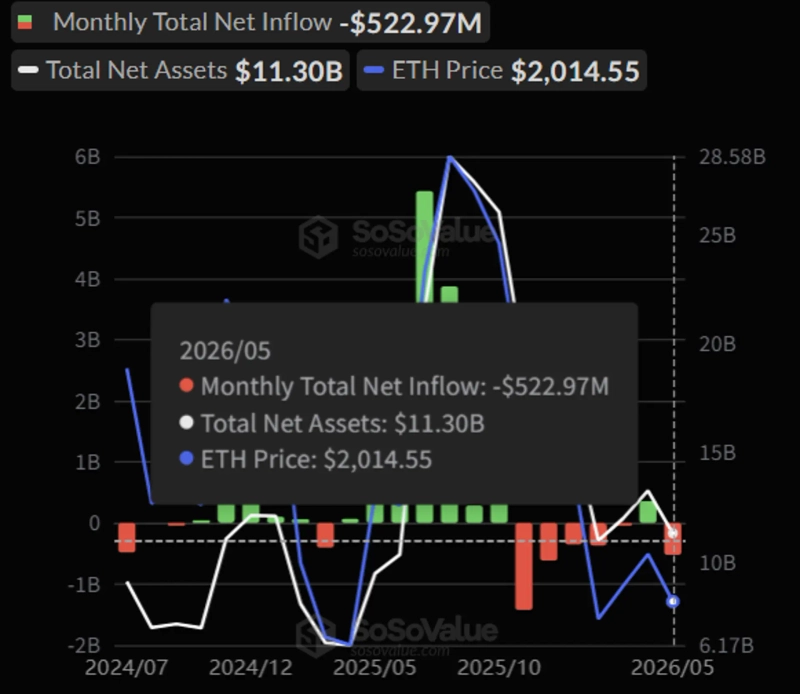
Institutional flows have also been negative. According to SoSoValue, US spot Ethereum ETFs have seen about $522.97 million in outflows so far this month. Selling by high-profile Ethereum supporters, weakness in derivatives and institutional outflows have combined to pressure sentiment.
The outlook remains cautious. Santiment said investors should be wary of excessive optimism after Ether fell below $2,000. Retail investors are treating the break of $2,000 as a buying opportunity, it said, adding that the market has become overly optimistic. That kind of excessive optimism could increase the risk of further declines. Crypto analyst Ali Martinez also outlined specific support levels. He said $1,850 is now Ethereum’s key support, and a weekly close below that level could accelerate the downturn. For a bullish reversal, Ether would need to reclaim the 200-week moving average near $2,500 and break above the 50-week moving average around $3,100, he said.
3. XRP
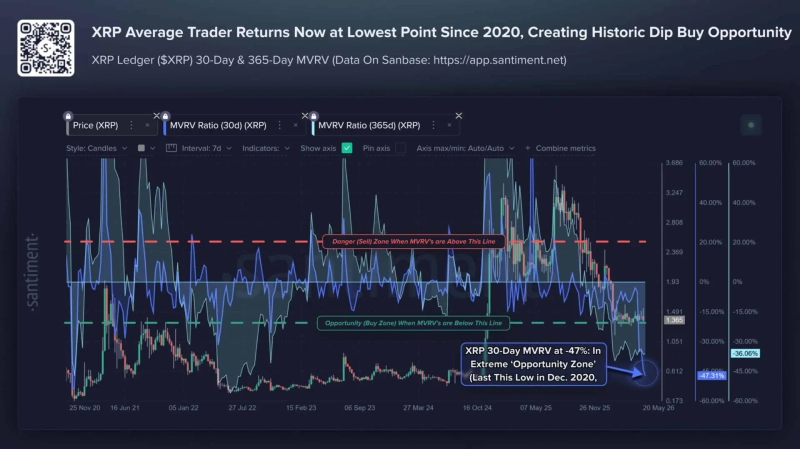
XRP’s decline accelerated this week, briefly dragging the token into the $1.20 range. It has since recovered part of the loss. As of May 29, XRP was trading at $1.3124 on Binance’s USDT market, up 2.12% from a day earlier.
The weakness reflects deteriorating sentiment and strong selling pressure. Santiment said on May 28 that XRP investors’ average 30-day return, measured by MVRV, had fallen to about negative 47%. That is the lowest level since December 2020 and suggests a large share of investors have moved into loss-making territory.
Santiment said the XRP market is now reflecting extreme fear and fatigue. Repeated price corrections have increased stop-loss selling by short-term investors, adding to downside pressure, it said.
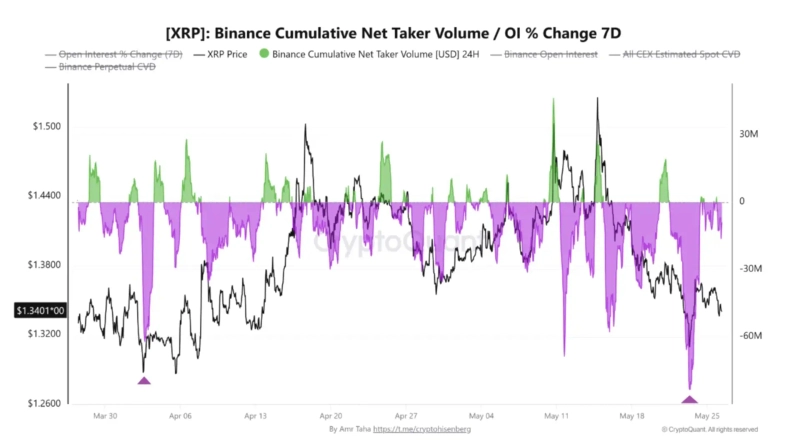
On-chain data also show heavy selling. According to CryptoQuant, cumulative XRP net taker volume on Binance recently fell to about negative $83 million. That means sell orders at market prices have continued to outpace buys.
There is also a case for a rebound. Santiment said MVRV has fallen to its lowest level since 2020 and that similarly extreme fear in the past was followed by meaningful rebounds. The market appears to be absorbing a large share of panic selling, it said, and bargain buying could support a recovery.
Still, XRP must hold a key support level for any rebound to continue. Ali said the number of XRP network transactions worth more than $1 million has recently dropped by more than 57%. Whale investors are watching to see whether prices stabilize rather than buying aggressively, he said. XRP could continue its rebound attempt if it holds the key support zone at $1.29. A break below that level could intensify selling pressure.
Issue Coin
1. Stellar Lumens (XLM)
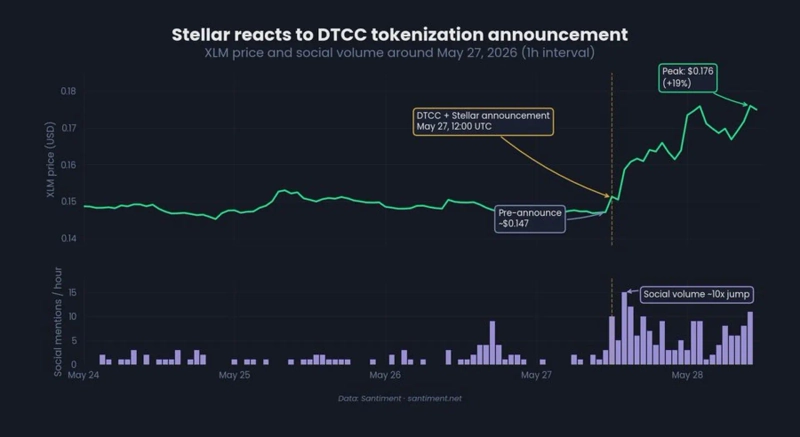
Stellar Lumens was the standout mover in the altcoin market this week. The token has risen more than 35% over the past week on Binance’s USDT market and 36% on South Korean exchange Bithumb. As of May 29, it was up 18% from a day earlier at $0.2022 on Binance’s USDT market.
The main catalyst for the rally was growing expectations of cooperation with the Depository Trust & Clearing Corporation, or DTCC, the core US financial market infrastructure provider that effectively handles securities settlement and clearing. CoinDesk reported on May 28 that DTCC is pursuing ways to use asset tokenization on the Stellar blockchain, with a target of the first half of next year.
Market expectations rose further because DTCC is reportedly reviewing a structure under which highly liquid traditional financial assets, such as US Treasuries and major stock indexes, could be issued and transferred on-chain in tokenized form. Real-world asset tokenization has recently become a major theme on Wall Street. Traditional financial firms including BlackRock and Franklin Templeton have already been actively expanding into the sector.
Still, the sharp rise over a short period means volatility could remain elevated. DTCC has not disclosed the specific scope of any deployment or a commercialization timeline, prompting concerns that expectations have already been priced in. Even so, some market participants say the move could renew attention on Stellar’s potential role in institutional finance.