
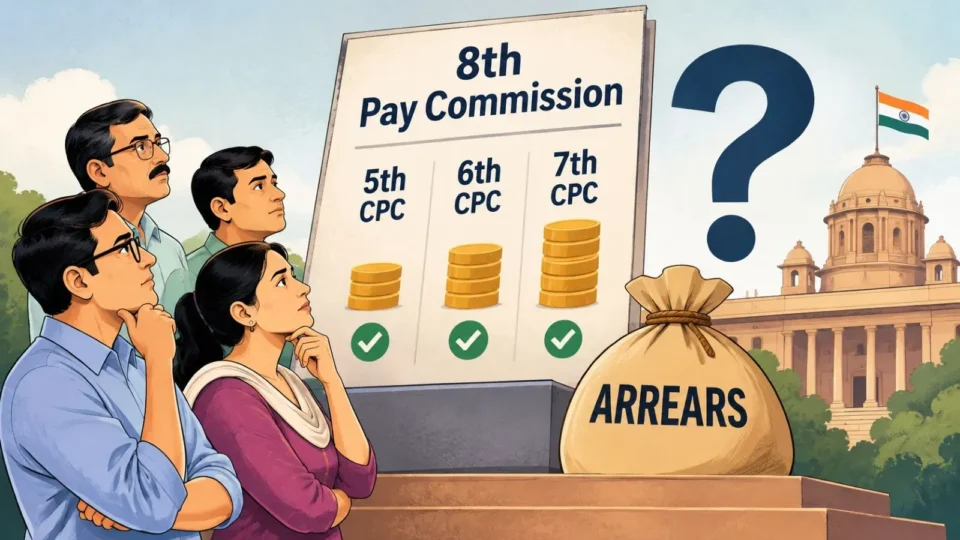
Assuming that the 8th CPC is implemented with effect from January 1, 2026, many central government employees expect arrears to be paid. But are arrears really a certainty? Drawing on the 7th CPC report, this article explains the approach adopted by the 5th, 6th and 7th CPCs towards arrears what that may indicate for the 8th CPC.
5th Pay Commission
The 5th Pay Commission’s award was paid in arrears. The 7th CPC report explained it, saying, “The implementation of the V CPC entailed payment of arrears. The first instalment of arrears was paid in 1997-98 and the second instalment in 1998-99.”
Two features of the 5th CPC arrears may matter now:
-
The arrears were split across two financial years rather than paid at once
-
The budget spike was temporary, with the share falling back within three years.
6th CPC Pay Commission
The 6th Pay Commission’s also carried arrears. The 7th CPC report noted this, saying, “The awards of the previous Pay Commissions, both V as well as the VI, involved payment of arrears. If awards are made with an arrears component then the cumulative impact of arrears would temporarily increase government expenditure on PAP, thereby causing an appreciable shock, albeit for a short time. This shock impacts both fiscal stability and the price level through demand and supply channels.”
It further said, “The cumulative effect of these elements on the award of the VI CPC was of the order of 0.77 percent of GDP in 2009-10. This Commission is of the view that any macroeconomic impact that exceeded this number would not be fiscally prudent and would put undue pressure on the government in terms of discharging its development and welfare spending responsibilities.” That 0.77% became the ceiling the 7th CPC set for itself.
7th Pay Commission
The 7th Pay Commission did something that not of its predecessors had done. It set its date of effect at the end of the 10-year cycle, so that the new pay arrived on time with almost no arrears.
“Seventh CPC recommendations entail, at best, payments of marginal arrears and we do not therefore envisage any macroeconomic shock on this score,” it concluded. However, the Staff Side had then asked for more. They had asked for implementation of 7th CPC from January 1, 2014, saying, “there has been substantial erosion in the value of wages owing to non-merger of DA, which has crossed the 100 percent mark in January 2014.”
However, the 7th CPC refused the demand while noting it was constituted in 2014 and that “the ten year period gets over on 01.01.2016.” It held that “the Commission does not agree with the demand of early implementation of revised pay structure and recommends that the date of effect should be 01.01.2016.”
The 7th CPC report also said, “The demand for retrospective pay hike cannot be accepted by this Commission.”
The mechanics of the 7th CPC fitment factor explained why the date mattered so much. The factor of 2.57 was not just a flat raise. “of this multiple, 2.25 provides for merging of basic pay with DA, assumed at 125 percent on 01.01.2016, while the balance is the real increase,” the 7th CPC report said.
The 7th CPC report also recorded how various governments cope when arrears do arise. Among the options states have used after earlier awards were “deciding on a date of implementation different from that of the Centre” and “staggering the payments of arrears suitably.”
What the 8th CPC has inherited
The 7th CPC cycle that began on January 1, 2016 ended on December 31, 2025. The 8th CPC was constituted in November 2025 with an 18-month deadline expiring in May 2027. If its award takes effect from January 1, 2026 but is implemented after May 2027, the gap between those dates would lead to arrears. In this case, the size of the arrears bill of the government will depend on the date of effect, not on the fitment factor.
While the 7th CPC engineered its way out of this problem, the 8th CPC may not be able to do so. Its predecessors have supplied two templates: the 5th CPC’s two-instalment spread, and the 6th CPC’s 0.77% of GDP as an outer limit. Which path the 8th CPC follows, or whether it simply aligns the effective date, as the 7th CPC did, remains to be seen.