
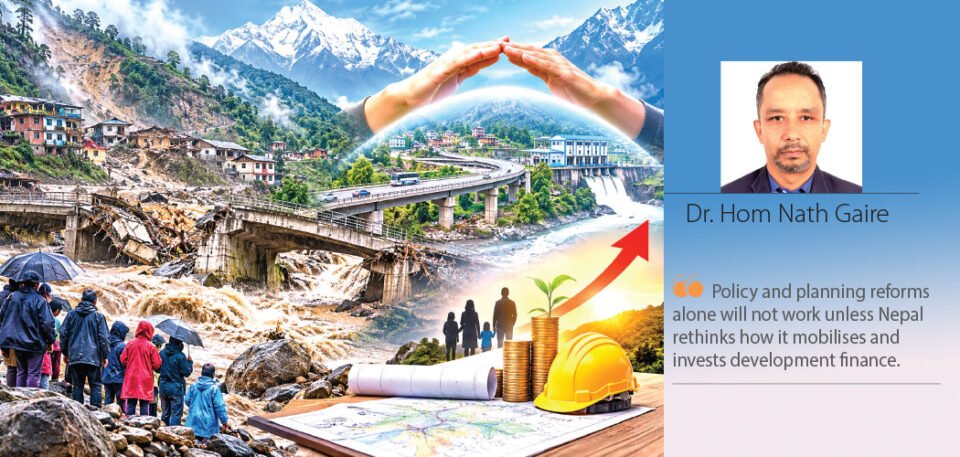
The devastating floods of the Bhotekoshi, the Kali Gandaki and the Budhi Gandaki River corridors during late August to early October 2026 in the Himalayan Mountains have warned us about the vulnerability of Nepal’s development finance model. These floods, possibly triggered by climate-induced tragedies, have swept away strategic bridges and people’s houses and severely damaged infrastructure. This is not the exception, as Nepal has been witnessing similar disasters over the last few years.
Together, these cyclical disasters have been warning the authorities to rethink the development and public investment model the country has been adopting for the last three or more decades. There is a fundamental ambiguity about our capacity to finance infrastructure, which was undermined in considering, informing, and managing the geographical and climatic risks to which the country is vulnerable. The fundamental infrastructures such as roads, bridges, business corridors, human settlements and hydropower projects remain vulnerable to extreme climatic floods, landslides and sudden changes in river behaviour.
Risk planning
The very preliminary assessment by the government estimates around Rs. 400 billion in asset damage and economic losses from the August Bhotekoshi disaster alone. In the meantime, the Kali Gandaki and Budhi Gandaki rivers repeatedly washed away several strategic infrastructures and means of livelihood. Here the fundamental question is not simply how quickly we can rebuild the damaged public properties but why our public investments continue to be exposed to such devastating risks in the first place.
The vital question is whether we should keep investing public resources in the same development patterns that again and again expose people, infrastructure and public finances to intolerable risks. Now the time has come that the nation needs an immediate shift in both infrastructure planning and development finance.
Over time, the country’s development priorities have been severely guided by political promises, election consciousness and the undue charm of large infrastructure projects. Often it is observed that the roads, bridges and other physical structures with very little value addition for the economy are counted as symbols of progress and political achievement. However, vulnerability assessment, antagonistic climate risks, river dynamics and long-term liabilities have not always received the attention they deserve.
It is obvious that the country needs better connectivity, reliable energy, resilient settlements and productive infrastructure, but it should be linked to employment, income and socioeconomic transformation of the community. Nepal, a country with steep slopes, fragile geological formations and unpredictable river systems, cannot rely only on conventional tools of development planning and investment modelling.
The burning issue of climate change has been complicating the planning and budgeting process as illustrated by the latest climate-induced disasters. It says how a hazard originating in a remote mountain catchment can cascade downstream, destroying infrastructure and livelihoods far beyond its point of origin. Such events warn the planner why risk-informed planning and budgeting are the most resilient strategic infrastructure networks.
Development economics
Flaws of the development model cannot be explained by technical limitations alone. It has a strong association with the political economy of public investment, procurement and natural-resource management. Economists believe that large public investments create opportunities for augmented economic activities and promote private sectors. However, it has been a common practice that the selection of strategic projects followed by the financial closure, procurement, construction and environmental regulation were often guided by political influence, resulting in conflicts of interest and rent-seeking incentives.
It was an open secret that the nexus among the political actors, public officials, regulators and business inflated project costs, compromised environmental safeguards and distorted engineering standards. Such a nexus resulted in a poorly regulated extraction of natural resources that was responsible for changing river channels, destabilising riverbanks and weakening nearby infrastructure.
In the meantime, politically exposed individuals and businesses knowingly occupy risky locations because of land market incentives and weak enforcement due to undue favours from the leadership. It would be unfair to attribute every incident to political economy, but we must acknowledge that the unchecked nexus creates risks for emergency services, public infrastructure and the wider economy.
The distorted development finance impacts far beyond the cost of reconstruction, affecting public revenue, household income, private investment and the government’s ability to finance essential services. When roads and bridges are destroyed, transport and trade are disrupted, and associated revenue declines, which in turn affects livelihoods, raises insurance claims and drags the economy into recession.
In response, public funds get diverted towards emergency relief, rehabilitation and reconstruction, creating a vicious cycle of fiscal burden. The government opted for debt financing to build infrastructure, but the misguided risk management and political-economy nexus leave these investments vulnerable to destruction, making new borrowing compulsory to restore what was lost. Meanwhile, debt-servicing obligations continue, even when the assets financed by borrowing are no longer delivering their expected economic and social returns.
Nepal cannot sustain such a vicious cycle, and the debt, which is supposed to finance productive assets, cannot repeatedly fund the replacement of infrastructure whose risks were ignored in the first place. This is creating a ‘Double Shoulders’ challenge for the present government, i.e. mobilise the finance for reconstruction and recovery while protecting the public budget from the recurrence of avoidable losses.
Opportunity for reforms
The present government has an opportunity to address this fundamental problem of development finance. Recovery is a pragmatic tool for rethinking development policies, institutional practices and investment modelling to avoid recurring loss and damage.
First of all, an evidence-based review of engineering codes and infrastructure standards for high-risk areas, with a flexible clause that allows such standards to be periodically updated with evolving evidence. Second, climate-induced disaster risk screening should be made mandatory for major public infrastructure investments.
Thirdly, risk-based zoning of river corridors with strong regulation is essential, especially for the areas that are exposed to exceptional flood and climate-induced hazards. In case of unavoidable risks, critical infrastructure and human settlements should be restricted or relocated with practical alternatives.
Fourthly, river-based material extraction must be governed by science-based limits rather than short-term revenue considerations. Finally, indigenous knowledge and skills should be institutionalised with proper testing and documentation in the development model.
Policy and planning reforms alone will not work unless Nepal rethinks how it mobilises and invests development finance. Tax-based budgets and debt financing are already under pressure from competing demands for infrastructure, social protection, universal health, education and unforeseen economic recovery.
It is high time for the government to implement a diversified framework for alternative development finance. However, alternative development finance must not become another route for contingent liabilities to invest in poorly appraised projects. As the conventional Public-Private Partnerships (PPP) could not work as expected, it requires rigorous value-for-money assessments and transparent disclosure of the government’s long-term financial commitments.
Investments in early-warning systems, river monitoring, hazard mapping, resilient infrastructure and planned relocation may not produce the immediate political visibility like a road or bridge, but their economic returns can be substantial when measured against avoided losses.
Development financing should be evaluated by whether such investments help reduce vulnerability, ease livelihoods, improve public services and generate sustainable economic returns.
The latest floods gave a painful signal that risk does not respect administrative boundaries, political promises or budget constraints. A bridge built without adequate consideration of flood risk, a settlement established in an unsafe corridor, can impose costs on generations of taxpayers. Thus, the challenge of development finance is about changing the investment incentives and institutions that shape public investment.
Political leaders should think beyond the volume of budget sanctioned for the physical structures that they will lay foundation stones for. The government must now stop the recurring cycle of construction, destruction and reconstruction by pursuing prudent public accountability and financial sustainability.
Public officials should dare to enforce scientific standards and to resist undue political pressure. Contractors must follow responsible business practices in compliance with quality and legal standards, whereas communities should be empowered to scrutinise the projects’ dashboards and whittle down the violations. Most importantly, planners should dare to accept that disaster resilience is not an additional cost but rather a precondition for protecting development gains.
(The author is an applied economist with experience in economic policy and development research.)