
PI Global Investments
Finance

Canada has to make final investment decisions on expanding LNG exports soon to take advantage of the next boom


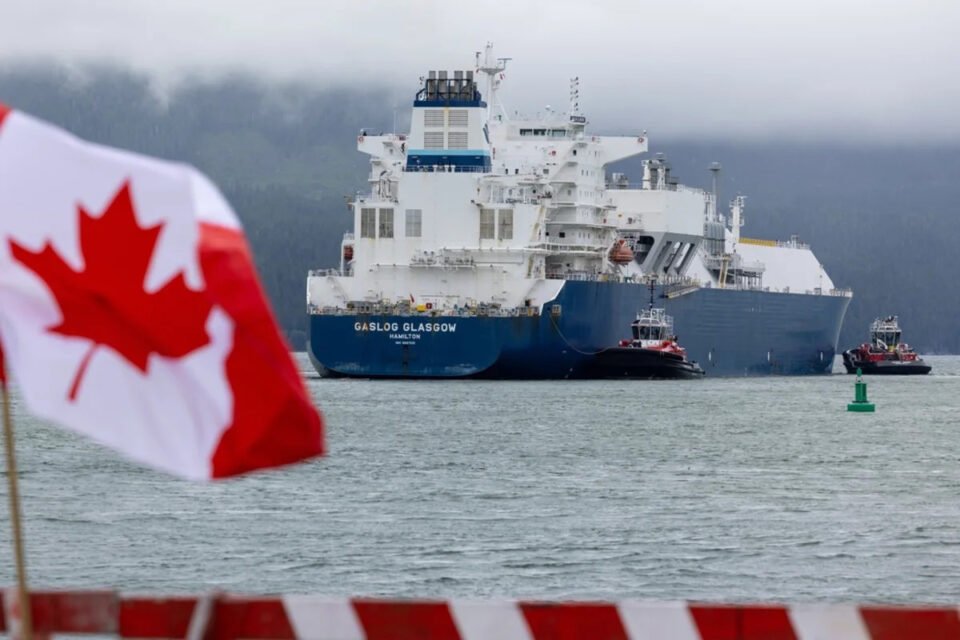
The LNG tanker GasLog Glasgow prepares to depart LNG Canada's shipping terminal in Kitimat, B.C.
The LNG tanker GasLog Glasgow prepares to depart LNG Canada’s shipping terminal in Kitimat, B.C. (Handout/LNG Canada)

Anyone who wants Canada to diversify its economy by building out its liquefied natural gas sector should keep one deadline in mind: May 2028.

That’s when the window closes to catch the next wave of LNG demand, according to a new report by S&P Global Energy.

S&P predicts global LNG demand will grow 50 per cent in the next five years, particularly as countries in Southeast Asia, such as India, increase consumption. By around 2028, the market will soften as more supply comes online, but LNG demand will still continue to grow for around 20 years.

“Fundamentally, people have not really focused on the degree of growth there’s going to be in energy demand,” Daniel Yergin, an energy historian and one of the report’s authors, said.

Canada has been exporting LNG from a terminal in Kitimat, B.C., since July 2025, primarily to Asian markets.

Much of Canada’s LNG comes out of the Montney Basin, a 130,000-square-kilometre area in northeastern B.C. and northwestern Alberta that S&P describes as one of the world’s lowest-cost resources.

But there is intense competition to grab a slice of the next LNG wave, with Argentina, Mozambique, Russia, the United States and other countries making plans to expand their offerings.

Nonetheless, Prime Minister Mark Carney has been pushing to expand Canadian production and diversify its trade, a huge task given the U.S. accounted for 72 per cent of Canada’s $779 billion in goods exports last year, with fossil fuels making up nearly 29 per cent of that trade.

“Canada needs to diversify its own economy away from the United States,” Yergin said. “This (LNG) is a very important way to do that.”

His team’s report said exporting 100 million tonnes of LNG — a number Carney has cited — is achievable by 2050, but that an eightfold increase would require faster permitting and new partnerships with affected Indigenous groups.

Canada is on track to export as much as 14 million tonnes of LNG in 2026, almost exclusively to Asian markets, according to Statistics Canada and industry estimates, which amounts to the nameplate capacity of the LNG Canada Phase 1 Terminal in Kitimat.

But there are many expansion projects under construction or discussions, which the report said could put Canada on a path to export 36 million tonnes per year of LNG by 2050.

It said exporting 100 million tonnes per year would enlarge Canada’s geopolitical profile, create hundreds of thousands of jobs and unlock $1 trillion in investment. About 20 per cent of the jobs would be outside the producing provinces.

Yergin takes a bullish view of LNG demand and Canada’s resources in particular.

“I’m just back from Saudi Arabia and Abu Dhabi, and I can tell you there is no question that the world is going to put a higher premium on secure sources of energy that don’t go through chokepoints,” he said. “The world’s confidence has taken a hit over the last nine months and that’s something that works in Canada’s favour.”

A round trip to Japan from B.C. is possible in 23 days compared to 50 days for LNG shipped from the U.S. Gulf Coast via the Panama Canal or 76 days via the Suez Canal, the report said.

A typical Western Canadian LNG well also yields products known as natural gas liquids (NGLs) — including ethane, a key component in plastic, propane and butanes — which account for 49 per cent of the value derived from a well.

It also produces condensate, a light oil that is used to transport Canada’s heavy oil by pipeline and crude oil.

“They’re the bedrock of petrochemicals,” Kevin Birn, S&P’s chief Canadian energy analyst, said about NGLs. “There’s those linkages. Every commodity will go up and shift around (in price), but the net benefit is they balance each other out.”

Like Carney, who has framed LNG as “an essential fuel of the energy transition,” the report said several factors, including B.C.’s location closer to end customers and its largely clean electrical grid, mean its Montney Basin LNG has a low emissions intensity.

By displacing higher-emitting fuels, the report said 100 million tonnes per year of Canadian LNG could save the equivalent emissions of 10 million gasoline-powered cars.

Editor’s Picks

But it does not address recent studies that say there are more methane leaks in the LNG supply chain than previously supposed, which may make its carbon footprint worse than coal.

The report also did not say how disruptions to energy supplies in the Strait of Hormuz may drive greater investment in renewables and affect long-term demand for fuels such as LNG. Yergin said this is a possibility, but building scale in renewables remains a challenge.

“Renewables are kind of getting rebranded as energy security right now and that makes sense,” he said. “The lesson here is that there’s not a single solution.”


Source link

Related posts

Proposition 4 would allow public campaign funding in California

D.William

HMRC reveals more details on new 2027 pension tax rules

D.William

Rs1.2tr alternative financing potential seen for social sector

D.William

Leave a Comment