
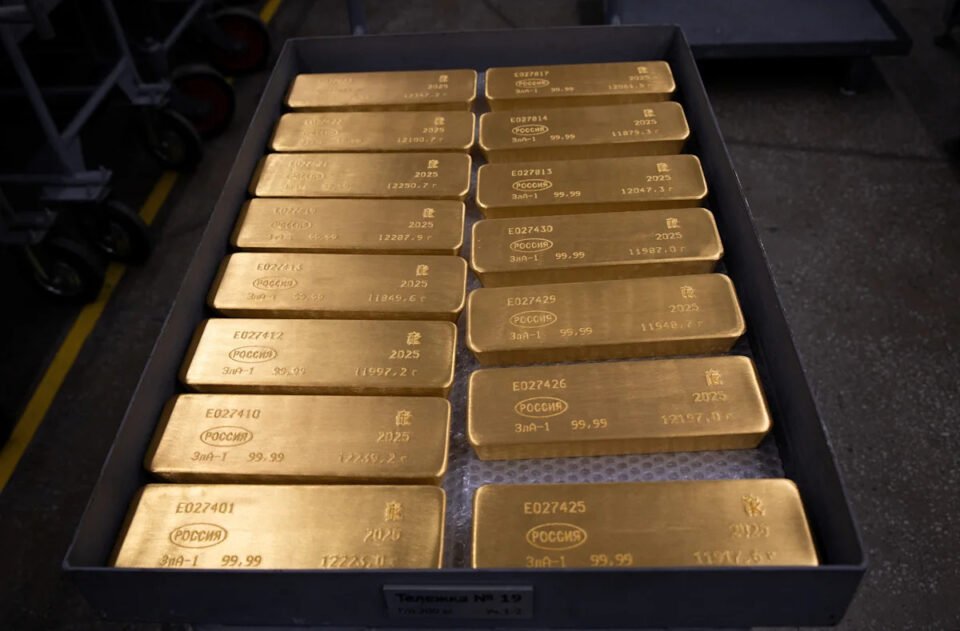
Gold (GC=F) just posted its best week since February. The investors who once crowded into the trade have mostly left.
The metal gained nearly 7% for the week, reclaiming its 50-day moving average and breaking the downtrend that had controlled prices since March. Wednesday’s 4% surge was its biggest one-day jump since February and carried gold futures to a seven-week high.

That breakout arrived after a spectacular investor retreat.
The rolling 125-day total for precious-metals ETF flows peaked at nearly $40 billion in February. By Monday, it had fallen to nearly negative $20 billion — a reversal of more than $55 billion and the lowest reading in data going back to 2015, according to Baird Strategas.

The January gold rush did not merely cool. It emptied out.
Now the first buyers are returning. Chinese gold ETFs recently attracted money for 14 straight sessions, collecting about $1.2 billion during the streak.
Central banks have also remained a steady source of demand. In the World Gold Council’s latest survey, 89% of reserve managers expected global official gold holdings to rise over the next year, while a record 45% expected their own institutions to buy more.
That leaves gold with an unusual setup. The longer-term buyers never fully disappeared, while the fast money and ETF crowd largely did.
Some trend followers may even be leaning the wrong way. Goldman Sachs estimates commodity trading advisers remain about $9 billion short gold. Under its strongest upside scenario, those funds could swing to more than $10 billion long over the next month — a potential reversal of more than $20 billion.
That is not guaranteed buying. It is the fuel available if the breakout keeps running.
The bond market remains the biggest obstacle. Gold pays no interest, so rising inflation-adjusted yields increase the appeal of Treasurys and raise the cost of holding the metal. But Treasury yields before adjusting for inflation can rise alongside gold when investors are worried about inflation, heavy government borrowing, or doubts about currencies.
Gold is not alone among metals perking up. Silver and copper have rallied on their own mix of investor demand, supply constraints, and industrial spending.
The immediate test is simpler. Gold needs to hold above $4,000 and the broken downtrend. To the upside, its 200-day moving average near $4,500 looms large.
As Baird Strategas ETF strategist Todd Sohn put it, “[ETF] flows suggest a low bar for tactical long exposure.”
Jared Blikre is the global markets and data editor for Yahoo Finance. Follow him on X at @SPYJared or email him at jaredblikre@yahooinc.com.
Click here for in-depth analysis of the latest stock market news and events moving stock prices
Read the latest financial and business news from Yahoo Finance