
Saturday 05th September, 2026 08:35 AM|

Members of Parliament (MPs) have demanded answers over millions of shillings paid by public secondary schools to the Kenya Secondary School Heads Association (KSSHA), questioning the legal basis and accountability of the transfers.
The National Assembly’s Public Investments Committee on Governance and Education said it will summon KSSHA officials to explain how money received from public schools is spent.
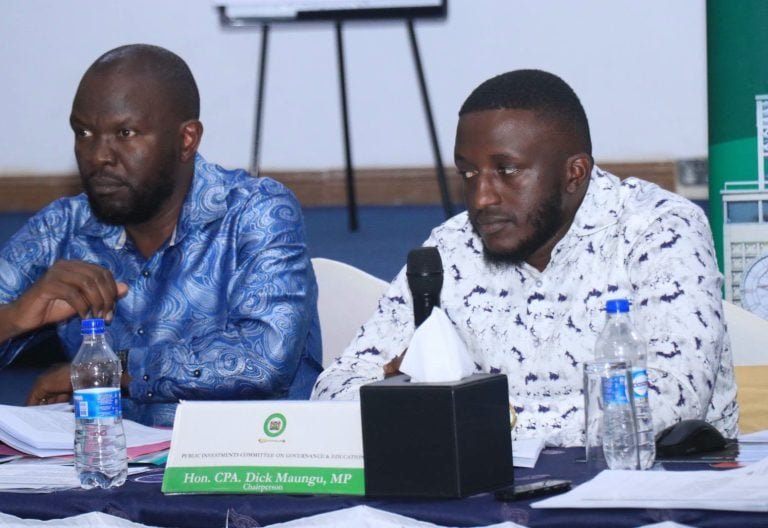
The committee, chaired by Luanda MP Dick Maungu, raised concerns after auditors flagged direct payments by public schools to KSSHA as irregular.
MPs warned that while individual schools may have transferred millions of shillings to the association, the total amount could run into billions of shillings if payments across the country are aggregated.
The issue emerged during the committee’s retreat at the Royal Swiss Hotel in Kisumu on Friday, September 4, 2026, where MPs are examining Auditor-General reports covering selected high schools for the 2020/21 to 2024/25 financial years.
Ksh1.247 million payment under scrutiny
An audit of Asumbi Girls High School provided one of the clearest examples of the payments being investigated.
According to the Auditor-General’s report for the financial year ended June 2024, the school transferred Ksh1.247 million to KSSHA.
The Auditor-General questioned the payment, noting that KSSHA is a welfare organisation whose membership consists of school principals and that the association is not defined within the government’s funding system.
The audit further found that there was no assurance that KSSHA had effective, efficient and transparent financial management and internal control systems for handling funds transferred by schools.
The payment was also found to contravene Regulation 23(2)(c) of the Public Finance Management (National Government) Regulations, 2015, which requires an accounting officer to obtain written assurance from an entity before transferring funds to it.
“Management was in breach of the law, and the value for money realised from the expenditure of Ksh1,247,220 could not be confirmed,” the Auditor-General said.
Schools defend KSSHA payments
School heads appearing before the committee defended the payments, saying the money was used to support students’ co-curricular activities and welfare.
Asumbi Girls High School Chief Principal Linet Pino Sati told MPs that the funds were used to support activities organised through KSSHA.
“The funds transferred to KESSHA are for conducting co-curricular activities. Each year KESSHA sends requests to schools for funding the budget for co-curricular activities and Asumbi Girls High School is not exempted,” Sati said.
Maseno School Principal Peter Owino Otieno similarly defended the payments, saying they supported student participation in sports, drama, music and other competitions.
“The payments were purely for student welfare and co-curricular activities,” Owino said.
He added that failure to make the payments could result in students being locked out of regional and national competitions.
Nyabururu Girls High School Principal Joyce Orioki also told the committee that KSSHA coordinates activities at grassroots and zonal levels, with contributions generally calculated according to student enrolment.
She acknowledged, however, that the association’s accounts were not audited, an issue she said needed to be addressed.
MPs question KSSHA’s legal status
The explanations did not settle the committee’s concerns.
Maungu said the evidence presented before the committee raised fundamental questions about the movement of public funds to an organisation that is not part of the formal government funding structure.
“What is coming out clearly is that most of these schools contribute money to an organisation known as KSSHA,” he said.
The committee chair said MPs wanted to establish whether KSSHA should be considered a recipient of public money and whether the activities financed through the contributions are subjected to proper public audit.
One school examined by the committee had paid about Ksh6 million to KSSHA over five years, while another had transferred approximately Ksh5 million during the same period.
“These are billions if you convert them into all the schools in the country,” Maungu said.
“We want to find out whether KSSHA is a recipient of public money and whether the activities they are undertaking are audited by the Auditor-General.”
MP calls KSSHA a ‘private club’
Kiminini MP Maurice Kakai Bisau questioned why public schools should transfer money to an organisation he described as a private association.
“KSSHA remains a private club managed by members of the teaching fraternity,” Bisau said.
Lungalunga MP Chiforomodo Mangale said the committee first needed to establish the legal foundation under which schools were transferring money to KSSHA.
“We must start from the point of understanding how these funds are transferred. KSSHA is an association for teachers and school heads, but it has no direct relationship with government,” Mangale said.

MPs say co-curricular activities are not the issue
The committee stressed that it was not opposed to funding sports, drama, music and other activities that form part of students’ education.
Instead, MPs said their concern was whether public money could legally be channelled through an organisation outside the Government’s formal financial management framework.
“The education activities may be good and necessary, but that does not mean public funds can be transferred outside the framework of the law,” Maungu said.
The committee is now expected to summon KSSHA officials to explain the association’s legal status, its relationship with the Ministry of Education, the amount of money received from public schools and how the funds have been managed.
The inquiry could potentially expand beyond the schools already examined by Parliament if MPs establish that similar payments are being made across the country.
The investigation comes amid broader scrutiny of how public schools manage funds, with Parliament increasingly focusing on whether money allocated for education is being spent lawfully, transparently and in a manner that delivers value to learners.