
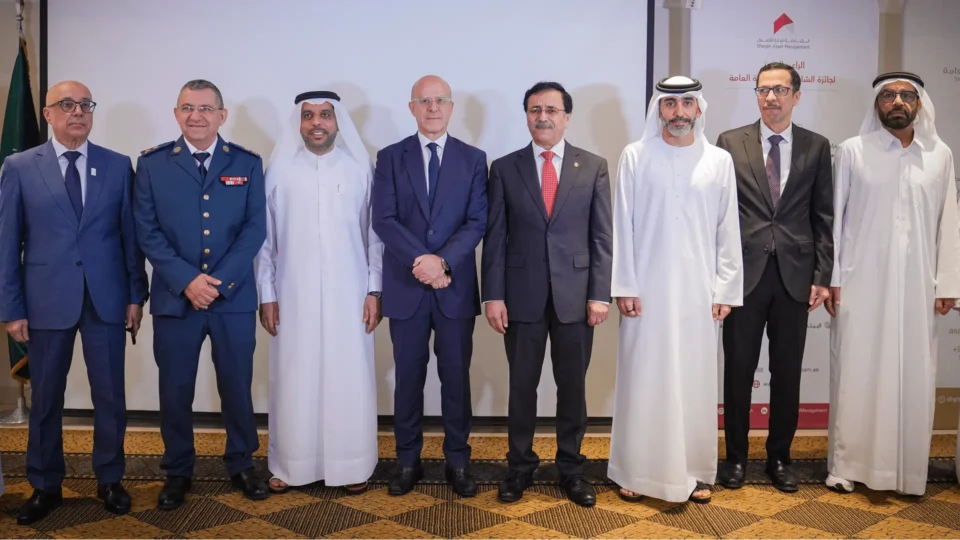
Held under the patronage of Dr Fadi Makki, Lebanon’s Minister of State for Administrative Development, the event brought together government officials, specialists and professionals to discuss ways to improve financial and administrative performance.
Attendees included Dr Waleed Al Sayegh, Director General of the Sharjah Finance Department and Chairman of the Award’s Board of Trustees; Sheikh Rashid bin Saqr Al Qasimi, Director of the Sharjah Finance Department and Secretary-General of SAPF; Dr Nasser Al Hatlan Al Qahtani, Director General of ARADO; Hassan Basha, a member of the Board of Trustees; and Nasser Abdulaziz Kashwani, a member of the Award’s Organising Committee.
The event provided a platform to introduce the Award’s objectives, categories, evaluation criteria and participation procedures, and to facilitate the exchange of expertise in public financial management. Discussions also focused on digital transformation and the integration of financial systems to improve resource management, strengthen transparency and governance, and enhance service quality.
The programme opened with addresses by Makki, Sheikh Rashid bin Saqr Al Qasimi and Al Qahtani, followed by an introductory video about the Award, a recognition ceremony and specialised sessions.
Promoting financial excellence and sustainable development
Al Sayegh said the Award reflects the vision of His Highness Sheikh Dr Sultan bin Mohammed Al Qasimi, Supreme Council Member and Ruler of Sharjah, to build strong government institutions grounded in sound resource management and aligned with comprehensive development priorities.
He said financial excellence extends beyond planning and expenditure to encompass institutions’ ability to translate budget allocations into tangible outcomes that improve quality of life and generate sustainable economic and social value.
Through the Award, he added, SAPF seeks to raise awareness of the developmental returns on public expenditure and help institutions achieve their priorities while ensuring that development gains benefit future generations.
Sheikh Rashid bin Saqr Al Qasimi said that holding the seminar in Lebanon reflected the Award’s commitment to expanding Arab cooperation in public financial management and to promoting the exchange of expertise and best practices.
He said that developing public financial management systems required an institutional culture grounded in efficiency, transparency and innovation, alongside more effective and sustainable resource management.
The Award aims to provide an Arab platform that encourages excellence, highlights successful experiences, and supports practices that improve financial performance and deliver sustainable development outcomes, he added.
Sheikh Rashid also emphasised the importance of partnerships for building institutional capabilities and keeping pace with digital transformation, noting that modern technologies can improve operational efficiency and service quality.
Investing in knowledge and skills
Al Qahtani said that advancing public financial management across Arab countries required institutional transformation that went beyond the modernisation of systems and procedures to include human capital development, stronger leadership and specialised skills, and greater capacity to manage change.
He stressed that investing in knowledge and skills was essential for improving public administration and achieving sustainable institutional development.
The seminar and training workshop were particularly valuable, as they combined knowledge exchange with practical capacity building, especially in digital transformation, he said. This process requires integrated systems, stronger digital skills and a reassessment of working methods and service delivery.
He added that knowledge-based cooperation and shared capabilities would help Arab institutions benefit from digital transformation, improve public administration, and develop services that better meet citizens’ needs.
Explaining the award’s criteria and procedures
The first day featured two introductory sessions delivered by the SAPF team. The first session outlined the Award’s objectives, categories and approved evaluation criteria for institutional and individual entries, helping participants understand how achievements and practices in public financial management are assessed.
The second session covered eligibility requirements and registration and application procedures via the Award’s electronic platform. Participants’ questions were also addressed, with clarification provided on the requirements for submitting applications.
Together, the sessions introduced institutions and individuals to opportunities to showcase their achievements and initiatives, while encouraging the exchange of knowledge and best practices.
Digital transformation in public financial management
The second day featured a specialised training workshop titled “Digital Transformation in Public Financial Management: Systems Integration and Improved Services for Citizens”.
The workshop examined how digital technologies can modernise public financial management, integrate systems, improve operational efficiency, and enhance service delivery.
Engineer Jamal Anouti led the first session, covering the conceptual and technical foundations of digital transformation and its role in modernising financial systems.
Engineer Zain Zuaib presented the second session, focusing on practical experiences and applied models demonstrating how digital solutions can improve institutional practices.
Discussions highlighted digital transformation as a key enabler of modern public financial management, supporting more efficient use of resources, better integration of operations and improved services for citizens.