
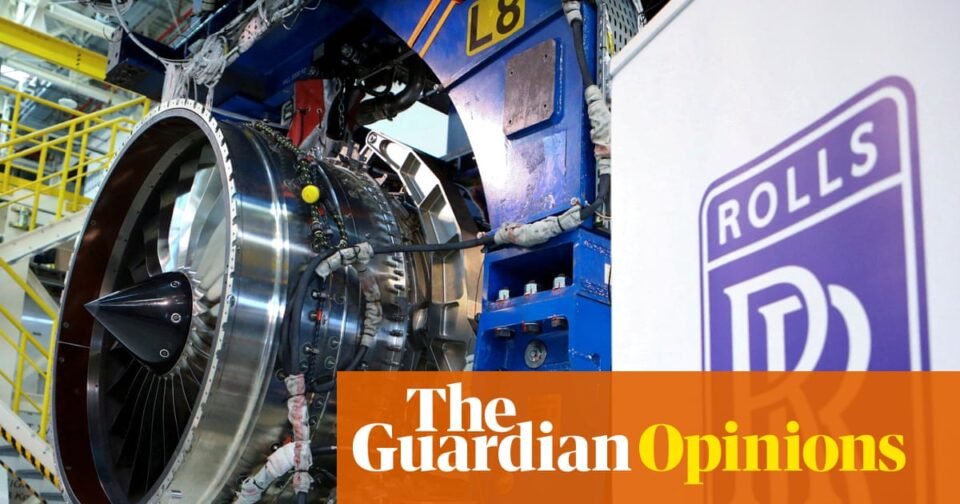
Tufan Erginbilgiç, the chief executive of Rolls-Royce, seemed to be getting ahead himself when he said a year ago that the engine-maker had the potential to become the most valuable company on the London Stock Exchange.
Yes, everyone knows about the remarkable turnaround. Rolls was a corporate calamity during the Covid shutdown of global aviation, then a tenfold increase in the share price followed under Erginbilgiç. But it still required a leap of imagination to think the firm could challenge the very top of the capitalisation charts one day.
And it still requires work. Today’s valuation of £120bn puts Rolls roughly neck and neck with the miner Rio Tinto for fourth place in the Footsie, but there is still a big gap to Shell (£185bn), AstraZeneca (£198bn) and HSBC (£274bn), none of whom intend to stand still.
Erginbilgiç’s long-term bullishness, however, sounds less fantastical with every set of results. Thursday’s half-year numbers came with the usual upgrade to financial forecasts. Cashflow over the full year will be £200m better than previously predicted at £3.8bn-£4bn; for operating profits, the increase was £700m to £4.7bn-£4.9bn. Those upgrades suggest there is still mileage in Erginbilgiç’s efforts to invest in the reliability of the engines to allow a “win-win” renegotiation of contracts with airlines.
The long-term growth projections, however, rely on many other things – way beyond widebody-aircraft engines – going well. Defence looks a safe bet, naturally. The sight of the prime minister at Barrow-in-Furness on Thursday served as a reminder that Rolls makes the nuclear propulsion systems for the UK’s submarines. The rest of the country’s defence investment plan, whatever the wrangles over the precise budget, is unambiguously good news for Rolls too. There are possibilities in propulsion systems for uncrewed aircraft and much more.
The division that is suddenly getting most attention, though, is power systems. It used to be seen as a maker of boring old-tech diesel systems for marine vessels and military tanks. But AI datacentres in the US also want the equipment. And they also want Rolls’s gas-fired turbines for primary power as they struggle to get hooked up to an under-invested US electricity grid. Rolls’s order book for power generation was up 55% in the half.
after newsletter promotion
It looks, too, as if there will be spillover AI benefits for Rolls’s small modular reactors (SMRs). At 470 megawatts, SMRs were originally intended only as sources of low-carbon power for national grids, but some hyper-scale datacentre projects in the US are so huge and power-hungry that they have become potential customers. It gives Rolls a foot in several AI power camps: diesel for back-up; gas for primary power; and SMRs when they arrive in the 2030s.
The very big possibility is Rolls’s intended re-entry into the market for engines for narrowbody aircraft. That is a slower story because Airbus and Boeing have yet to commit formally to new single-aisle models. Nor it is guaranteed that Rolls would win a place as an engine supplier given the competition from incumbents.
But the potential market is enormous – many times the size of the widebody one – which is why Rolls’s requests for financial support from the UK Treasury will almost certainly be granted, never mind that corporate welfare for a company awash with cash-for-share buybacks sounds an aberration. In reality, subsidies are a fact of life in the international aerospace business, a point that will surely not be lost on a reindustrialising prime minister. Think of the potential for 40,000 jobs in UK advanced manufacturing, runs the corporate pitch.
If it all comes together, then, yes, Erginbilgiç’s projections for Rolls’s potential are not as wild as they seem. The company is positioned squarely at the centre of “major global trends”, as he puts it: defence, AI and energy transition via nuclear. One of these days, something will go wrong, just as it did regularly at Rolls for about two decades. But it is also impossible to name another major UK company with huge opportunities on various fronts.
In retrospect, the Treasury missed a trick in 2020. Instead of granting loan guarantees to help Rolls out of its Covid financial hole, the UK state could have made a few billion quid by insisting on bonds that converted into shares.