
Andreessen Horowitz (a16z) published a long essay on its newsletter on Nov. 13 arguing that AI will make pharma even bigger. Its case is that drugs are as big a business as software, and that AI, by raising the odds of success and shortening development time, changes the economics of making them. Because the authors invest in drug-discovery startups, we went through the argument, the evidence behind it, and the parts that deserve a second look.
Source: a16z News
Why pharma looks like software
The essay starts with scale. The top 30 pharma companies are worth about $5 trillion combined, and nine of them are worth more than $200 billion, against 16 software companies above that line. Eli Lilly has crossed $1 trillion, joining a club once dominated by tech, on the strength of its GLP-1 drugs Mounjaro and Zepbound.
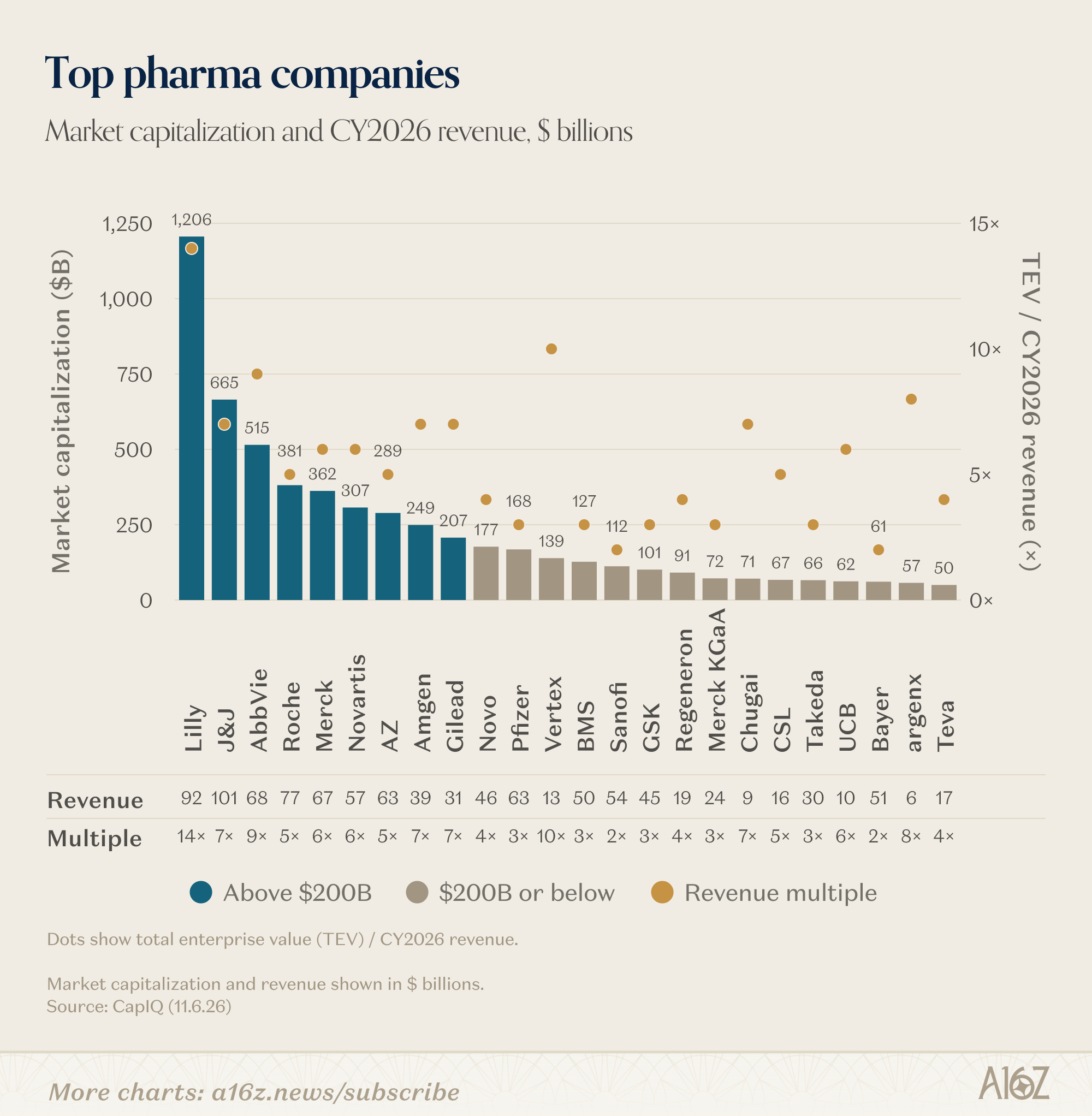
Source: a16z (CapIQ, as of Nov. 6, 2026)
A single drug can rival a software company. Lilly’s injectable GLP-1 portfolio sold nearly $40 billion in 2025, roughly Salesforce’s annual revenue. a16z says Lilly’s GLP-1 sales came close to $17 billion in the third quarter alone, nearly matching Anthropic’s revenue in the same quarter. On 2026 estimates, GLP-1 drugs from Lilly and Novo Nordisk reach $101 billion, against $85 billion for OpenAI and Anthropic combined, though a chart footnote says Anthropic’s fourth quarter is assumed to equal its third.
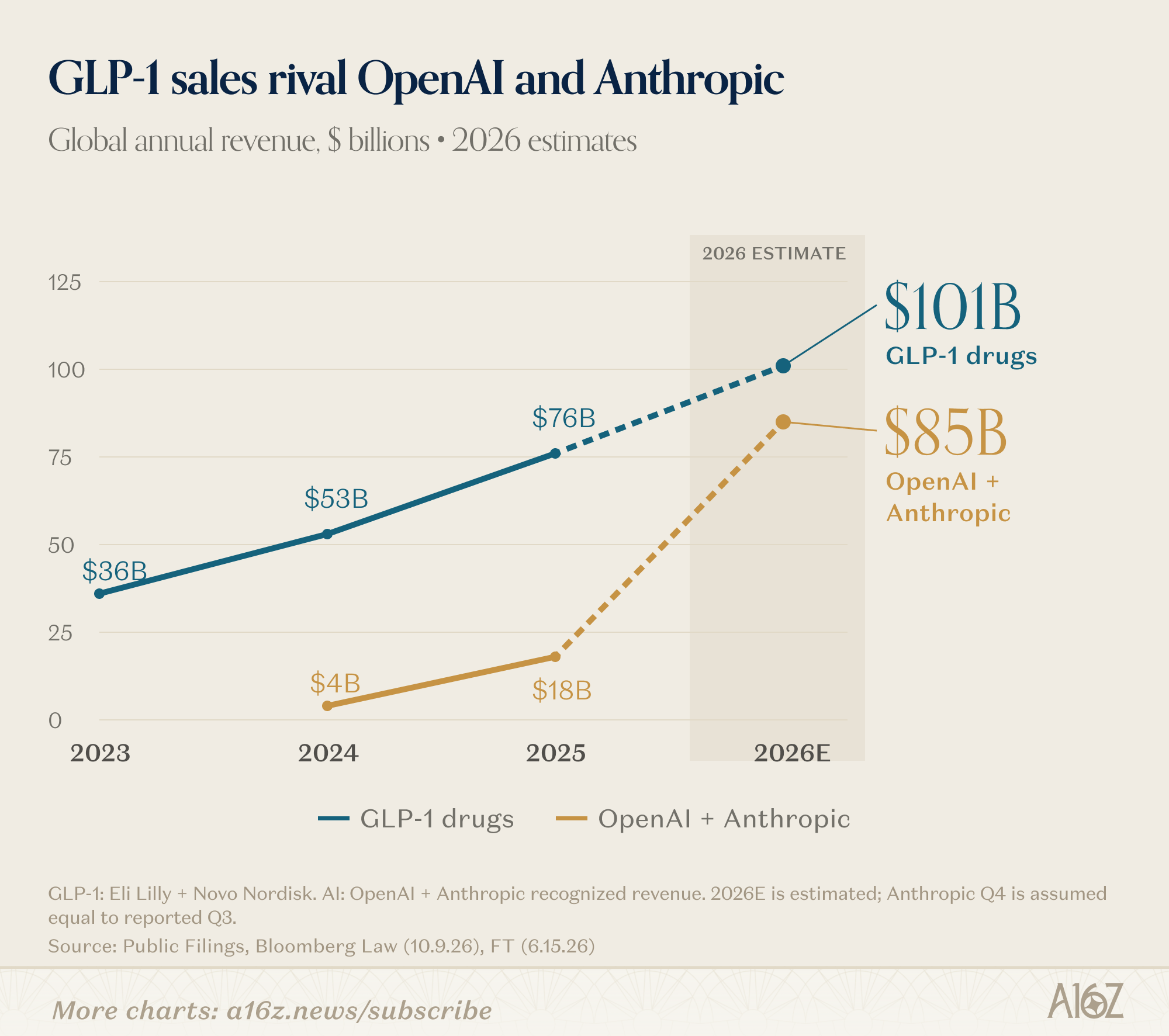
Source: a16z (public filings, Bloomberg Law, FT)
On peak sales, including forecasts, Mounjaro and Zepbound reach $88 billion and Keytruda $38 billion, against $42 billion each for SAP and Salesforce. About 29% of branded drugs, roughly 300, are $1 billion-plus “blockbusters,” while about 190 public software companies fall in the same revenue band.
The business is lumpy, though. The top 25% of drugs generate about 85% of revenue, and for the top 10 pharma companies roughly half of revenue comes from their top three assets. GLP-1s were 63% of Lilly’s 2025 revenue, and Keytruda was 54% of Merck’s. When a drug works, it becomes an annuity. Dupixent launched in 2017, brought in nearly $18 billion in 2025, and is expected to keep patent protection in the U.S. until 2031.
The bottleneck is development
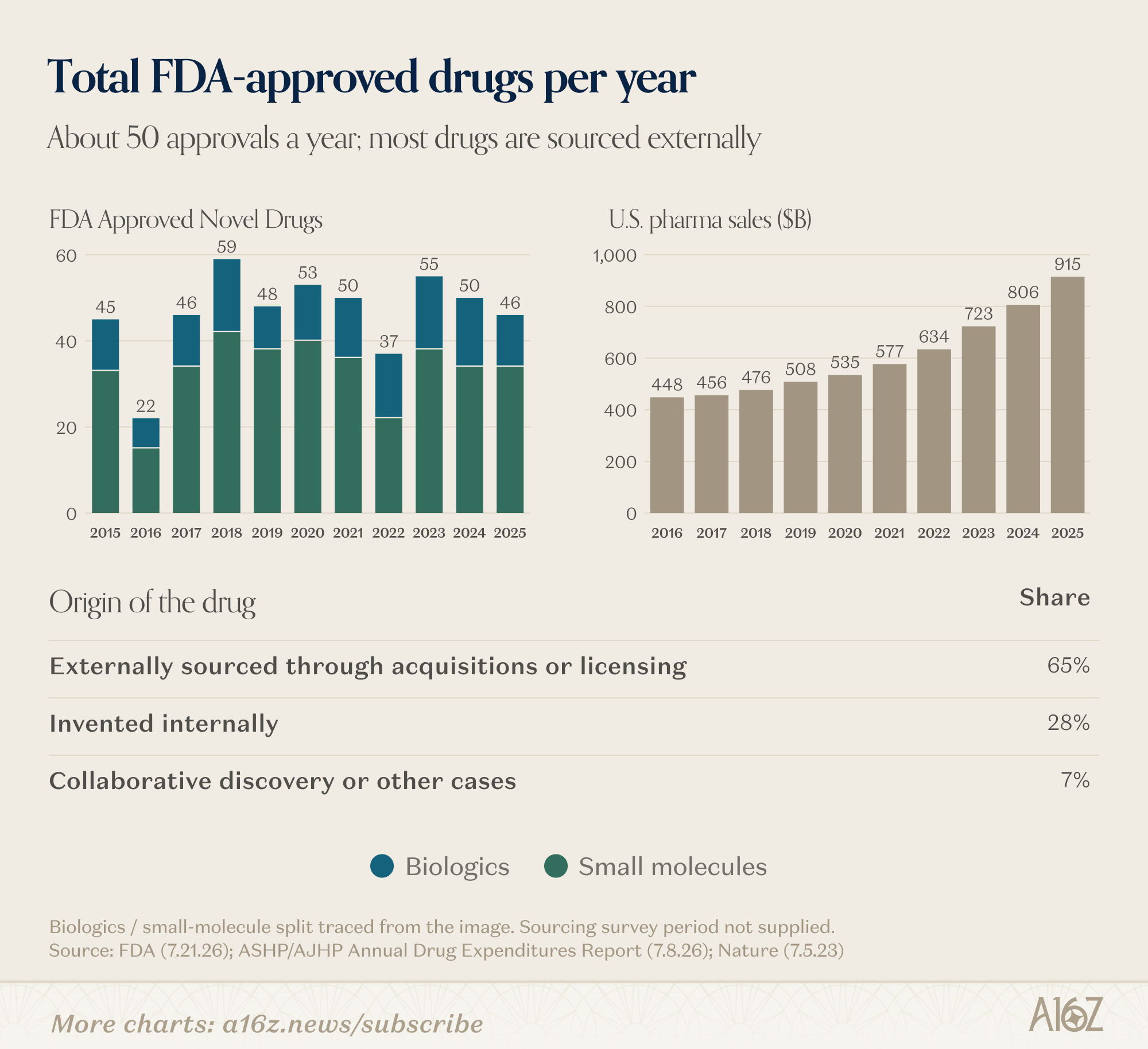
Spending has not translated into more medicines. U.S. prescription drug spending more than doubled, from $448 billion in 2016 to $915 billion in 2025, while the FDA still approves only 40 to 50 novel drugs a year. About two-thirds of large pharma’s new drugs are bought or licensed from outside.
Source: a16z (FDA, ASHP/AJHP, Nature)
Fewer than 10% of drugs that enter clinical trials are approved, and under 5% of candidates make it from the start to approval. Spreading the cost of failures across the pipeline, a16z puts the present-value cost of one new drug at close to $2 billion and 13 years.
How AI could change the math
a16z names two levers: raising the probability of success and cutting time to approval. It sees AI helping across the pipeline, from reading literature to pick targets, to screening molecules in silico, designing trials and recruiting patients, to drafting FDA filings. It also quotes a prediction that the industry is heading into an era of drug-candidate abundance.
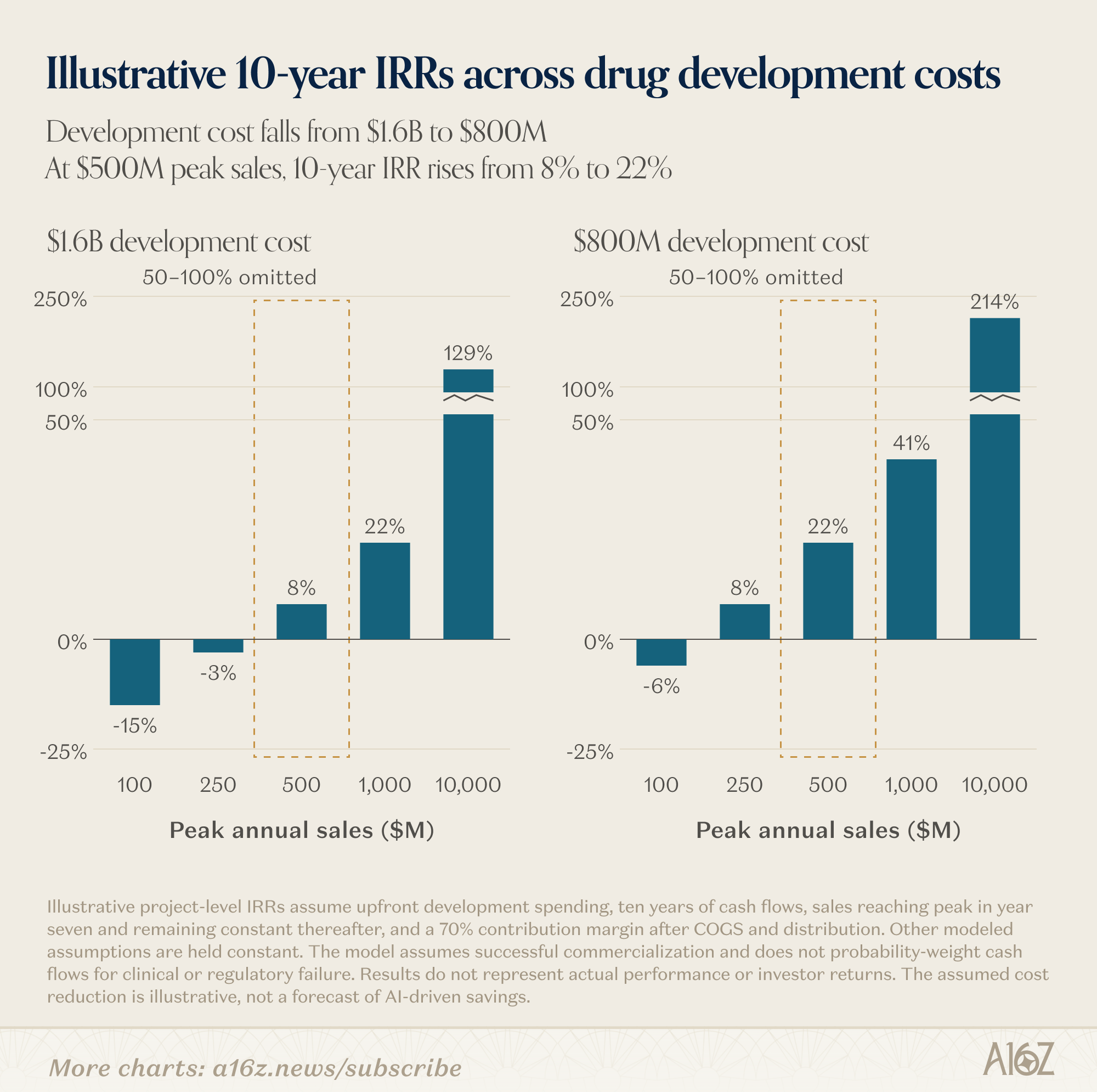
The essay turns the idea into numbers. If development cost falls from $1.6 billion to $800 million, the 10-year internal rate of return on a drug with $500 million in peak sales rises from 8% to 22%. Targets and indications that don’t pay off today start to look investable.
Source: a16z (illustrative model, not a forecast of AI-driven savings)
The more interesting argument is about valuation. Pharma companies are valued on discounted cash flows from approved drugs and those past Phase 2, typically at 8 to 20 times earnings or 3 to 7 times revenue. Drugs still in development are a rounding error, and the discovery engine earns no credit. AbbVie’s Humira revenue fell from $20 billion in 2022 to $4 billion in 2025 after patent protection ended, which is why big pharma keeps buying. If discovery becomes repeatable, a16z argues, investors could start paying for a company’s AI infrastructure the way they pay for platforms in tech. It says a joint-venture fund it launched with Eli Lilly, the Biotech Ecosystem Fund, was set up for that purpose.
Why now
The essay frames the trend through Eroom’s law, Moore’s law spelled backward, the observation that drug discovery has grown slower and costlier despite better technology. a16z believes continuous frontier-model improvement is the counterforce. It sees progress on two fronts: LLMs and reasoning models that take over work scientists do today, and diffusion-based models that generate and optimize molecules. It describes bio-AI as close to a “GPT-3 level” of market maturity.
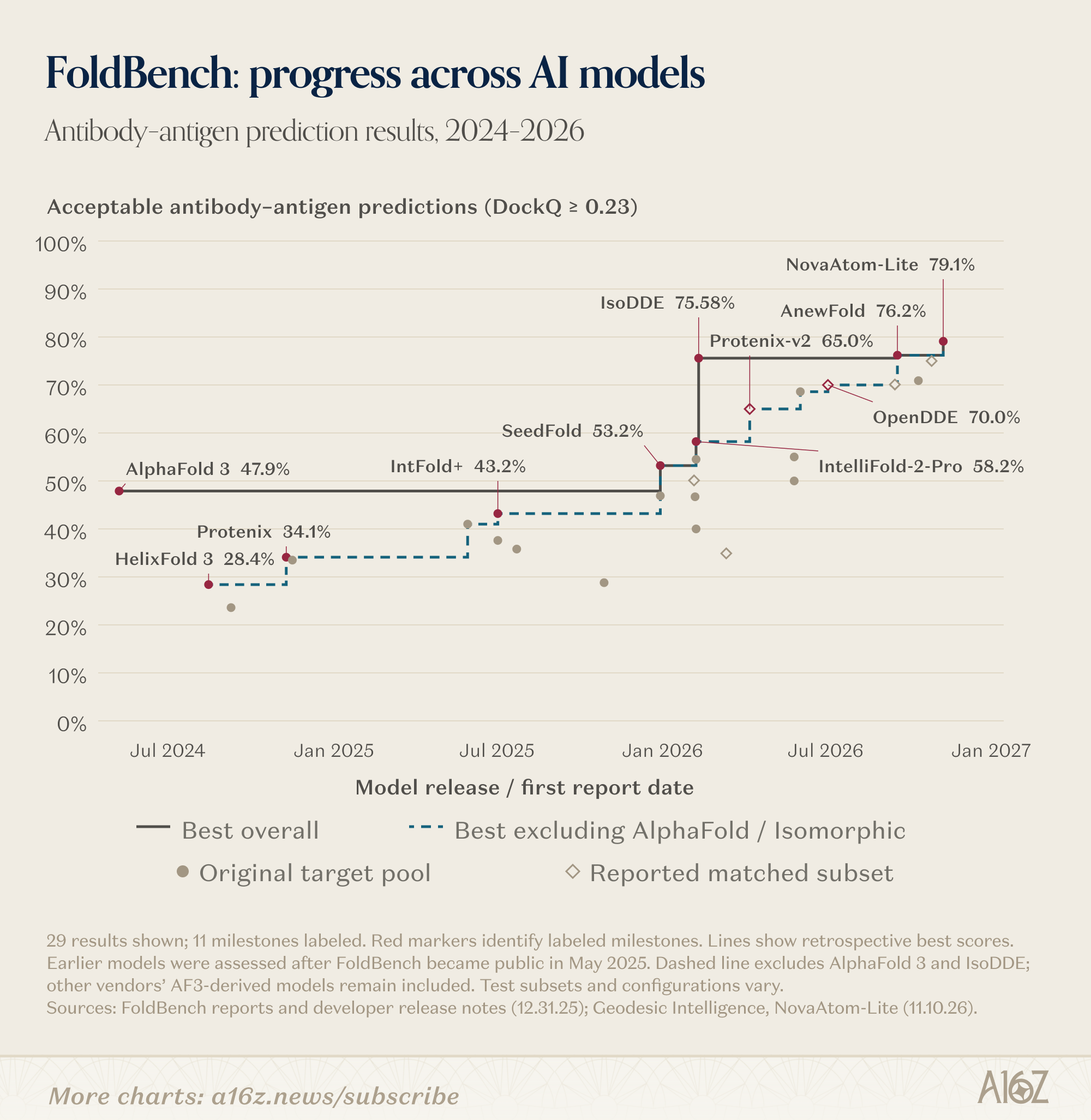
One data point is FoldBench, a benchmark for antibody-antigen structure prediction. The share of acceptable predictions rose from 47.9% for AlphaFold 3 in 2024 to 79.1% for NovaAtom-Lite, reported Nov. 10. A chart note says the scores are retrospective and test subsets and configurations vary.
Source: a16z (FoldBench reports, developer release notes, Geodesic Intelligence)
Commercial signals are building. Isomorphic Labs has partnerships with J&J, Novartis and Lilly, including potential milestone payments of $1.2 billion from Novartis and $1.7 billion from Lilly. Chai Discovery works with Pfizer, Novartis, BMS, GSK, Roche and Lilly. Boltz counts Pfizer, Takeda, GSK and BMS as partners, and BigHat Bio works with Lilly, J&J and Merck. a16z also points to frontier labs: Anthropic opened a wet lab and announced its own drug candidates for neglected diseases, and OpenAI acquired Orchestra Bio to build an agent layer for biotech program execution.
Sell the tools, or make the drugs
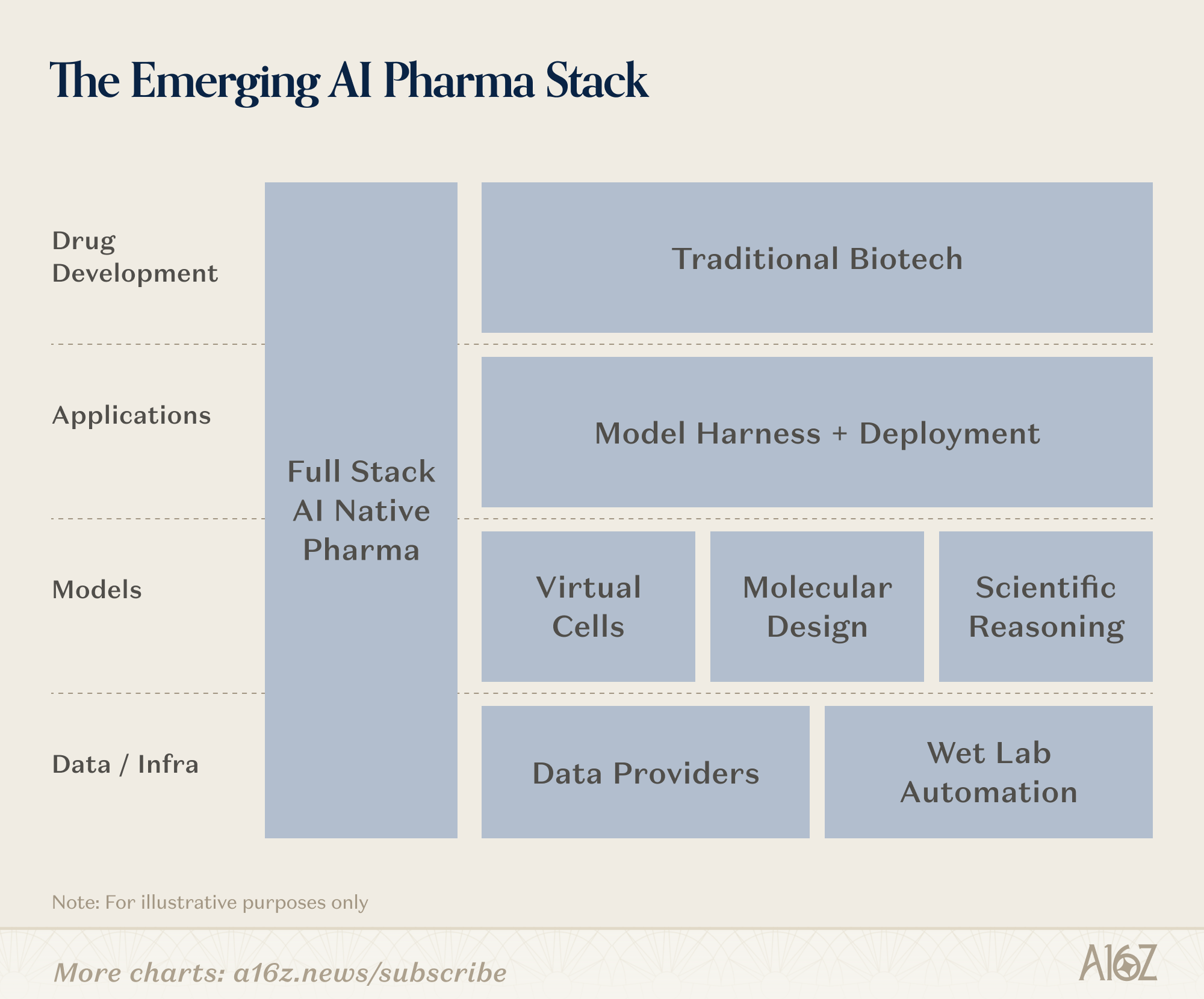
a16z sees two ways for startups to capture value. One is selling data, models and technology to pharma and AI labs: data providers and lab automation (Medra, Tacit, Latch, BigHat Bio), predictive models of biology (Axiom Bio, insitro, Noetik), scientific reasoning agents (Edison Scientific, Phylo), molecular design (Chai, Boltz), and model-deployment tools (Valkai, Collate). It cites Veeva, a $50 billion pharma-software company, as precedent.
The other is building full-stack biotechs that use AI to develop and commercialize their own drugs, among them Recursion, Isomorphic, insitro, Xaira, Relay Tx and Octant Bio. That route needs more capital and carries more risk, but it captures the full value of an asset and keeps the loop between lab data, models and clinical results under one roof.
Source: a16z (illustrative)
What to read with care
The essay is both an investment thesis and a market guide, and a few things are worth reading separately.
First, the author’s stake. a16z has invested in life sciences since 2015 and names insitro, Formation Bio and BigHat Bio among its portfolio companies. It also runs the joint fund with Lilly, so many of the examples are companies it has backed or may back.
Second, the framing. The 16 “software” companies above $200 billion include, per the footnote, Apple, Amazon, Tesla, Samsung, Netflix and Dell, a far broader group than software in the usual sense. And the revenue comparisons set a single drug’s peak sales against a company’s annual revenue. They show scale, not profitability or risk.
Third, the assumptions. a16z itself says the halved-cost scenario is an illustration, not a forecast of AI-driven savings. The model assumes successful commercialization, does not weight cash flows by the risk of clinical or regulatory failure, and assumes a 70% contribution margin and peak sales in year seven. a16z also concedes that some stages, such as long-term toxicology studies, run on FDA-set timelines, and that rising trial costs remain a pressure.
Fourth, the open problems. Biology lacks an internet-scale corpus: the Protein Data Bank holds only about 300,000 structures. Biology is also a complex system, and as insitro’s founder has argued, better molecular design does not guarantee a more effective drug if the right mechanism isn’t targeted. Results can’t yet be fully validated on a computer, so long feedback loops through the lab and clinical trials remain. a16z names the next test: whether continuing model gains turn into better drugs entering the clinic.
The money is already moving
Capital is already moving on that bet. Superluminal Medicines raised $60 million in September for AI-driven GPCR drug discovery. Isomorphic Labs raised a $2.1 billion Series B in May, and Chai Discovery raised $400 million in July. Nvidia and Lilly also launched a $1 billion joint AI drug-discovery lab. Whether that money produces better medicines will be settled in the clinic.