

Growth equity bridges venture capital and traditional buyout investing
It backs proven companies scaling without heavy leverage
Fundraising pressure and liquidity needs are widening its role.

Global assets under management of growth equity strategies exceeded $1.2 trillion in 2024, making it one of the fastest-maturing segments of private equity. Its share of total private equity fundraising has averaged around 20% since 2008. As technology, healthcare, and consumer goods companies grow beyond venture capital funding capabilities but do not yet have the cash flow maturity that traditional buyout funds seek, an intermediate layer of capital is now treated as a distinct, stand-alone category rather than a transitional stage.
How Growth Equity Differs From Venture Capital
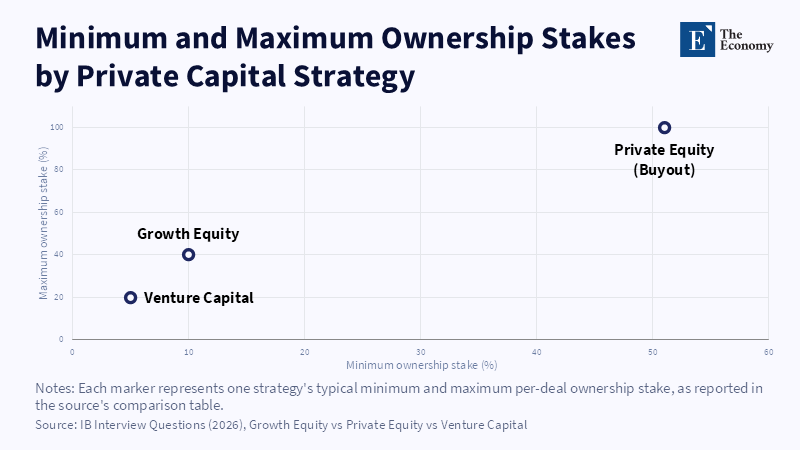
The clearest difference is the target company’s stage and the amount of capital involved in each round. Venture capital often funds businesses before they fully prove their business model, with revenue frequently below $5 million and investments that can range from roughly $500,000 to $50 million per round. Growth equity, in contrast, targets companies with a proven model, revenues often between $10 million and $200 million or more, and growth rates that can reach 20% to 50% per year. At larger growth platforms, investment sizes can extend from about $25 million to $500 million per transaction. The size of the stake follows the same logic: venture capital investors commonly acquire minority positions, while growth equity can involve significantly larger minority stakes and, in some strategies, majority ownership.
The legal structure of the investment also differs, although the line is less absolute than it first appears. Venture capital investments are commonly structured as preferred shares with protection rights such as liquidation preferences, anti-dilution provisions, board representation and participation rights in subsequent rounds. Similar protections can also be negotiated in growth equity, including preferred securities, board rights, veto provisions and liquidity protections, depending on the ownership position and transaction structure. Because the target companies have established operating histories, greater weight is usually placed on detailed financial diligence, governance, valuation and ongoing institutional reporting.
Returns are generated differently. Venture capital is based on a power-law distribution, where two or three investments in a portfolio of thirty companies can generate most of the return on capital while many others may fail completely. Growth equity seeks a positive return on each investment individually, with managers historically targeting roughly 3x to 5x gross returns at the investment level, a lower total loss rate and a less binary outcome. The holding period reflects this difference: venture capital can hold positions for five to ten years while markets and products mature, whereas growth equity often works on a more compressed horizon of three to seven years, closer to the life cycle of an already operating business.
How Growth Equity Differs From Traditional Buyouts
At the other end of the spectrum, the difference with buyouts lies primarily in leverage and the value creation mechanism. Traditional private equity funds acquire controlling holdings, ranging from 51% to the entirety of a company, and often finance the acquisition with significant debt, commonly around four to seven times EBITDA depending on market conditions and company quality. Returns are generated through three levers combined: revenue and margin growth, exit multiple expansion, and debt repayment that increases the value of the equity holding even when the total enterprise value remains stable. Growth equity generally lacks this third lever, as its targets often do not produce the predictable cash flow required to service significant acquisition debt, and deleveraging is therefore far less central to the strategy.
The transaction structure also differs at the mechanism level. Growth equity investments are structured either as a primary capital injection into the company’s balance sheet, with the issuance of new shares that dilutes existing shareholders, or as a secondary purchase of shares from founders, early venture capital investors or employees, providing liquidity without adding capital to the business. Many transactions combine both elements. The company’s management team is usually kept in control when the investor takes a minority position. In a traditional buyout, control is transferred to the sponsor even when incumbent management is retained and economically aligned through rollover equity or incentive plans. At the same time, some growth equity funds now seek controlling stakes in fast-growing companies, in transactions described as “growth buyouts,” gradually blurring the line with traditional private equity.
Why Growth Equity Is Expanding Now
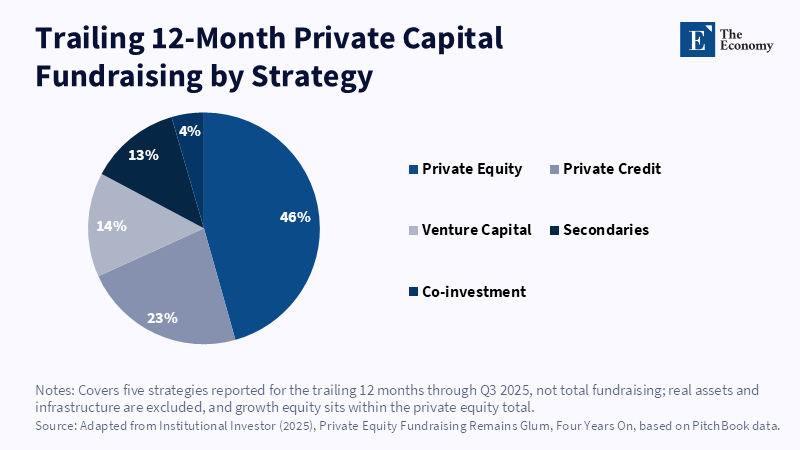
Growth equity is expanding as broader private-market capital raising weakens. Trailing twelve-month private capital commitments fell 15.5% in value by March 31, 2026, while private equity fundraising specifically declined 29.1% to $385.2 billion. At the same time, distributions to investors have remained below 15% of net asset value for four consecutive years, limiting the capital returned to institutional investors for reinvestment. In this environment, smaller, faster-growing companies are increasingly being targeted by large buyout funds before they reach the maturity that leverage has traditionally required.
At the same time, the middle market, where much of the private equity pricing advantage used to be located, is becoming increasingly competitive, with global buyout dry powder exceeding $1 trillion. As leverage and multiple expansion contribute less than they did in earlier periods, alternative sources of return are increasingly being sought earlier in a company’s lifecycle, which is exactly where growth equity operates. This approach was pioneered by firms such as General Atlantic, TA Associates, and Summit Partners. Summit raised $9.5 billion in 2024 for its twelfth U.S. growth equity fund, a sign that the strategy now attracts institutional commitments on a scale once associated mainly with the largest buyout platforms.
Manager Risk, Liquidity, and the Next Phase
Choosing a manager remains crucial, perhaps more so than in most other private equity strategies. The dispersion of returns among growth equity managers is the second highest after venture capital: research covering 2000 to 2020 found a difference of more than 42 percentage points per year between the top and bottom 5% of managers. That spread highlights how much outcomes depend on sourcing, underwriting, entry valuation and the manager’s ability to sustain growth after investment.
Liquidity remains the most tangible issue for investors and founders. While IPOs attract the most attention, acquisitions remain a central exit route: Carta recorded 151 acquisitions among startups it tracked in the first quarter of 2024 alone. The third route, the secondary sale of a stake to another institutional investor, is growing rapidly as a liquidity alternative. The volume of secondary transactions in private markets reached a record $160 billion in 2024, an increase of 41% year on year. In venture capital specifically, the value of secondary transactions reached $61.1 billion in the twelve months ending June 2025, surpassing the $58.8 billion IPO value of venture-backed companies over the same period. Only 30% of 2020-vintage venture funds had made any distribution to investors by the first quarter of 2025, an indication that the pressure for alternative liquidity is not limited to growth equity but extends across private markets.
Table 1: Growth Equity Between VC and Buyouts
| Strategy | Company Stage | Typical Ownership | Leverage | Main Return Driver |
|---|---|---|---|---|
| Venture Capital | Early-stage, model still developing | Minority | Usually none | A few outsized winners |
| Growth Equity | Proven model, rapid scaling | Usually minority or flexible | Limited or none | Revenue growth and operational scaling |
| Buyout | Mature, cash-generative business | Usually control | Material | Operations, growth and deleveraging |
The conclusion is not that growth equity replaces venture capital or buyouts, but that it has established itself as a separate, third arm in the architecture of private equity, with its own characteristics of investment size, transaction structure, risk and liquidity. As capital raising across broader private equity remains under pressure and large managers look for new sources of growth, the more than $1.2 trillion already managed in growth equity seems more likely to widen than shrink, making an understanding of its differences from VCs and buyouts a prerequisite for any institutional investor planning an allocation to private equity.
This article reflects the analytical judgment of The Economy Markets Editorial Board and does not constitute business advice or the official position of any affiliated institution.
References
Abbott Capital Management (2026) Year End 2025 Private Equity Market Overview. Abbott Capital Management.
Bain & Company (2026) Global Private Equity Report 2026. Bain & Company.
Barwick, R. (2025) ‘VC secondary exits top $61 billion’, Axios Pro, 28 August.
Carta (2024) IPOs Stayed Scarce in Q1 2024. Carta.
Carta (2025) VC Fund Performance Q1 2025. Carta.
Cliffwater (2025) Growth Equity: Private Capital’s Overlooked Sweet Spot. Cliffwater.
Evercore (2025) Full-Year 2024 Secondary Market Survey Results. Evercore.
Lentati, A. (2026) ‘Growth Equity vs Private Equity vs Venture Capital’, IB Interview Questions, 27 March.
Private Markets Insights (2026) ‘Private Capital Fundraising Slides for a Fourth Straight Year as Real Assets Buck the Trend’, 25 May. Based on PitchBook’s Q1 2026 Global Private Market Fundraising Report.
Ranking News (2026) Top 30 Growth Equity PEF 2026. Ranking News.
Summit Partners (2024) ‘Summit Partners Raises $9.5 Billion for Twelfth U.S. Growth Equity Fund’, 2 October.
The Economy (2026a) Private Capital Markets. The Economy Wiki.
The Economy (2026b) Private Equity Secondaries. The Economy Wiki.