
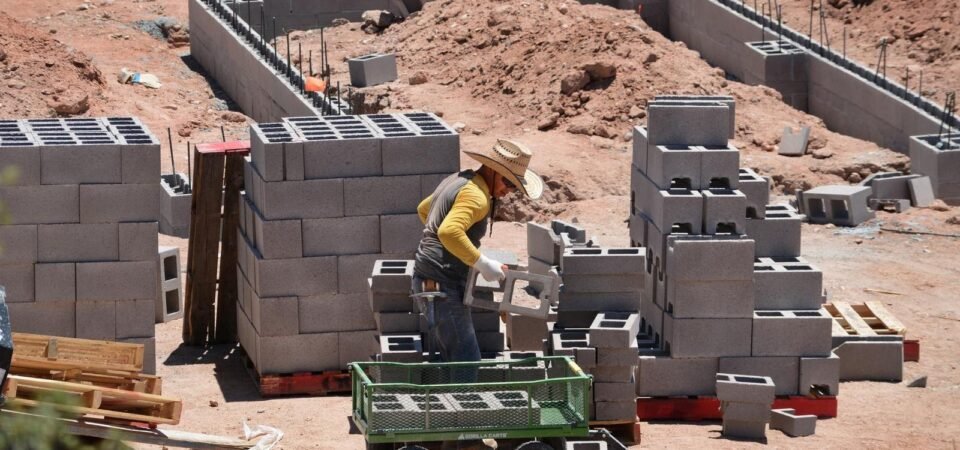

Cascade uses AI to help construction firms identify new business opportunities they would otherwise miss out on
Getty Images
At first sight, Hannia Zia and Joana Ferreira are unlikely founders of a start-up promising to shake up the American construction industry. But the two young women, who last year launched Cascade, are not concerned about being taken seriously in a traditionally conservative sector dominated by men. And investors are backing them – the business is today announcing it has raised $3.5 million of new capital.
“We get this question a lot, because there are these preconceived biases about construction, but people seem to be really excited to talk to us,” says Zia, the company’s CEO. “The fact we’re young and bring a fresh perspective gives us an edge.”
CTO Ferreira agrees. “Construction is full of some of the most innovative people you’ll ever meet,” she points out. “This is an industry constantly being asked to build new projects and to try new things – we have clients working on everything from data centers to modular nuclear reactors.”
Ultimately, the founders of London-based Cascade argue, the proof is in the pudding. Their job is to show clients that the platform they’ve set up can help construction businesses clinch valuable contracts they would otherwise have missed out on.
The value proposition is deceptively simple. Many construction firms simply never hear about projects they might have a good chance of winning business on, Cascade argues, because procurement is so disjointed. Both public and private sector businesses invite bids for work across multiple industry portals and websites, or simply through word-of-mouth. Construction firms lacking the resources to constantly scan these platforms often never hear about potentially lucrative projects.
Cascade therefore uses artificial intelligence tools to constantly scrape every construction industry portal for details of upcoming jobs and notifies clients about work it thinks might be a good fit. Its AI tools also predict where work yet to be advertised might come up – for example, by scanning news sources such as housing project funding announcements and analyzing who has run such projects in the past. It will also analyze clients’ own networks – their LinkedIn connections, for example – to identify organisations offering work where the client may already have a relationship.
“Construction industry procurement is so haphazard,” Zia says. “It’s an opaque process where architects, engineers and construction firms often miss out on projects simply because they don’t know about them – as a result, they’re leaving millions of dollars on the table.”
Launched last year, Cascade has so far signed up around 20 customers to its platform, working with these architecture, engineering and construction (AEC) clients to hone the value proposition. The good news, says Zia, is that their theory is working, with multiple clients winning business they have heard about through Cascade – and increasing their spend with the start-up accordingly.
Sarah Sapone Hayes, director of strategy and innovation at San Francisco-based design firm FORGE Architecture, is one such client. “Business development in AEC has always run on relationships, timing and institutional memory,” she says. “Cascade gives us a systematic way to see the opportunities that matter, a credible path into them, and far less manual work behind every pursuit.”
“A project broke ground a few blocks away from me. I’ve been in the industry for 30 years, I didn’t even know it was out for bid,” adds Tim Johannesson, principal at Smallwood, a luxury architecture firm that has worked on projects for the Four Seasons, the Ritz and Hyatt. “Cascade has now helped us respond to and win more projects, including a recent $6 million project that I was only able to locate through Cascade.”
Syed Irfan Raza, CFO at Munoz Engineering, which has worked on projects at La Guardia Airport, Moynihan Train Hall and Cuomo Bridge, is also a fan. “Cascade helps us plan strategically ahead in the highly competitive AEC industry in NYC,” he says.
Such testimonials resonate with Zia and Ferreira, whose own families have a background in the industry. Ferreria grew up in a Portuguese town built on construction and carpentry, while Zia’s father started a construction business that failed due to the difficulty of navigating procurement processes. The two women met at UnlikelyAI, the startup founded by William Tunstall-Pedoe, who played a leading role in the development of Amazon Alexa, but were keen to launch their own venture and took inspiration from their families’ experience.
Having proved that Cascade can deliver on its promise, the two founders are keen to expand their go-to-market activity and to hire more engineers to build out the platform further; they also see opportunities to target new markets, including the UK. Today’s $3.5 million funding round will be a big help – the money is coming from a group of investors including Andreessen Horowitz Speedrun, Ada Ventures, Blitzscaling Ventures, Indico Capital, shuckerVC, G2C Ventures and Snowball VC.
“Construction is one of the largest markets in the world, and the way firms find and win work has barely changed in decades,” says Marcus Segal, an investor at Andreessen Horowitz Speedrun. “Cascade starts with a painful revenue problem. That is a powerful wedge into how construction work gets pursued, partnered on and delivered.”