
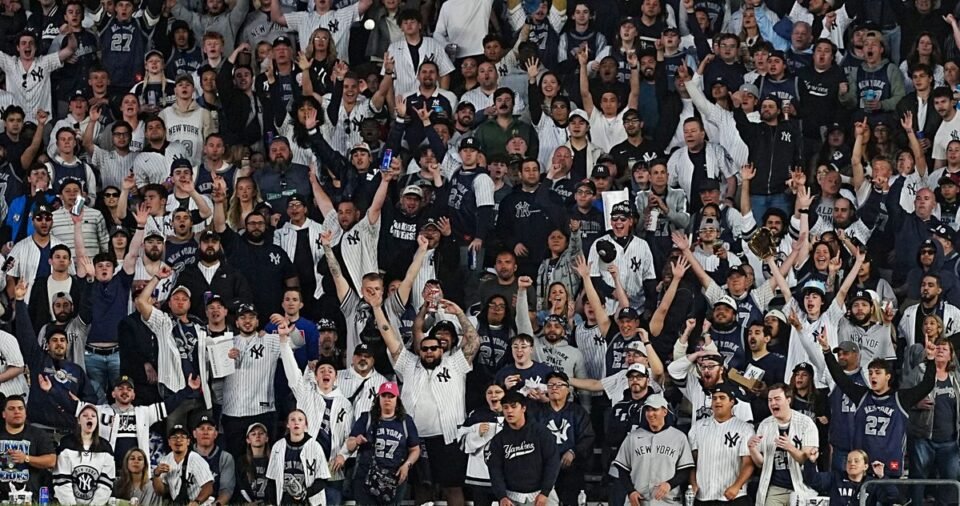

The only ROI Yankees fans want and expect is this.
Photo: Mary DeCicco/MLB Photos via Getty Images
The New York Yankees announced monumental news last week, but it had nothing to do with Aaron Judge or Cody Bellinger’s returns from injury, Ben Rice finding a slump buster, or Yankee Stadium concessions no longer selling the 99 Burger in a mushy, lukewarm state. Instead, a week after Major League Baseball’s trade deadline closed, the Steinbrenner family acquired an unlikely teammate at the owners’ table — Apollo Sports Capital, an equity investor that owns stakes in Madrid’s second-biggest soccer team, Major League Pickleball, and Wrexham AFC (the as-seen-on-reality-TV Welsh soccer club co-owned by (and co-starring) Ryan Reynolds). In return for $2.6 billion, the Steinbrenners gave up as much as 15 percent of the Bronx Bombers to an industry often unfavorably compared to (the not cool kind of) vampires.
It seems like everyone is hooking up with private equity guys these days, and sports are no exception. Now that American sports leagues have begun allowing outside investment, large investors such as Apollo have been buying non-controlling stakes in teams. But this is the Yankees. Love them or hate them, they are an outsized institution not only in baseball, but all pro sports, and they have a well earned reputation for ambition and doing whatever it takes to win. As the Yankees went, so went the rest of the sports world.
But times and the Yankees have changed. The Steinbrenners have found themselves in a familiar spot among sports franchise owners: operating a wildly popular family-run team, with control of huge but illiquid assets, and facing rising operating costs. The Yankees have nearly paid down and refinanced $1 billion of debt after moving to new Yankee Stadium 17 years ago, and, according to The Athletic, are thought to still have about $100 million in debt remaining. As with many 21st century sports franchises, it’s far more than a ball club — it’s a holding company called Yankee Global Enterprises whose portfolio contains a baseball team; a spring training stadium in Florida; an operating agreement for Yankee Stadium; and minority stakes in a regional sports network (YES), a hospitality company (Legends) and two soccer teams (New York City FC and AC Milan).
There’s also no getting around the fact that the modern-day Yankees aren’t quite what they used to be; their days as baseball’s apex predator in talent acquisition are over. The Los Angeles Dodgers’ wealthy ownership group, sweetheart TV deal, and free-jazz accounting have made them the new inevitable destination for most stars, and they are the team now constantly accused of “ruining baseball.”. The Dodgers have surpassed the Yankees in annual revenue as well as on the field; while LA is chasing their third World Series title in a row, the Yankees are close to equaling their longest championship drought. (They last won it all in 2009.)
That’s all a long way of saying the Yankees’ owners could use some money, and they no longer seem interested or possibly able to spend their own dollars in order to compete at the top. Hal Steinbrenner all but admitted it after the Dodgers beat the Yankees in the 2024 World Series. “It’s difficult for most of us owners to do the kind of things they’re doing,” he said. Being part of the downwardly mobile elite is not a good look for the New York Yankees, but what does the introduction of private equity (that comes with a seat on the board) mean for the team and fans? And for the incoming lockout battle over a salary cap? Private equity has brought ruin to housing, health care, bowling alleys, veterinary clinics, big-box toy stores, nursing homes, grocery chains, hipster media — the list goes on and on. Could it hollow out the Yankees as well?
The private equity industry isn’t the first-choice investment partner most fans or owners would pick to help run their team, but nowadays sports owners don’t have a lot of options. “The valuations [of sports franchises] are reaching into the billions, and there aren’t many people or enterprises that have the money to make that kind of investment,” explains Lee Igel, a professor at New York University’s Tisch Institute for Global Sport. Leagues already recognized this several years ago: Major League Baseball allowed private equity into the sport in 2019; Major League Soccer (which in the past has teetered on the brink of insolvency, and even allows tribal casino ownership) in 2020; the NBA and NHL in 2021; and the NFL in 2024. Several baseball teams have private equity involvement, including the Dodgers, Athletics, Boston Red Sox, Houston Astros, Chicago Cubs, and San Francisco Giants, among others. One PE firm, Silver Lake, owns nearly 50 minor league teams.
While opening the door to private equity, Major League Baseball was at least canny enough to spot the potential danger of letting in an industry known for, shall we say, streamlining its holdings and showing little interest in long-term stability. The league limits the stake of single firms to no more than 15 percent ownership of a ballclub, and multiple firms can only own up to a total of 30 percent. This is designed to restrict private equity’s influence by limiting its voting power: at those percentages, a fund can’t unilaterally force important decisions on operating, payroll, or league matters. (Unless, of course, the rest of the board likes their ideas.)
It’s telling that big investors interested only in ROI, not the fun or prestige of owning a team, are attracted to sports. Like prime real estate, you’d think there’s a ceiling to how much these assets can appreciate before their values come back down — but there doesn’t seem to be one yet. For one thing, both are scarce assets (these teams play in closed leagues) with limitless demand (sports fans are among the most loyal customers on earth). Even among this group, the Yankees are unique. Who could pass up an opportunity to own a piece of them? This is also where this offseason’s looming lockout comes into play, should the Major League Baseball Players Association refuse to agree to a salary cap desired by the owners. Salary caps offer more predictability to owners — and investors love predictability: They increase the value of holdings. In fact, MLB commissioner Rob Manfred recently said the quiet part out loud when he stated, “given some of the issues we’re dealing with right now, people are thinking that the game could be on an upswing in terms of its investment potential.”
The timing here for investors is perfect: Baseball teams tend to be undervalued relative to other sports’ franchises precisely because of their lack of a salary cap. If the players’ union relents on the cap in the winter, Apollo will have gotten in at just the right time. On the other hand, it seems obvious the union will leverage the Yankees’ new deal against team owners, using it as evidence backing up their claim that owners simply want a salary cap to increase the value of their ball clubs — not to “Level the Playing Field,” as owners are publicly campaigning on, and which this deal certainly does not help accomplish.
Steinbrenner, for his part, hasn’t shared specifics on how he’ll spend Apollo’s $2.6 billion — which may be telling, given all the news surrounding the deal. “We are continually seeking ways to strengthen our positioning, and this partnership allows us to explore pursuing strategic opportunities,” he wrote in an impressively vague statement announcing the deal. Opportunities could mean anything from stocking up on more stars to win another World Series, or simply cashing out and living large.
NYU’s Igen also points out an overlooked but essential element of partnering with private equity. Owners not only get access to more money, they get to learn how to cut costs from the most ruthless to ever do it. Who better to learn from about maximum wealth extraction than the PE industry? In the case of the Yankees, the Steinbrenner family can maintain its principal ownership “while also taking advantage of insights,” Igen said. “There’s a massive knowledge transfer here.”
The danger is that while these insights might be great for owners, they could be terrible for fans and employees. The mind runs wild at what a worst-case scenario might look like if the Yankees fully adopt a private-equity playbook: Lower payroll; less access for fans by way of more tiered memberships, and more expensive tickets and YES subscriptions; more advertising; worse food; chintzier giveaways; endless raffles, upgrades, and theme nights; dynamically priced everything; convenience fees; more gambling partnerships; outsourcing, layoffs and understaffing of stadium workers and employees at Yankee Global Enterprises’ holdings; and a complete disregard for elements of “the Yankee way” — those traditional, sometimes anachronistic quirks that help set this ball club apart, yet often run counter to commercial interests. It’s hard for fans to imagine the Yankees playing in red uniforms, or renaming Yankee Stadium after a crypto or payday loan company; but not so hard for private equity to imagine it if they see revenue opportunities there.
Hopefully, some of this dire speculation remains far fetched. But for the banality-of-evil scenario, look no further than the Yankees’ longtime arch rivals, the Red Sox. The team is owned by Fenway Sports Group and backed by private equity firms Redbird Capital and Arctos Partners, and in recent years, Red Sox fans have been living out the frustrating realities of how a Wall Street-brained team operates.
The Red Sox were an early adopter of private equity in 2021, once the league allowed it. They won four World Series between 2004 and 2018, and were used to winning, but once they invited private equity in, the focus appears to have changed, as sports journalist Joon Lee and others have argued. Despite being one of baseball’s richest teams, they often trade away or cast off their expensive stars, from Mookie Betts to Alex Bregman and Rafael Devers, running the ball club like a financial asset: built not to win at all costs, but to win as much as possible while minimizing risk, maximizing efficiency, and maintaining flexibility. It’s unbecoming of a big-market team to behave like a small-market team, maybe even cowardly, and fans complain of a distinct lack of ambition relative to resources. The Red Sox operate like a ball club already designed to function within the confines of a salary cap.
The real risk for the Yankees, then, is allowing this kind of thinking into their decision making. It would fundamentally alter the team’s DNA by clouding or curbing their inveterate ambition. The most dystopian private-equity scenario for them might be slipping into a financially acceptable ordinariness — and not even achieving that strategy of lucrative mediocrity first, but getting beat to it by their biggest enemy. Meanwhile, the celebrated Yankees-Red Sox rivalry, among the greatest in American sports, would be perpetually reduced to dull, low-stakes encounters.
This is the heart of the problem: Private equity’s definition of success doesn’t align with fans’ and players’ definition of it. People who love the Bronx Bombers will never leap out of their seats for balance sheet victories like they do for walk-off homers. The New York Yankees have always chased one kind of success, but it’s fair to wonder which version of it the Apollo Yankees pursue from here.