
If a burial heritage is found while digging up land and building, the cause of the damage to the heritage should be borne by the person who provided the cause of the damage to the heritage should be borne by the excavation and investigation costs
Controversy over the infringement of property rights…Constitutional Court Decision 2010
Support for State Excavation Costs for Private Detached Houses and Agricultural and Fishery Facilities
The cost of preservation measures can be supported by the state since last year
Foreign countries are gradually increasing the burden of the cause
The National Assembly has been pending for more than a year due to opposition from the financial authorities of the Special Act on Pungnaptoseong

If a buried cultural asset is found while digging to build a building on my land, it can be a good thing for the country, but the landowner is upset. Whatever expensive artifacts come out, the state owns them, because the cost of excavating them is often borne by the landowner or project implementer. Then, is such cost sharing reasonable.
Let’s look at the legal system first. Relics or remains can come out while digging. Our law calls this burial heritage. There are three main procedures related to this. The step of confirming the possibility of a burial heritage, such as searching for literature or interviewing residents without digging, is called an indicator survey. After that, the process of digging up the actual land and digging up the burial heritage is an excavation, and after the excavation, it is covered and preserved or moved safely is called a preservation measure.
In Korea, the state or public institutions are already paying for the cost related to the index survey, so this is not a problem. The problem is that in the case of excavation and preservation measures, individuals will pay for developers unless they build single-family houses or small-scale facilities such as agricultural and fishing facilities. In particular, when creating apartment complexes, commercial facilities, and industrial complexes, all project implementers must bear the costs.
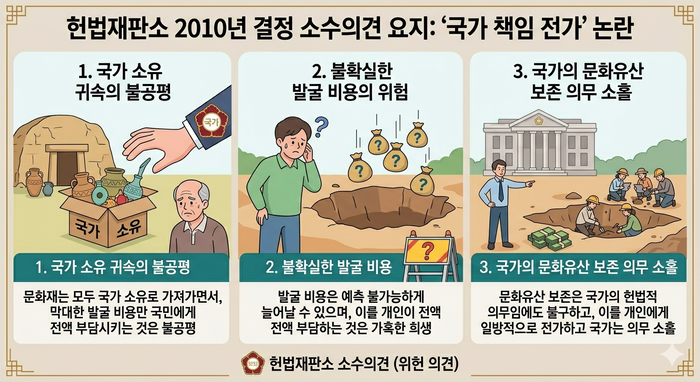
There has been a lot of controversy over whether it is reasonable to let the operator bear the cost of excavation and preservation measures when it is impossible to claim ownership of the burial heritage. This is because it is contrary to the common sense or legal sentiment of the general public. In response, our Constitutional Court decided that it did not infringe property rights to bear costs to the project operator for the following reasons.
![an argument of the Constitutional Court's decision. [Artificial intelligence Gemini created the image]](https://wimg.mk.co.kr/news/cms/202604/16/news-p.v1.20260416.2449507391044ea0a5fe82357171139a_P1.png)
First of all, the logic is that the project operator who caused the risk of damaging the burial heritage is the cause provider. At the time, the Constitutional Court said that the risk of damage to buried cultural properties did not occur naturally on the ground where they were still, but because the project operator acted as a construction project (development), and that it was justified to bear the cost to the person who provided the cause.
Next, he also argued that by paying the developer, it is possible to protect precious cultural assets buried in the ground from indiscriminate development. He also argued that if the excavation cost is greater than the development profit at the excavation stage and is deemed unaffordable, the project implementer will also have the option to stop it and give up the project.
Despite the Constitutional Court’s judgment, there is an unreasonable point, so the burden on the state and public institutions is gradually increasing through the revision of the law. First of all, the cost of the index survey is currently borne by the project implementer, which is a state or public institution. At least in the indicator survey stage, private businesses do not bear the cost.
However, the problem is the excavation stage where the largest cost is spent. According to the law, project implementers pay for the construction of apartment complexes, large commercial facilities, and industrial complexes in accordance with the principle of paying the cause. The state shall bear the cost of excavations incurred when an individual builds a detached house (less than 792㎡ of land and less than 264㎡ of total floor area) or constructs agricultural and fishing facilities, small private businesses, and factories.
The cost of preservation measures is also a problem. Similarly, in the case of apartment construction or large-scale commercial facilities, the project implementer must pay in full. This includes all the costs of the construction work and the transportation and re-installation of burial heritage, the planting of grass and trees, and the production of information boards and exhibits.
Fortunately, from August 2024, the cost of preservation measures could be supported by the state or local governments for the construction of detached houses for the general public, and it was reflected in the budget from 2025. However, depending on the budget conditions, the full amount may not be supported.
Legislative examples in advanced countries such as the United States and Japan are similar to ours, but they were gradually changing in the direction of increasing the burden on the state and public institutions.
First of all, in the case of projects that require federal funds or approval, the project implementer must bear the cost of evaluating and excavating buried cultural properties. On the other hand, in the case of pure private property without federal intervention, such as environmental regulations, the owner often does not bear the excavation cost. In other words, private property rights are more strongly protected.
In Japan, for-profit and large-scale development projects are borne by business operators, but small private houses are borne by the public. The cause of commercial development or profitability projects of large corporations is fully covered by the cause, but when an individual builds a house, the state or local government subsidizes the whole or a large part of it.
In Germany, if excavation costs are excessively high compared to the value or development profits of the land, the state government will bear the costs that exceed the limits recognized by the court. The logic is that there is a limit to the number of people that individuals can afford.
Currently, the National Assembly has been pending at the competent standing committee for more than a year since the “partial amendment to the Special Act on the Preservation and Management of Pungnaptoseong Fortress” was proposed. The content at issue is that the state has prepared the basis for the excavation of the burial heritage in Pungnap-dong. Regardless of the nature and size of the project, the state should provide support. The Ministry of Strategy and Budget, the financial authority, opposes this.
![A view of the plenary session held at the National Assembly on the 10th [Photo source = Yonhap News]](https://wimg.mk.co.kr/news/cms/202604/16/rcv.YNA.20260410.PYH2026041017450001300_P1.jpg)
Since Baekje artifacts were discovered at an apartment reconstruction site in 1997, Pungnap-dong, Songpa-gu, Seoul, has been tied to a state-designated cultural heritage for nearly 30 years, restricting development and infringing on residents’ property rights. The residential environment has deteriorated seriously as regulations such as prohibition of new construction and restrictions on underground excavation have been implemented. As a result, Pungnap-dong has become the most underdeveloped area in Songpa-gu, and Park Jung-hoon, a lawmaker of the People’s Power who proposed the bill, believes that population decline and regional slum are underway.
According to Park’s office’s explanation, the budget office opposes it on the logic that it cannot give preferential treatment only to Pungnap-dong. In other words, there will be issues of equity with other regions such as Gyeongju.

In 2010, the Constitutional Court released the minority opinion of two judges, saying, “If the owner of the artifacts from the ground is not found, they will eventually be owned by the state, and it is unilaterally passing on and sacrificing the state’s obligation to preserve cultural assets to individuals to fully bear the huge cost of digging them.”