

By Goddy Ikeh
DESPITE Nigeria’s abundant transportation resources, including waterways, aviation, rail and pipelines, the country remains heavily dependent on road transportation.
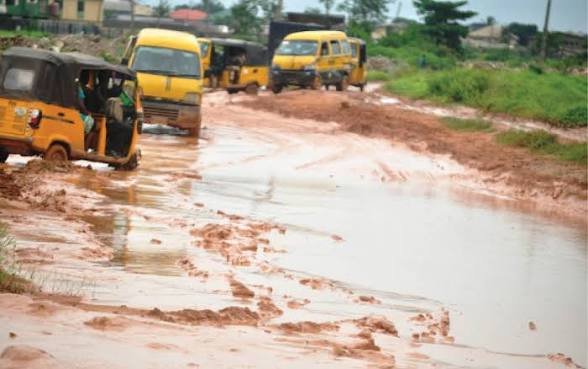
The dependence has continued to impose huge costs on the economy through bad roads, traffic congestion, vehicle damage and delays in the movement of goods and people.
Transport experts say road transportation carries more than 90 per cent of goods and passengers in Nigeria.
They also say only about 19 per cent of the country’s estimated 194,000-kilometre road network is paved, creating significant infrastructure gaps.
According to analysts, the infrastructure deficit and severe traffic congestion cost the Nigerian economy billions of dollars annually.
They said the situation contributed to inflation, disrupted supply chains and increased the cost of doing business.
The losses, according to them, include direct financial and vehicle losses, as well as increased maintenance costs for haulage companies.
They said haulage operators incurred between 30 and 50 per cent higher vehicle maintenance costs due to potholes and poor road surfaces.
The analysts also claimed that road freight systems lose about 7.8 billion dollars annually, equivalent to about 1.6 per cent of Nigeria’s Gross Domestic Product, GDP.
They further claimed that more than 51 per cent of vehicle users experienced physical damage to their cars or trucks monthly as a result of bad roads.
High fuel prices, they said, had further increased transportation costs, with petrol averaging about N1,430 per litre nationwide.
The high cost of transportation also affects agricultural production and food prices, particularly in food-producing states where poor roads hamper access to markets.
Reports indicate that farmers in states such as Benue, Ebonyi, Kogi and Kebbi lose up to 40 per cent of perishable produce because trucks are unable to reach markets on time.
The African Development Bank, AfDB, estimates Nigeria’s annual post-harvest losses at about N3.5 trillion, partly due to poor rural roads and inadequate transportation infrastructure.
Analysts said delays in the transportation of agricultural produce and other goods disrupted supply chains and contributed to rising food prices.
They also said traffic congestion resulted in the loss of productive working hours, particularly in major commercial centres such as Lagos.
Research by the Danne Institute for Research showed that the annual economic cost of traffic congestion for small and medium-sized businesses in Lagos ranged from N600,053 to more than N5.4 million per business.
The institute also noted that poor roads around major ports slowed cargo movement, resulting in port congestion and additional demurrage charges.
Some stakeholders described Nigeria’s transportation system as being built on a faulty foundation, with excessive pressure placed on the nation’s roads.
They said the situation had affected government, investors, importers, freight agents and ordinary Nigerians.
According to them, the consequences include higher operating costs, unemployment and capital flight, stressing the need for greater investment across the various modes of transportation.
They called for increased investment in road, rail, water, air and pipeline transportation to reduce the pressure on roads and improve the movement of people and goods.
The stakeholders noted that Nigeria is endowed with extensive maritime resources and a coastline capable of supporting a more efficient transportation system.
They, however, observed that the country has failed to adequately exploit its waterways and maritime resources to complement road transportation.
According to them, excessive dependence on roads also places huge financial pressure on government through continuous road construction and maintenance.
They said poor roads and traffic bottlenecks also exposed travellers and goods in transit to security risks.
They noted that criminal elements could exploit isolated areas, potholes and traffic slowdowns to carry out robbery, kidnapping and other criminal activities.
The situation was recently demonstrated on sections of the Lagos-Benin Expressway, where hundreds of road users and trucks conveying goods were reportedly held up for two to three days.
The journey, which normally should have been completed within six to eight hours, left some passengers and drivers stranded on the highway.
Some stranded road users were reportedly seen using cutlasses to clear portions of the forest to create alternative access routes for their vehicles.
However, some authorities, including the minister of works, have defended government’s efforts, saying investments have been made in rail, air and water transportation to ease the movement of people and goods. They also called for the resuscitation of the Road works maintenance department that should regularly monitor and repair failed portions of the nation’s highway, while the Federal Government should review its Road Concension policy, which appears to have failed.
They noted that some state governments had established airlines and train services as part of efforts to develop alternative transportation systems.
The impact of such initiatives, however, remains limited, as airfares and road transportation costs continue to rise beyond the reach of millions of Nigerians.
Stakeholders attributed the high cost partly to the rising prices of petrol and aviation fuel.
There have also been improvements in the rail sector, particularly with the introduction of standard-gauge rail services on some routes.
Some experts, however, argue that standard gauge should no longer be regarded as the ultimate benchmark for modern rail transportation.
They advised the government to explore faster and more efficient rail systems, citing developments in countries such as Kenya and South Africa.
Experts also identified pipeline transportation as another option for reducing the cost of transporting petroleum products across the country.
Pipeline transportation can move crude oil and refined petroleum products over long distances without the high costs associated with the use of trucks.
They acknowledged pipeline vandalism, theft and siphoning as major challenges but said these could be addressed through adequate security measures and effective monitoring.
Stakeholders also called for increased investment in air transportation and the maritime sector to diversify the economy and reduce overdependence on the energy sector.
They urged greater participation by local and foreign investors in developing Nigeria’s transportation infrastructure.
According to them, maritime transportation remains particularly strategic because of its potential to support trade, facilitate movement of cargo and serve as a major pillar of the Nigerian economy.
They stressed that a coordinated multimodal transportation system would reduce pressure on roads, lower logistics costs, improve productivity and strengthen Nigeria’s economic competitiveness.
The stakeholders said sustained investment in transportation infrastructure was therefore necessary to unlock economic opportunities and reduce the burden of failed transport infrastructure on Nigerians.
M.P
Tags: Transport Infrastructure