
Road works (more or less 20% of all infrastructure output) remain under pressure because many local authorities face budget deficits (see also below Germany’s €500bn fund). Public funding is being directed towards a range of investment and spending priorities, leaving only limited support for road construction.
Telecommunications construction has recorded modest growth in recent years, supported by Germany’s fibre optic rollout and investments in mobile network infrastructure. Germany still has significant catch-up potential compared with many other European countries, suggesting further investment needs in the years ahead.
The energy sector has been growing since 2024, driven by investments in renewable energy and the expansion of electricity grids. Growth is expected to remain strong through 2027 as Germany continues upgrading its power infrastructure to support the energy transition and rising electricity demand.
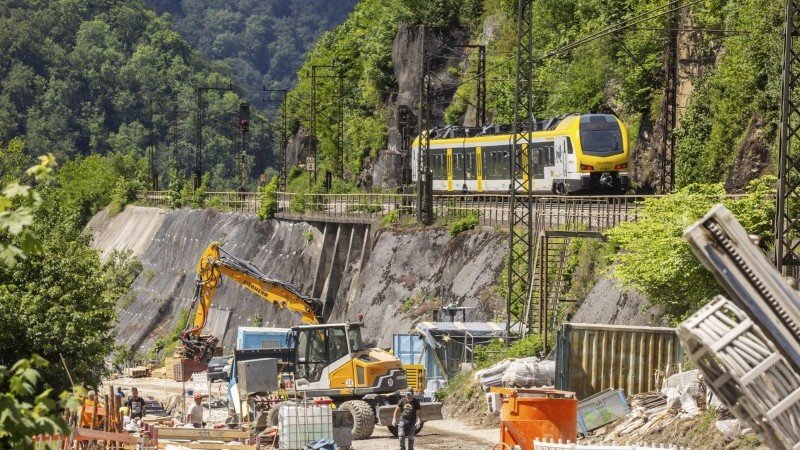
Railway construction is the only major infrastructure segment showing strong growth. The recent increase in activity is largely renovation-led rather than driven by new rail lines, with substantial federal funding and Deutsche Bahn’s nationwide network renewal programme boosting spending on upgrades. A major project is the modernisation of the 278km Hamburg-Berlin rail corridor, which started in 2025. Together with the earlier refurbishment of the Riedbahn corridor, it illustrates Germany’s large-scale programme to renew ageing rail infrastructure. Growth is expected to moderate from 2027 onwards as funding momentum weakens and much of the current renovation backlog has already been addressed.
Germany’s €500bn fund
Germany’s €500bn Special Purpose Vehicle (SPV) for Infrastructure and Climate Neutrality has now moved from political announcement to implementation, but the impact on construction activity will be gradual rather than immediate. The SPV was launched in 2025 and is designed to run until 2034, with money available for transport infrastructure, digitalisation, education, hospitals, housing construction and climate-neutral investment. The federal government, Länder and municipalities are all expected to benefit, while a sizeable share is reserved for the Climate and Transformation Fund.