
Key Takeaway
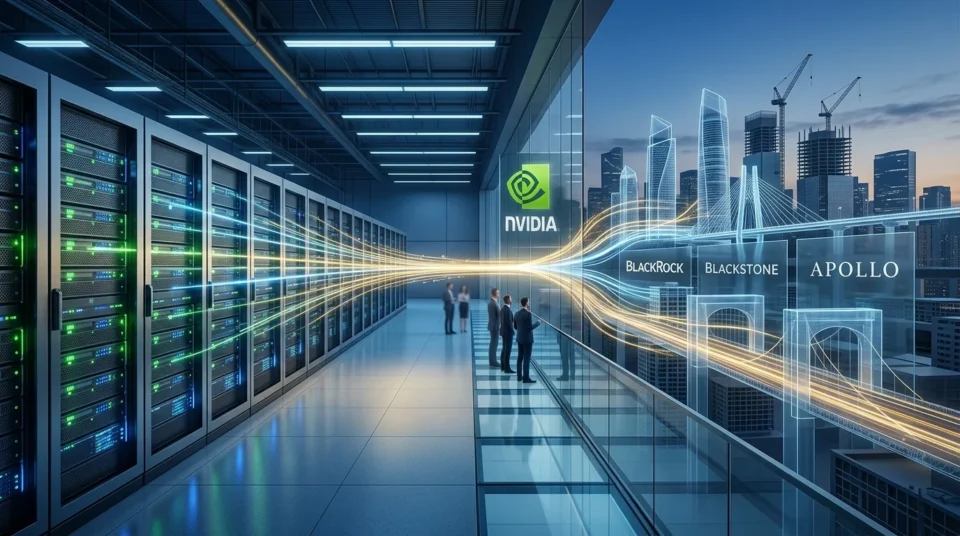
Nvidia has orchestrated the most significant infrastructure financing deal in modern financial history, partnering with six Wall Street giants to raise over $500 billion for artificial intelligence infrastructure development. This unprecedented collaboration with Apollo, BlackRock, Blackstone, Brookfield, Goldman Sachs, and KKR transforms how AI compute capacity gets funded and positions Nvidia at the center of the global AI revolution. For investors, this deal represents a fundamental shift in how AI infrastructure gets built, financed, and monetized, potentially accelerating the deployment of data centers, chip factories, and power stations needed to sustain the AI boom.
The financing structure treats compute infrastructure as an investable asset class, similar to commercial real estate, toll roads, or other yield-generating assets that institutional investors have traditionally favored. By creating dedicated pools of capital at attractive rates, Nvidia is solving one of the biggest bottlenecks facing AI adoption: the massive upfront capital requirements for building out the physical infrastructure that powers artificial intelligence applications.
The Historic $500 Billion Partnership Explained
Breaking Down the Wall Street Coalition
Nvidia’s strategic partnerships represent a carefully curated coalition of financial powerhouses, each bringing unique capabilities to the AI infrastructure financing ecosystem. Apollo Global Management contributes its credit expertise and private lending capabilities, having built a formidable business in direct lending and alternative credit strategies. Blackstone brings its massive real assets platform and experience in infrastructure investing, with over $300 billion in assets under management in this category alone.
BlackRock, as the world’s largest asset manager with over $10 trillion under management, provides unparalleled scale and access to institutional capital pools. Brookfield Asset Management contributes its expertise in owning and operating critical infrastructure assets globally, from data centers to renewable energy facilities. Goldman Sachs brings its investment banking prowess and deep relationships with corporate clients seeking AI infrastructure solutions, while KKR adds its private equity expertise and track record in technology infrastructure investments.
How the Financing Platforms Will Work
The financing platforms represent a novel approach to funding AI infrastructure that treats compute capacity as a financial asset rather than just a technology investment. Under these arrangements, Nvidia customers can access capital at attractive rates to build data centers, purchase AI chips, and develop the power infrastructure necessary to run large-scale AI operations. This structure effectively transforms Nvidia’s technology stack into collateral that institutional investors can underwrite with confidence.
The model works by creating special purpose vehicles that own the physical AI infrastructure assets, with cash flows generated from leasing compute capacity to end users. These predictable revenue streams appeal to institutional investors seeking yield in a low-interest-rate environment, while Nvidia customers benefit from access to capital that might otherwise be unavailable or prohibitively expensive. The arrangement creates a virtuous cycle where more infrastructure investment drives more AI adoption, which in turn drives demand for more infrastructure.
Why This Deal Changes Everything for AI Investing
Democratizing Access to AI Infrastructure
Perhaps the most significant implication of this financing arrangement is how it democratizes access to AI infrastructure for companies that aren’t tech giants with deep balance sheets. Previously, building large-scale AI capabilities required billions in upfront capital investment, effectively limiting participation to hyperscalers like Amazon, Google, and Microsoft. The new financing platforms lower these barriers by providing structured financing solutions that spread costs over time.
This democratization extends beyond just the largest enterprises. Mid-sized companies, research institutions, and even governments can now contemplate AI infrastructure investments that were previously out of reach. The financing structures can be tailored to different risk profiles and use cases, from enterprise data centers to sovereign AI clouds designed to keep sensitive data within national borders. This broadening of access could accelerate AI adoption across industries and geographies that have been slow to embrace the technology.
For investors seeking exposure to the AI infrastructure boom without picking individual winners, tools like the AI Screener can help identify companies positioned to benefit from this capital expansion.

Creating a New Asset Class
The $500 billion financing initiative effectively creates a new asset class: AI infrastructure as an investable category. By packaging compute capacity, data center real estate, and power infrastructure into financial instruments that institutional investors can understand and underwrite, Nvidia and its partners are pioneering a market that could eventually rival traditional infrastructure categories like telecommunications, energy, and transportation.
This asset class creation has profound implications for portfolio construction and asset allocation. Pension funds, insurance companies, and sovereign wealth funds that have traditionally invested in toll roads, airports, and pipelines can now add AI infrastructure to their alternatives portfolios. The yield characteristics of these investments, combined with their inflation-hedging potential and exposure to secular technology trends, make them attractive for long-term institutional capital.
Nvidia’s Strategic Positioning and Competitive Moat
Cementing Market Leadership
This financing deal reinforces Nvidia’s dominant position in the AI chip market by addressing the capital constraints that might otherwise slow adoption of its products. By making it easier for customers to finance large-scale AI infrastructure purchases, Nvidia effectively removes a major friction point in its sales process. The company isn’t just selling chips anymore; it’s providing a complete ecosystem that includes hardware, software, and now financing.
The strategic brilliance of this approach lies in how it locks customers into Nvidia’s technology stack. When customers finance infrastructure through these platforms, they’re committing to Nvidia architectures for the duration of the financing period, which typically spans several years. This creates switching costs that competitors will find difficult to overcome, as customers would need to not only replace hardware but also restructure financing arrangements.
The Investable Asset Narrative
Nvidia CEO Jensen Huang has been actively promoting the concept of Nvidia chips as an investable asset class, comparing them to commercial real estate and other yield-generating infrastructure. This framing serves multiple purposes: it attracts institutional capital seeking yield, it justifies premium valuations for Nvidia products, and it reframes the conversation around AI infrastructure from pure technology spending to strategic asset acquisition.
The narrative also positions Nvidia favorably for the next phase of AI development, where the focus shifts from training large models to deploying AI applications at scale. Inference workloads, which run continuously in production environments, require different infrastructure considerations than training workloads. By financing the infrastructure needed for widespread AI deployment, Nvidia is positioning itself to capture value across the entire AI lifecycle.
Market Impact and Stock Analysis
Analyst Reactions and Price Targets
Wall Street analysts have generally reacted positively to the financing announcement, viewing it as a catalyst that could accelerate Nvidia’s revenue growth and strengthen its competitive position. The consensus price target for NVDA stock currently sits around $302-$305, representing significant upside from current levels. Analysts cite the financing deal as evidence of Nvidia’s ability to innovate not just in technology but also in business models.
Goldman Sachs maintains a Buy rating on Nvidia with a price target of $275, highlighting the company’s data center momentum and the potential for the financing platforms to unlock additional demand. Other analysts have noted that the deal could help Nvidia maintain its premium valuation multiples by demonstrating the company’s ability to create and capture value across the AI ecosystem.
The stock’s performance following the announcement reflects investor enthusiasm for the financing strategy, with shares showing resilience even amid broader market volatility. The deal addresses one of the key concerns analysts had raised about Nvidia’s growth trajectory: whether customers could continue to afford the massive capital expenditures required for AI infrastructure at the scale Nvidia is targeting.
Implications for the Broader AI Ecosystem
The $500 billion financing commitment has ripple effects throughout the AI ecosystem, benefiting not just Nvidia but also companies across the semiconductor, data center, and energy sectors. Data center REITs stand to gain from increased construction activity, while power companies will see demand growth from AI facilities that consume enormous amounts of electricity. Even companies in the water infrastructure sector could benefit, as data centers require significant cooling capacity.
For investors looking to identify the best opportunities within this ecosystem, the AI Stock Picker provides data-driven recommendations based on fundamental analysis and market positioning.

Risks and Challenges to Consider
Execution Risk and Scale
While the $500 billion financing commitment is impressive in scale, executing on this vision presents significant challenges. Coordinating six major financial institutions with different cultures, risk appetites, and investment timelines requires sophisticated management. There’s also the question of whether sufficient demand exists to absorb $500 billion in AI infrastructure investment, or whether this represents a supply-push strategy that could lead to overcapacity.
The financing platforms must also navigate complex regulatory environments across multiple jurisdictions. Data centers face increasing scrutiny over their energy consumption and environmental impact, while cross-border data flows raise privacy and security concerns. Any regulatory changes that make AI infrastructure development more difficult or expensive could impact the returns expected by institutional investors.
Competition and Market Dynamics
Nvidia’s financing strategy, while innovative, could also attract competitive responses. AMD and Intel may develop similar financing partnerships to help their customers compete, potentially commoditizing the financing advantage Nvidia currently enjoys. Cloud providers like Amazon Web Services, Google Cloud, and Microsoft Azure already offer AI infrastructure as a service, which could reduce demand for the kind of owned infrastructure that Nvidia’s financing platforms support.
There’s also the risk that the AI market evolves in ways that reduce demand for Nvidia’s specific chip architectures. If AI workloads shift toward edge computing, specialized inference chips, or alternative architectures like neuromorphic computing, the infrastructure financed through these platforms could become obsolete faster than expected.
The Macroeconomic Context
Interest Rate Environment and Infrastructure Investing
The timing of Nvidia’s financing initiative coincides with a period of uncertainty around interest rates and monetary policy. The Federal Reserve has maintained rates in the 3.50%-3.75% range, with markets pricing in some probability of rate hikes depending on inflation data. Higher interest rates could make the financing platforms more expensive to operate and reduce the attractiveness of infrastructure investments relative to fixed-income alternatives.
However, the long-term nature of AI infrastructure investments provides some insulation from short-term rate fluctuations. Institutional investors with multi-decade time horizons, such as pension funds and sovereign wealth funds, can look through cyclical rate variations to focus on the secular growth trends driving AI adoption. The yield premium offered by AI infrastructure over traditional fixed-income investments may also increase if rates remain elevated.
Inflation and Infrastructure as a Hedge
With inflation remaining above the Fed’s 2% target, infrastructure assets have gained attention as potential inflation hedges. The July 2026 CPI report showed headline inflation at 3.4% year-over-year, with core CPI at 2.5%. AI infrastructure investments offer several inflation-hedging characteristics: revenues often escalate with inflation through contract terms, replacement costs for physical assets tend to rise with inflation, and the secular demand growth for AI capabilities provides pricing power.
For investors concerned about inflation eroding portfolio returns, AI infrastructure represents an alternative to traditional inflation hedges like real estate, commodities, and Treasury Inflation-Protected Securities. The growth component of AI infrastructure returns, driven by expanding adoption of artificial intelligence, provides an additional return source not available from purely defensive inflation hedges.
Global Implications and Geopolitical Considerations
Sovereign AI and National Security
The financing platforms have significant implications for the emerging concept of sovereign AI, where nations seek to develop domestic AI capabilities to reduce dependence on foreign technology providers. Countries from Europe to the Middle East to Asia are investing heavily in domestic AI infrastructure, often citing national security and data privacy concerns. Nvidia’s financing partnerships could accelerate these investments by making capital more accessible to government-backed AI initiatives.
However, this also raises geopolitical considerations as the U.S. government seeks to maintain control over advanced AI chip exports. The same financing mechanisms that enable allied nations to build AI infrastructure could potentially be accessed by countries of concern, requiring careful oversight and compliance frameworks. Nvidia will need to navigate these complexities while scaling its financing platforms globally.
Energy and Sustainability Challenges
The massive scale of AI infrastructure investment raises serious questions about energy consumption and environmental sustainability. Data centers already account for a significant portion of global electricity use, and AI workloads are particularly energy-intensive. The $500 billion financing commitment will fund infrastructure that consumes enormous amounts of power, potentially conflicting with global decarbonization goals.
This tension creates both risks and opportunities. On the risk side, regulatory restrictions on data center energy consumption could limit the deployability of financed infrastructure. On the opportunity side, there’s growing demand for renewable energy solutions tailored to data center needs, from solar and wind installations to battery storage and advanced cooling technologies. The financing platforms could evolve to support sustainable AI infrastructure as environmental considerations become increasingly important to institutional investors.
Conclusion
Nvidia’s $500 billion AI infrastructure financing deal represents a watershed moment in the development of artificial intelligence as an investable asset class. By partnering with six of Wall Street’s most powerful financial institutions, Nvidia has created a mechanism to channel massive amounts of institutional capital into AI infrastructure development, potentially accelerating the technology’s adoption across industries and geographies.
For investors, this deal offers multiple angles for participation in the AI boom. Direct investment in Nvidia stock provides exposure to the company’s central role in this ecosystem, while the broader AI infrastructure theme offers opportunities across semiconductors, data centers, energy, and real estate sectors. The financing platforms themselves may eventually become accessible to a wider range of investors as the asset class matures and securitization structures develop.
The key question for investors is whether this financing initiative represents a sustainable new model for funding technology infrastructure or a cyclical peak in AI investment enthusiasm. The involvement of sophisticated institutional investors with rigorous due diligence processes suggests confidence in the long-term demand outlook for AI capabilities. However, execution risks, competitive dynamics, and regulatory uncertainties mean that not all investments made through these platforms will succeed.
To stay ahead of developments in AI investing and identify the best opportunities as this ecosystem evolves, consider signing up for Intellectia.ai. Our platform provides real-time analysis, AI-powered stock screening, and personalized investment recommendations to help you navigate the rapidly changing landscape of technology investing.