
Overloading of official duties within a lean organizational structure.
The territorial space and population size of communes and wards in Can Tho City have increased many times after the merger. For example, Lieu Tu commune has a natural area of 83.15 km² (reaching 277.2% of the standard) and a population of 31,790 people. Thanh Quoi commune has an area of 103.86 km² with a population of over 39,110 people. The current local government apparatus has to directly handle and operate a list of approximately 1,085 different state management tasks in the area. The immense workload falls on the grassroots level, especially the tasks of institutional and legal development, inspection, review, and systematization of legal documents.
The city’s current legal workforce is severely understaffed. According to the People’s Committee of Can Tho City, only 23 civil servants are currently assigned to legal affairs in the specialized agencies under the City People’s Committee. Of these, only 9 are full-time civil servants, while the remaining 14 are performing this role in addition to their other duties.
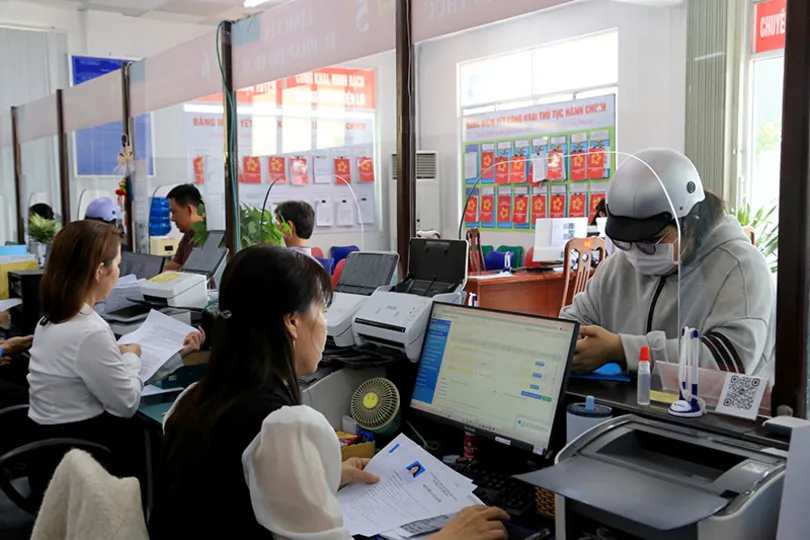
Notably, at the commune level, the entire heavy workload of advising on institutional development and reviewing and systematizing legal documents is carried out solely by civil servants from the People’s Council and People’s Committee Office, while most professional departments such as Economy and Culture-Social Affairs lack specialized personnel according to the Job Position Scheme. The civil servant workforce is small, mostly consisting of part-time staff, and some officials still need a lot of time to familiarize themselves with and operate various technological platforms, limiting the capacity for responding to and organizing law enforcement at the grassroots level, easily causing localized confusion in the initial stages.
Part 3: Fiscal pressure and implementation capacity on the “front lines”” data-socail-link=”https://baocantho.com.vn/khoi-thong-ha-tang-mem-chinh-quyen-dia-phuong-hai-cap-cuoc-cach-mang-tai-cau-truc-the-che-thuc-tie-a213926.html” class=”zoomimg” alt=”” src=”https://vstatic.vietnam.vn/vietnam/resource/IMAGE/2026/09/02/1788304039064_khoi-20thong-201.webp” style=”height: 533px; width: 800px;”>
The small staff, mostly working on a part-time basis, limits the capacity for responding to and enforcing laws at the commune level. Photo: LAN PHƯƠNG
Practical experience shows that the process of handling administrative procedures and reviewing legal documents requires very high professional skills. The shortage of dedicated legal officers at the commune level forces office staff to simultaneously handle many complex administrative areas. This not only increases the risk of delays in processing documents but also easily leads to legal errors, directly affecting the progress and quality of public service delivery at the grassroots level.
Financial allocation bottlenecks
According to the People’s Committee of Can Tho City, along with professional analyses, the effectiveness of institutional implementation by the two-tiered local government in Can Tho City is under pressure from the inadequacies of the public finance system. Specifically, the current State Budget Law lacks a mechanism for “regional budgets” and does not have regulations for allocating a satisfactory percentage of retained revenue to the grassroots budget after administrative unit reorganization.
In a report submitted to the Ministry of Justice , the leaders of the People’s Committee of Can Tho City frankly acknowledged that the simultaneous operation of the centralized administrative procedure information system of ministries, sectors, and local systems has created many shortcomings in implementation at the grassroots level. Officials at the commune-level one-stop service centers have to simultaneously operate on multiple different software systems, easily leading to process bottlenecks and delays, directly affecting the progress of processing applications for citizens, especially during peak hours.
City leaders believe that the modernization of the grassroots administrative apparatus is facing significant challenges in terms of resources. The allocation of administrative management funds has not been adjusted to reflect the large geographical area and the surge in population following the merger. Although the locality is making great efforts to promote digital transformation, the fact that commune-level revenue depends heavily on budget allocations from higher levels means that the need to self-balance finances is creating significant financial pressure. This is partly slowing down the progress of upgrading offices, equipment, and synchronized digital infrastructure at the grassroots level.
Part 3: Fiscal pressure and implementation capacity on the “front lines”” data-socail-link=”https://baocantho.com.vn/khoi-thong-ha-tang-mem-chinh-quyen-dia-phuong-hai-cap-cuoc-cach-mang-tai-cau-truc-the-che-thuc-tie-a213926.html” class=”zoomimg” alt=”” src=”https://vstatic.vietnam.vn/vietnam/resource/IMAGE/2026/09/02/1788304040716_khoi-20thong-202.webp” style=”height: 480px; width: 800px;”>
The Soc Trang Ward Public Administrative Service Center guides residents on how to find kiosks and obtain automatic queue numbers. Photo: LAN PHUONG
Regarding fundamental solutions to address the resource bottleneck, many opinions suggest that assigning additional functions and tasks to commune-level People’s Committees must be legalized, accompanied by resource allocation, and the mechanical decentralization process must be ended. It is necessary to amend budget laws to increase the percentage of retained revenue for communes to ensure financial resources; simultaneously, regulations on job positions should be revised, and specific staffing levels should be added for specialized departments at the commune level to enable them to handle the new workload.
Furthermore, the experience in Can Tho also shows that information technology infrastructure and equipment at the commune level need continued investment and upgrading to handle work in an electronic environment, overcoming the current shortage of specialized human resources for digital transformation at the grassroots level.
As clear evidence of this difficulty, Mr. Pham Quoc An, Chairman of the People’s Committee of Dai Thanh Ward, shared that the locality is very keen to invest in upgrading digital infrastructure, but the cost exceeds the self-sufficiency of the local budget.
Sharing the same concerns, according to the leaders of An Binh ward, after more than a year of operating the new model, the locality still lacks specialized IT personnel to handle the digital transformation task. In addition, the leaders of Phu Loi ward also reported that the technical infrastructure is not yet fully compatible and the sample electronic processes have not been configured synchronously, causing localized difficulties in the initial stages.
Mr. Nguyen Van Hao, Chairman of the Can Tho City Business Association, commented: If decentralization is not accompanied by operational guidance, forms, databases, and coordination mechanisms, businesses may encounter situations where documents are passed back and forth, prolonging the process or requiring multiple supplementary documents. Essential procedures such as land information verification, land use change updates, land data provision, and coordination of compensation, support, and resettlement urgently need clear guidance on the receiving point, processing time, and clear coordination responsibilities between different levels.
The simultaneous pressure on human resources, fiscal resources, and technical infrastructure at the grassroots level has sent a strong message: the reform process cannot continue to operate with mechanical administrative orders or inconsistent decentralization. When the capacity of the grassroots apparatus has reached its limit, the two-tiered governance system demands a comprehensive reconstruction – where decentralization must be coupled with real resources and public service oversight must be transparently enhanced by the power of digital technology . This is also the key to unlocking all bottlenecks and shifting the administration from a reactive to a development-oriented state.
LAN THANH
(To be continued)
Final installment: Breakthrough through institutions and “digital public service oversight”
Source: https://baocantho.com.vn/khoi-thong-ha-tang-mem-chinh-quyen-dia-phuong-hai-cap-cuoc-cach-mang-tai-cau-truc-the-che-thuc-tie-a213926.html