
National Public Debate on Real Estate Policy Held on the 27th, Presided Over by the Prime Minister
Differentiated Comprehensive Real Estate Holding and Capital Gains Taxes Depending on Residency and Price Level
Experts: “If Holding Taxes Are Raised, Capital Gains Taxes Should Be Lowered to Provide an Exit Route”
There has been a proposal to maintain the current levels of the comprehensive real estate holding tax and the capital gains tax for owners of a single residential home. However, for ultra-high-priced homes, commonly referred to as “smart picks,” the suggestion is to set a deduction limit, introducing a graduated tax burden.
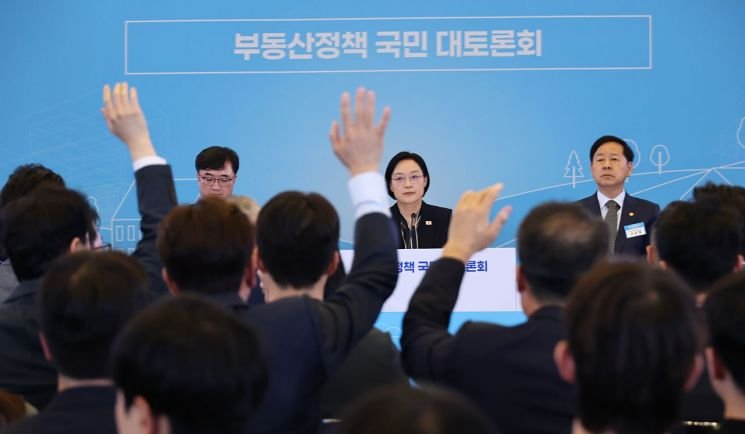
On the afternoon of the 27th, a “National Public Debate on Real Estate Policy” was held at the Korea Chamber of Commerce and Industry in Jung-gu, Seoul, presided over by Prime Minister Han Seong-sook. This event was an extension of the debate hosted by President Lee Jaemyung on the 23rd, continuing discussions on major areas such as housing supply, finance, and taxation that were not thoroughly covered previously.

Prime Minister Han Sung-sook is speaking at the National Real Estate Policy Public Debate held on the 27th at the International Conference Hall of the Korea Chamber of Commerce and Industry in Jung-gu, Seoul. Photo by Yonhap News
Kang Seong-hun, Professor of Policy Studies at Hanyang University, who led the presentation, suggested a direction for the revision of the comprehensive real estate holding tax. He stated, “Tax credits should be shifted from homeownership-based credits to residency-based credits, so that the tax burden on non-residential single-home owners is normalized.”
He went on to say that even in the case of single residential homes, if the property is ultra-high-priced, the burden of the comprehensive real estate holding tax should be increased. Currently, if a homeowner retains a single property worth several billion won for an extended period, up to 80% of the comprehensive real estate holding tax can be reduced. Professor Kang emphasized, “While the tax burden should be maintained at current levels for single-home owners whose property value does not reach a certain threshold, even for primary residences, a deduction limit should be set for ultra-high-priced single residential homes.”
At present, various opinions exist as to the definition of an ultra-high-priced home, with suggested values ranging from 3 billion to 5 billion won. Professor Kang stated, “Achieving social consensus on this matter is important.”
Deputy Prime Minister and Minister of Economy and Finance Koo Yoon-cheol also expressed his agreement with differentiating tax burdens according to home use, such as between residential and non-residential properties, for both holding and capital gains taxes. Deputy Prime Minister Koo said, “Many members of the public have voiced that properties not used as residences should not receive the same tax benefits as residential ones,” adding, “We are considering that it may not be appropriate for them to be treated the same as residential homes under the tax code.”
He continued, “While we will take into account those residing in reasonably sized homes, we are considering imposing differentiated capital gains taxes on owners of multiple homes who hold onto properties they do not personally occupy.” In the case of multiple-home owners with non-residential properties, this implies the intention to consider separate limits for long-term ownership special deductions.

At the Real Estate Policy National Forum held on the 27th at the International Conference Hall of the Korea Chamber of Commerce and Industry in Jung-gu, Seoul, participants raised their hands to ask questions. Photo by Yonhap News
Many experts argued that if property holding taxes increase, capital gains taxes should be reduced to facilitate exit strategies and release properties onto the market. Ko Jong-wan, Head of Korea Asset Management Research Institute, stated, “While holding taxes should be raised to levels seen in developed countries, capital gains taxes should be lowered to provide an exit route.” He suggested, “The definition of high-priced housing could be set at 4 billion won or above, or as the top 3% of all housing units.”
Song Seung-hyun, CEO of Urban and Economy, commented, “The market needs clear policies that raise holding taxes but lower transaction taxes.” However, he also cautioned, “If holding taxes are raised too aggressively while there is a shortage of homes available for monthly or yearly rental, the rental market could be negatively affected, so the pace should be carefully managed.” In response, Deputy Prime Minister Koo replied, “We have also received comments about the need to provide an opportunity for homeowners to sell, and we will take these into consideration.”
There were also calls for a more long-term approach to reforming real estate taxation. Ko Jong-wan stated, “Tax reform should be pursued over ten years, not just four, to reduce resistance to tax changes.” He added, “In cases where elderly homeowners experience several-fold increases in the comprehensive real estate holding tax even without income but only due to rising home values, it is necessary to prepare measures such as deferred taxation or tax reductions.”
Hot Picks Today
“After Dominating 80% of the Global Market… China’s Solar Industry Hit with 3 Trillion Won Losses”
This content was produced with the assistance of AI translation services.
© The Asia Business Daily. All rights reserved. Unauthorized AI training and use prohibited.