
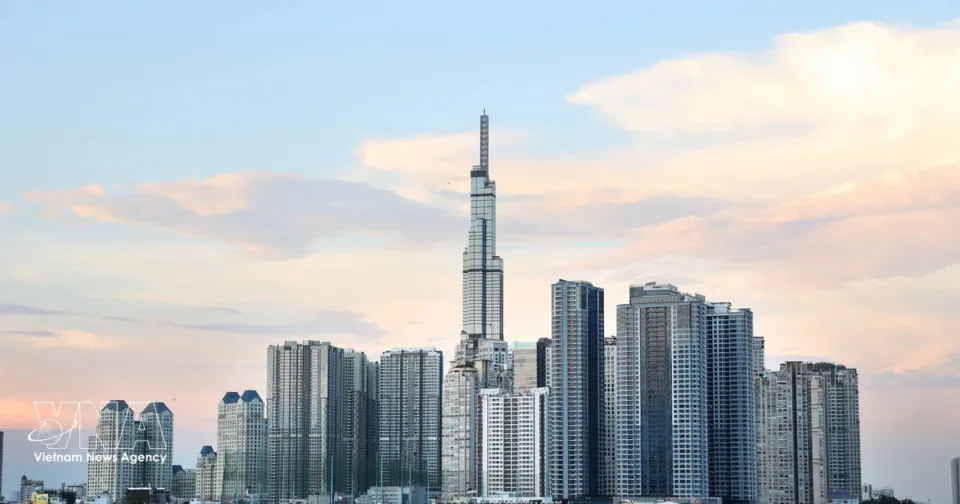
Ho Chi Minh City’s real estate market is shifting toward sustainable growth as weak housing demand, high borrowing costs and legal bottlenecks push developers and investors to prioritize productive assets and long-term cash flows.
Ho Chi Minh City’s real estate market is approaching a turning point. Rather than being measured by transaction volumes and price growth, its value increasingly depends on its ability to turn land and investment capital into assets, sustainable cash flows, production activities and substantive economic growth.
Addressing supply-demand imbalance
In the first 10 months of 2026, revenue from real estate services in Ho Chi Minh City reached about 373 trillion VND (14.5 billion USD), up 10.8% year on year, while state budget revenue from land rose 20%. However, these figures do not necessarily reflect the sector’s actual contribution to the city’s Gross Regional Domestic Product (GRDP) or the efficiency of land and capital use.
Housing demand remains weak, with absorption rates for primary apartments at just 25% and for landed houses and villas 27%. This raises concerns over capital being tied up in unsold inventory and slow-selling projects.
According to Avison Young Vietnam, the main challenge is the mismatch between housing supply and purchasing power. Mid- and high-end properties account for a large share of supply, while affordable housing remains scarce. High prices, floating home loan interest rates of 12–15% and rental yields of only 2–4% are adding pressure on buyers and investors.
As more projects enter the market in 2027–2030, competition is expected to intensify, making it harder for developments relying on location advantages or speculative price increases to attract buyers without meeting actual demand.
Although primary housing prices are unlikely to fall significantly due to high land, compensation and construction costs, developers are adjusting apartment sizes, designs and handover standards to make homes more affordable. Expanding reasonably priced commercial housing, social housing and rental accommodation, alongside mechanisms for clean land reserves and affordable long-term credit, is essential to addressing the imbalance.
Land-related legal procedures are another major bottleneck. Dr. Su Ngoc Khuong, senior director of investment at Savills Vietnam, said some businesses had accumulated land banks in line with urban development plans but could not develop commercial housing because their sites lacked residential land components.
Under the conventional mechanism stipulated in the 2024 Land Law, investors negotiating land-use rights transfers for commercial housing projects are, in principle, only permitted to acquire residential land. Thus, the problem is not necessarily a shortage of land but the lack of mechanisms to convert existing land resources into viable projects. Prolonged procedures also increase capital costs and can push up housing prices.
Generating cash flows and attracting investment
Commercial and industrial real estate are more directly linked to business operations and production. Avison Young Vietnam said their investment appeal increasingly depended on tenant quality, operational efficiency and sustainable cash flows rather than asset scale or location alone.
In office and retail segments, growing supply is forcing landlords to prioritise occupancy and tenant retention. High asking rents do not necessarily translate into higher net revenue, given rent-free periods, fit-out costs and operating expenses.
Although office transactions are expected to remain subdued through the end of 2026, the Vietnam International Financial Centre (VIFC) offers medium- and long-term growth prospects. After six months of operation, it had secured around 20 billion USD in capital commitments from domestic and foreign investors and partners.
Thanh Pham, research and consulting director at CBRE Vietnam in Ho Chi Minh City, said these commitments would take time to generate actual office demand, as financial institutions typically need 12–24 months to complete procedures, recruit staff and select premises. CBRE expects the VIFC’s two-hub model, linking the existing central business district with Thu Thiem New Urban Area, to drive office market growth from 2027.
In industrial real estate, the city attracted 19.1 billion USD in foreign direct investment (FDI) in the first 10 months of 2026, nearly 74% above its annual target. However, converting investment commitments into actual projects requires better infrastructure, shorter implementation timelines and streamlined administrative procedures.
In hospitality real estate, profitability likewise depends on operational efficiency, stable occupancy and sustainable cash generation rather than room rates alone.
Ho Chi Minh City’s challenge is not simply to increase supply or promote transactions, but to direct land and capital towards projects that meet genuine demand and generate economic value, Avison Young Vietnam said.
Real estate can become a sustainable growth driver only when land resources are transformed into productive assets with practical use value and the capacity to generate long-term cash flows./. VNA