
The risk of inflation overshooting the Reserve Bank’s forecast is growing, putting households on notice for potentially more interest rate hikes.
In an address to the House of Representatives Standing Committee on Economics on Friday, RBA governor Michele Bullock warned it could be several years until inflation returns to the bank’s 2-3% target range.
The longer inflation remains higher than this, the more monetary policy tightening – rate hikes – will be needed to balance out the economy, she warned.
“Inflation is too high; we are focused on getting it back down and making sure that it does not become embedded into price and wage-setting decisions,” she explained.
The bank’s latest outlook was published in the August statement on monetary policy and brought forward the timeline for inflation returning to the midpoint of the target range from mid 2028 to late 2027.
Since then, inflation data from the Australian Bureau of Statistics has revealed underlying inflation did not peak in June as both the RBA and Treasury expected, instead holding steady at 3.6% over the 12 months to July.
With August data not set to be released until the end of this month, the RBA’s monetary policy board will be reliant on the concerning July figures when it makes its next call on interest rates in just over a week.
Governor Bullock has now warned that ‘upside’ risks to inflation – things that could cause inflation to be higher than expected – are starting to play out.
“The Middle East conflict, the AI boom and extreme weather events are contributing to upward pressure on a range of energy, agricultural and technology-related prices,” she warned.
“There is little sign of resolution of the Middle East conflict. Oil and related prices have increased sharply again and will add directly to inflation.”

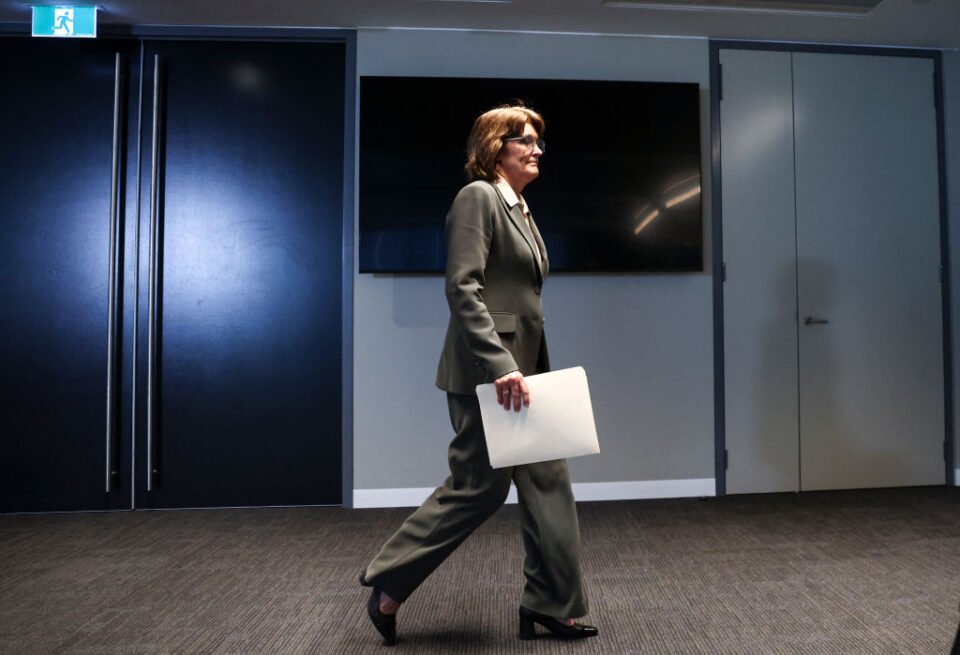
RBA governor Michele Bullock warns rate rises could be around the corner. Picture: David Gray
While households are already feeling the effects of three cash rate hikes this year, businesses are also passing on their higher costs directly to customers, she added.
“This was expected, but it is important that these effects remain contained and do not become embedded into price and wage setting decisions, otherwise, inflation could prove more persistent and require a stronger policy response,” she warned.
The grim warning for further rate hikes comes two days after the US Federal Reserve raised interest rates in the United States for the first time in 2023, indirectly weakening the Australian dollar.
The US Federal Reserve raised its benchmark interest rate by 25 basis points to a target range of 3.75% to 4.00% on Wednesday. Picture: Valerie Plesch
“Central banks in many other advanced economies are responding to this global inflation shock by increasing their policy rates,” Ms Bullock added. “A period of subdued growth of aggregate demand is needed to reduce capacity pressures and bring inflation down sustainably.”
While Australia’s economy is still growing, sluggish performance is hampering inflation prospects. The economy grew 0.4% in the June quarter, only marginally stronger than the 0.3% recorded between January and March.
Property is a driving factor in the lacklustre economy, with home prices falling for the fifth month in a row in August.
“A larger-than expected easing could be a downside risk to economic activity,” Ms Bullock confirmed. “Housing prices have fallen in most capital cities and new housing loans have declined.”
While rate hikes have played a part in softer housing prices, Ms Bullock pointed at the government’s May budget property tax overhaul as a key instigator.
Reforms to how capital gains tax is calculated and the removal of negative gearing options on established homes from 2027 have been controversial, with changes largely been met by criticism from Australia’s investor-strong property market.
Growth in the property market is expected to come in around 2% lower in 2026 compared with last year, while further rate hikes would also contribute by lowering borrowing capacity for buyers.
“I want to emphasise that, while we expect housing prices to be affected when interest rates rise, monetary policy does not target housing prices,” Ms Bullock said.
“Rather, what matters for monetary policy is how changes in housing prices affect economic activity, the labour market and, ultimately, inflation.”
The next monetary policy board meeting will begin on 28 September, culminating in the next cash rate decision on 29 September.
“We’ll discuss our assessment of the flow of data and how the risks are unfolding,” Ms Bullock said. “I recognise that higher interest rates are difficult for Australians with mortgages who are also facing cost-of-living pressures, but reducing inflation is essential.”