
Commercial real estate lending rebounded sharply in 2025, and in Central Kentucky the growth is increasingly being driven by retail, industrial and health care projects. Multifamily lending, however, has seen limited growth in the region compared to national benchmarks.
According to the Mortgage Bankers Association, commercial real estate borrowing and lending nationwide reached $706 billion in 2025, up 40 percent from 2024 and 65 percent from 2023. Multifamily lending accounted for roughly $413 billion of the total.
“As capital markets conditions stabilized in 2025, there was a meaningful rebound in commercial real estate lending activity,” said Reggie Booker, the MBA’s associate vice president of commercial research. “The strength in multifamily originations, combined with increased lending from depositories and a return of capital from other lender groups, reflects growing confidence across the commercial real estate finance market.”
While multifamily lending remains a major driver nationally — accounting for about 60 percent of total lending — Central Kentucky’s market has shifted in a different direction, said Jason Heflin, president of the Mortgage Bankers Association of Kentucky.
“We’ve seen an increase certainly when it comes to retail and business,” Heflin said. “Publix is a great example. I think they’ve opened their third store in the Lexington area now. It had been a lot of multifamily, but that has seemed to shift now towards retail and shopping centers.”
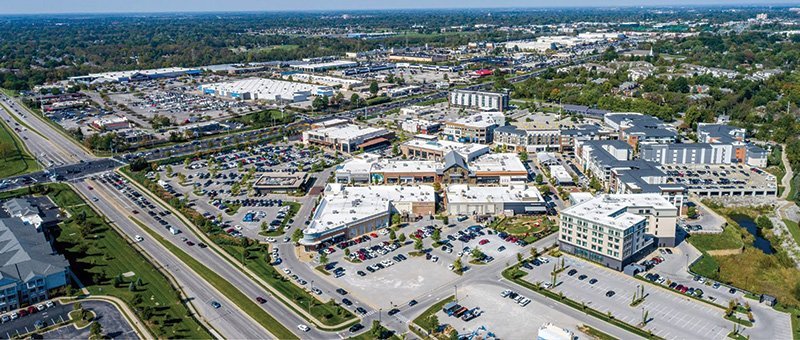
Retail expansion is especially visible in Lexington developments such as The Summit at Fritz Farm, where Hendricks Commercial Properties recently announced a $14.1 million expansion that will add three new buildings ranging from 8,000 square feet to more than 12,000 square feet.
Heflin said the shift toward retail development marks a dramatic change from just a few years ago.
“The landscape, especially around Lexington, is really shifting towards commercial retail development, and that is a complete 180 from where we were two or three years ago,” he said. “My understanding is it’s probably due to a lot of the regional and local mid-size banks pulling back on commercial lending due to the regulatory constraints.”
That pullback has created opportunities for larger institutional investors, including hedge funds and insurance companies, which tend to focus on larger commercial projects, Heflin said.
Commercial lending activity is also expanding in the health care sector, particularly for medical offices and hospital-related development. Despite the recent slowdown in multifamily projects, Heflin said he expects housing development to eventually rebound as population growth increases and continues to create pressure across the region.
“It’s great that this commercial development is coming in,” he said. “It’s opening up some areas, but at the end of the day we still need more residential.”
Industrial real estate remains another bright spot for the Lexington market.
According to a recent report from TenantBase, Lexington’s industrial sector is operating near maximum capacity, with vacancy rates around 6.8 percent. Demand for large warehouse space remains especially tight, with limited speculative construction over the past two years creating intense competition for properties larger than 50,000 square feet.
The report also noted continued demand for Class A office and research space near the University of Kentucky from biotech and fintech companies.
While industrial and retail properties remain strong, traditional office space could face increasing pressure in the coming years as remote and hybrid work continue to reshape the market.
Matt Stone, managing director with SVN Stone Commercial Real Estate, said he is also seeing lending to build retail development outpace lending for office space in the area. Lenders like to be involved with grocery-anchored developments that generate high traffic, he said. Demand for office space has been flat or slightly decreased, a trend that had been in process but accelerated during the COVID pandemic.
“In Lexington, what we’ve seen is very little new product [in terms of office space] coming on the market that isn’t specific to its use,” Stone said. “And lenders are giving preference to owner-occupied projects because of their stability. We haven’t had much office space built because there’s enough current inventory for the demand. A lender is going to struggle to finance a speculative office building given current occupancy rates.”
Stone said he expects to see some office space converted to other uses.
“I think you will see some conversion of office space to multi-unit housing or mixed-use downtown,” he said. “We are already seeing it in a few projects, but it won’t be quite as prevalent as it will be in larger metropolitan markets across the country.”
Heflin said broader economic and geopolitical uncertainty could eventually slow commercial lending nationwide, but he believes Central Kentucky is better positioned than many markets because of its employment base and population growth.
“As far as commercial lending, I think if things don’t turn around quickly with certain things going on in the world, by 2027 we’re going to hit a slowdown,” he said. “But Central Kentucky has always been somewhat insulated from what the national scene looks like as far as real estate goes. … Because of the demographics and the employment base here, this area always seems to hold steady.”