
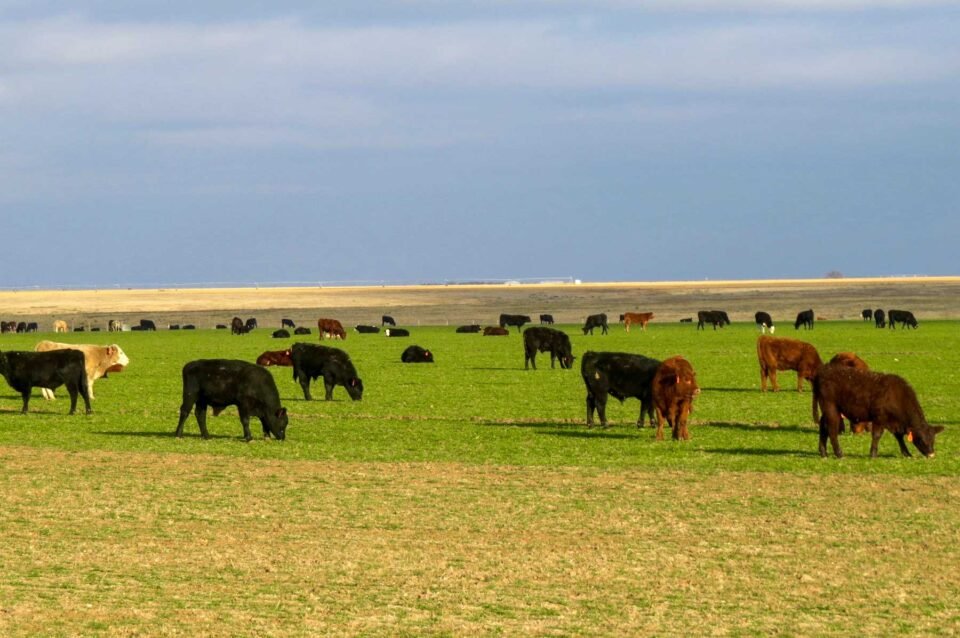

The Freeman Family Ranches sold after being listed for nearly $128 million. The property includes feedyards for cattle and is set to stay a ranch property.
Texas counties and metro areas have more ranch listings than other areas of the country by a wide margin.

When looking at the sheer number of ranches, Texas definitely jumps out, said Anthony Smith, a senior economist at Realtor.com.
“That is definitely going to be tied to just the amount of space that’s available in such a vast area,” Smith said. “That’s really what we see in Texas. It just has a lot of open space to offer to really support the number of ranches that we see.”
Article continues below this ad
A Realtor.com report measured active inventory for-sale ranch and farm properties from Realtor.com listing data as of June 2026. In the report, Texas led many listings in terms of volume, but not price.
Smith said part of looking through Texas data also meant differentiating between land used for ranches and land for sale that hadn’t been developed into a ranch.
Metro markets

The Freeman Family Ranches are three ranches in the Texas and Oklahoma panhandles that include nearly 88,000 acres.
Texas counties led the country when it comes to ranch listing volume.
Article continues below this ad
Nine of the top 10 counties with the most ranch listings are in Texas. Additionally, most of the counties on the list are near Austin and San Antonio.
At 237 ranch listings, Burnet County had the most in the nation. Other high ranking Texas counties on the list included Fayette County at 232 listings, Williamson County at 189 listings and Kerr County with 188 listings.
When looking at metro areas, the Austin-Round Rock-San Marcos area led U.S. metros with 727 ranch listings. Houston-Pasadena-The Woodlands ranked second with 640 ranch listings. San Antonio-New Braunfels was third with 564 listings.
Dallas-Fort Worth-Arlington ranked fifth — behind the Nashville-Davidson-Murfreesboro-Franklin metro area in Tennessee — with 274 ranch listings. D-FW had a median ranch listing price of $1.4 million, according to the report.
It’s hard to beat properties within a two-hour radius of the metro, said Tyler Thomas, owner of TT Ranch Group, a real estate firm within Briggs Freeman Sotheby’s International Realty.
Article continues below this ad
“I think there’s a lot of discerning, educated and savvy buyers out there and they’re looking at ‘If I buy this today, what’s it going to be worth when my kids or grandkids sell it?’” Thomas said.
Premium prices

A 667-acre property listed for sale has more than 10,000 feet along U.S. Highway 67.
Everything’s bigger in Texas doesn’t ring true when it comes to ranch prices. Although Texas leads the nation in terms of the number of listings, higher prices are farther west.
Jackson, Wyoming, had the highest median listing price of any metro area at $7.9 million. Bozeman, Montana, ranked second with a median listing price of $4.9 million.
Article continues below this ad
None of the volume leading counties and metros in Texas came close to the top of the premium price list, according to the Realtor.com report.
That doesn’t mean that Texas is without high priced ranches. The Freeman Family Ranches, near the Texas-Oklahoma border, had a nearly $128 million listing price and sold in late July. Additionally, The Dallas Morning News reported on a property near D-FW listed for $20 million in June.
Areas of Texas like Big Bend, Fort Davis and the panhandle have larger legacy ranches that seldom trade because they are often passed down through generations, Thomas said. When they do sell there’s a demand for them, he said.
When it comes to big ranches, like sites over 30,000 acres, there are few for sale right now, said Chad Dugger of Hall and Hall, who was a listing agent for the Freeman Family Ranches. Options are more limited for properties with 75,000 acres and up.
Who’s buying?

The Pearl Ranch is about 40 minutes away from downtown Dallas, in the western portion of Ellis County.
TT Ranch GroupThe people looking to buy ranches tend to fall into three categories: operators, investors and people leaving the city, Dugger said.
Article continues below this ad
Operators are people looking to expand their ranching business. They might own livestock or produce another agricultural product as their primary business and want more property.
Investors are buyers who might have sold other properties and are interested in the agricultural aspect of a ranch, but are also looking for a safe investment.
Then there are people moving out of the city, buying a ranch as a primary or secondary residence, using the space mostly for recreational purposes. All three markets have an investment component, Dugger said.
Market forces
During the COVID-19 pandemic, many people were looking for a secondary home, Thomas said. People were buying recreational ranches at a time when interest rates were low.
Article continues below this ad
“The truth of the matter is we kind of sold through most of the good inventory on the market during those couple years, and we kind of hit historical lows in inventory,” Thomas said.
However, Thomas said inventory has come back to the market, but there weren’t as many buyers. He said that could be because of economic uncertainty.
Inventory contracted between 2020 and 2021, falling from nearly 28,900 listings nationally to about 16,540 listings, according to the report. There were about 19,500 listings in June.
Ranch and land sales are different from other real estate markets because they are working with a finite supply, he said.
“You can build more manufacturing buildings,” Thomas said. “You can build more office space. The one thing you can’t build more of is land. And that’s the space that we operate in.”
Historically, the industry has had peaks and valleys, but Thomas said he thinks the industry in Texas is moving towards peaks and plateaus, performing well as population goes up and avoiding sharp downturns.
“But unless you can convince me that people are going to quit moving to Texas, I don’t think we’re going to have these extreme valleys that we experienced in the 80s and early 2000s,” Thomas said.