

The big real estate news that came out of last night’s RH 0.00%↑ Q2 2026 earnings call?
The Company’s pivot to developing single story, multi-building “compounds” rather than large, multi-story galleries.
The strategy will be put in action with two new RH properties set to open next year in Naples, FL and Aventura, FL—both on redeveloped mall sites.
The RH Naples compound will take the place of a ~75,000 square foot, 2-story former Nordstrom store at Waterside Shops, the premier open air mall in Southwest Florida.
But the new “horizontally” developed RH property will be comprised of just 30,000 square feet of retail space spread across 6 separate single story buildings.

The individual buildings will be connected by landscaped courtyards, glass-roofed walkways and outdoor areas that include fountains and palm trees.

At the center of the buildings will be a 4,000 square foot restaurant and wine bar.

Single story RH compounds will be quite different than the grand, multi-story vertical galleries that RH developed in prominent, upscale locations over the past 15 years.
These include one-of-a-kind properties like RH England, an adaptive reuse of a 55,000 square foot, 17th century castle.
Or RH Indianapolis which is located in a 60 room, Palladian-style villa that had been the private home of real estate developer Christel DeHaan.
As well as RH San Francisco, an adaptive reuse of the ~80,000 square foot neoclassical Bethlehem Steel building that is located at historic Pier 70 and dates back to 1917.

These galleries were large and unique—but expensive both to build and operate.
Some galleries cost as much as $60 MM—and ~$1,000 per square foot—a massive sum for any retail site, let alone a home furnishings and furniture store.
But this cost makes sense given the need for deep footings, structural steel framing, specialized cranes, elevators and other elements of mid and high rise construction.
Contrast this to the smaller, single story RH Compound properties that can be developed via wood framed, tilt up construction at a fraction of the cost to build multi-story steel structures.
Large vertical galleries are also expensive to operate—both to heat, cool and maintain large interior spaces with and because they require a significant amount of non-revenue producing common areas like grand staircases and elevators.

The low density, single story footprint is also likely to be more palatable to landlords and the real estate investors that may acquire future RH-developed compounds.
That is because the single story buildings closely resemble “fungible boxes,” or standard, utilitarian properties that can be more easily repurposed or re-tenanted were RH ever to leave.
Like the real estate operated by companies such as AutoZone AZO 0.00%↑ and Tractor Supply TSCO 0.00%↑ which is both relatively inexpensive to build and can be adapted for other tenants at modest cost.

These attributes make it easier for landlords and investors to determine the residual value of the property without RH tenancy.
And it will likely make them more willing to fund the development of these buildings for RH or to acquire RH’s internally developed properties via sale-leasebacks.
Contrast that to the RH England and RH Indianapolis properties that are so unique that seeking a new user for the space would be like looking for a needle in a haystack.
That is one of the reasons why RH has struggled to complete sale leasebacks of its owned England and Indianapolis galleries.

The downside of low density, horizontal properties like RH Compounds?
They require a lot more land on which to build.
Which may work for vacant department store properties and mall parking lots in Florida or in low density suburban areas but is not often feasible in expensive, supply constrained areas like New York City and other urban markets.
Still at this point RH probably has enough large gallery space in those high density urban markets anyway.
Its future real estate growth—at least in the U.S.—will likely be in smaller markets with less population density and more affordably priced land.
Plus the “all of the above” real estate strategy (e.g. some large, multi-story galleries in lucrative urban markets and other smaller, single-story properties in markets with lower population density and less costly land) is probably well suited to RH.
In fact other retailers are pursuing this real estate strategy from the other direction.
Like RH rival Arhaus ARHS 0.00%↑ which has added a few ~40,000 square foot galleries in places like Pasadena, CA and Uptown Charlotte over the past year.
These properties are adaptive reuses of high profile, 2nd generation sites—like the new two story Arhaus gallery in the heart of Old Town Pasadena that was previously home to Forever 21 and a small-format Saks Fifth Avenue department store.
But the art deco-style building—which features an iconic 47-foot tower—dates back to 1925 when it opened as a grand auto service center for Penn Oil & Supply
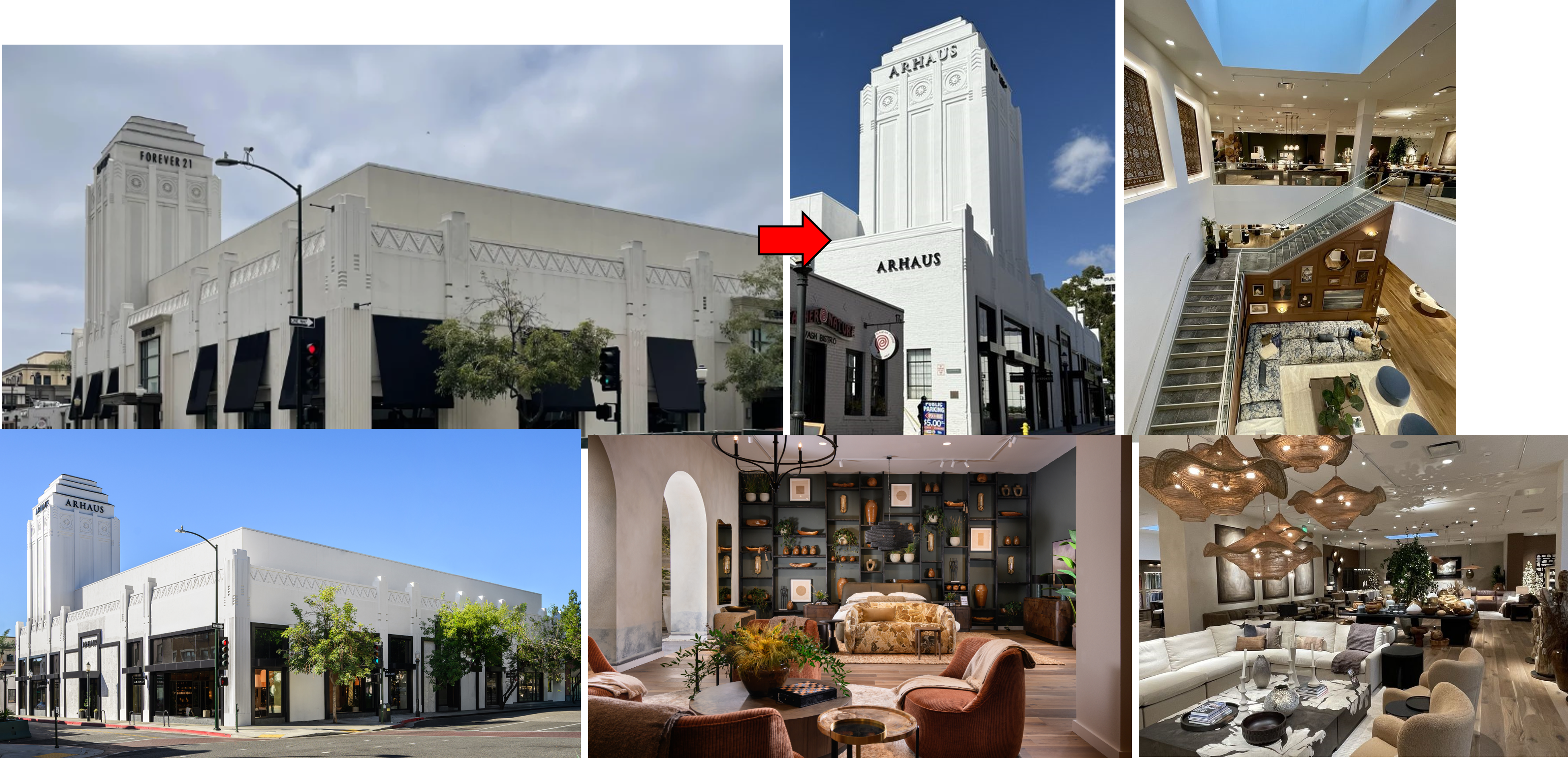
These new Arhaus galleries—which are ~3x the size of one of its standard stores—have provided a pathway for the home furnishings and furniture retailer to enter lucrative markets and supplement its smaller stores in other areas.
But RH has a significant head start on Arhaus—and others pursuing a similar strategy—since it already has large sites in expensive, hard-to-enter markets.
All while the cost to acquire and construct these types properties has increased considerably in the years since RH completed these projects.
So while recently opened multi-story RH galleries in places like Oklahoma City, Cleveland and Detroit could have been developed at much less cost and with a higher return profile had RH pivoted earlier to the “compound” real estate strategy…
At least RH now has a capital efficient, flexible and higher return store expansion model to enter and serve these types of markets in the future.