
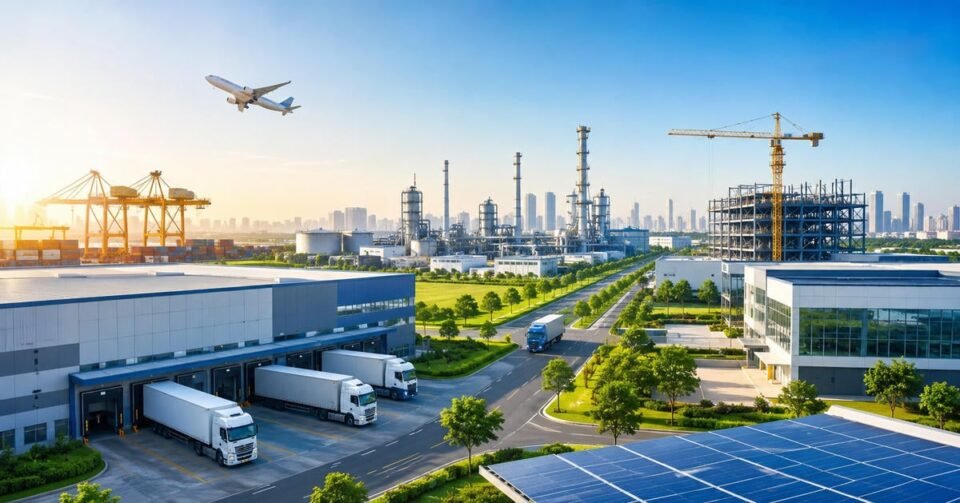
Industrial land absorption and recovery are strong.
According to SSI Research’s 2027 Investment Strategy Outline report, after a period of stagnation due to uncertainties related to tariff policies in 2025, demand for industrial land leases has clearly recovered in the second quarter of 2026.
In the North, net absorption reached approximately 217 hectares in Q2, the highest quarterly figure since Q1/2024, when it reached 218 hectares. Compared to Q1/2026, absorption also increased sharply from 134 hectares.
In the South, the market continued to improve with net absorption reaching approximately 67 hectares, up from 57 hectares in Q1 2026 and significantly higher than the 10 hectares of the same period last year. Industrial land lease prices also continued to increase, but at a moderate pace. According to CBRE, the average asking lease price in the North in Q2 2026 reached US$143/m²/lease cycle, up 2.9% year-on-year. In the South, the price reached US$185/m²/lease cycle, up 3.7%.
Developer profits declined in the first half of the year.
Despite the recovery in leasing demand, the business results of industrial park developers in the first half of 2026 were still affected by changes in accounting methods and lower recorded leased area.
The industry’s net revenue decreased by 20.2% year-on-year, to approximately VND 38,000 billion. Net profit decreased by 40%, to approximately VND 4,000 billion.
BCM, KBC, and D2D recorded a sharp decline in profits due to the lack of large-scale land sales transactions and additional pressure from interest expenses. Meanwhile, the profits of SZC and SNZ decreased significantly due to a shift to an even distribution of revenue.
Conversely, IDC and VGC continued to record profit growth thanks to a sharp increase in land absorption and a recovery in demand for construction materials.
New supply accelerates, with Chinese and Taiwanese tenants as the main drivers. Entering Q4 2026 and 2027, the supply of new industrial land is projected to accelerate. According to CBRE, the total new supply is expected to reach approximately 1,347 hectares, including 664 hectares in the North and 683 hectares in the South.

In the North, future supply is concentrated in Bac Ninh, Thai Nguyen, Hai Phong, Hung Yen, and localities adjacent to Hanoi . These are areas that continue to benefit from FDI inflows and the trend of supply chain diversification.
In the South, new supply is expected to come from Dong Nai, Binh Duong, Long An, Tay Ninh, and Ba Ria – Vung Tau , amidst continued upgrades to transportation infrastructure. According to the research firm’s assessment, tenants from China, Taiwan, and Hong Kong will continue to be the main driving force for new industrial parks.
The area under new lease contracts and memoranda of understanding (MOUs) for businesses within the study area is projected to increase by 18.6% in 2027, primarily in Tier 2 industrial parks. This growth is driven by the relocation and expansion of production by FDI enterprises.
However, new tenants also tend to be more cautious in light of US tax policies. Demand for ready-built factory space to test the market and a preference for smaller-scale projects may increase, thereby impacting the timing of revenue and profit recognition for investors.
Investment costs are rising, and profit margins for new projects are shrinking.
One of the major challenges for the industry in 2027 is investment costs. The cost of developing new industrial parks is increasing due to difficulties in compensation and land clearance. The restructuring and consolidation of provinces and adjustments to administrative boundaries also contribute to increased land compensation costs.
Meanwhile, the prices of key construction materials such as sand, stone, cement, and leveling materials have increased by an average of about 20% year-on-year. These factors could cause the profit margins of new industrial parks to fall to around 30-35%, compared to over 50% in existing industrial parks.
Land lease prices are projected to remain relatively stable in 2027 as new supply increases and developers tend to offer more competitive prices to attract large tenants and accelerate occupancy rates.
Profits are projected to accelerate in 2027.
Despite projected stable rental rates, the profit outlook for industrial park developers is considered more positive due to increased land leases and revenue contributions from newly launched projects. The total net profit of industrial park developers and rubber companies involved in land conversion within the study area is estimated to reach VND 22,300 billion in 2027, a 12.4% increase compared to 2026.
VGC is projected to record the strongest profit growth, with net profit increasing by 29%, thanks to contributions from new industrial parks such as Song Cong II and Tran Yen, along with leasing activities at Phu Ha, Thuan Thanh and Yen Phong IIC.

Meanwhile, PHR and GVR are projected to achieve record profits, with net profits increasing by 12.4% and 10% respectively, thanks to compensation revenue from the conversion of rubber plantations.
In the long term, demand for industrial real estate is expected to continue to be supported by improvements in infrastructure, including the North-South Expressway, the expansion of the Long Thanh-Dau Giay Expressway, the Bien Hoa-Vung Tau Expressway, and the Ring Roads 3 and 4. Better infrastructure will contribute to reducing logistics costs and increasing the attractiveness of industrial parks.
In addition, new FDI support policies, including Resolution No. 10-NQ/TW dated June 8, 2026 and the amended Investment Law, are expected to support capital attraction through simplifying administrative procedures, promoting eco-industrial parks, and strengthening decentralization to local governments.
Tariff risk remains a significant variable to watch.
Despite the positive outlook for FDI, the industrial real estate market still faces risks from trade policies. Vietnam is subject to an additional import tariff of 12.5% under Section 301, higher than the 10% applied to some countries in the region such as Bangladesh, India, and Indonesia .
If ongoing trade investigations lead to additional measures, expansion plans for labor-intensive industries such as textiles, footwear, and wood products could be affected. This is also the group of tenants most likely to experience a more pronounced impact on their need to expand production space.
With improved prospects for FDI inflows, land lease demand, and new supply, VGC and IDC are positively evaluated due to their attractive valuations and strong operating cash flow, thus supporting their ability to maintain cash dividends. GVR, PHR, and DPR are also expected to benefit from compensation revenue from the conversion of rubber land. PHR and DPR, in particular, are projected to maintain cash dividend yields at 8-11%.