
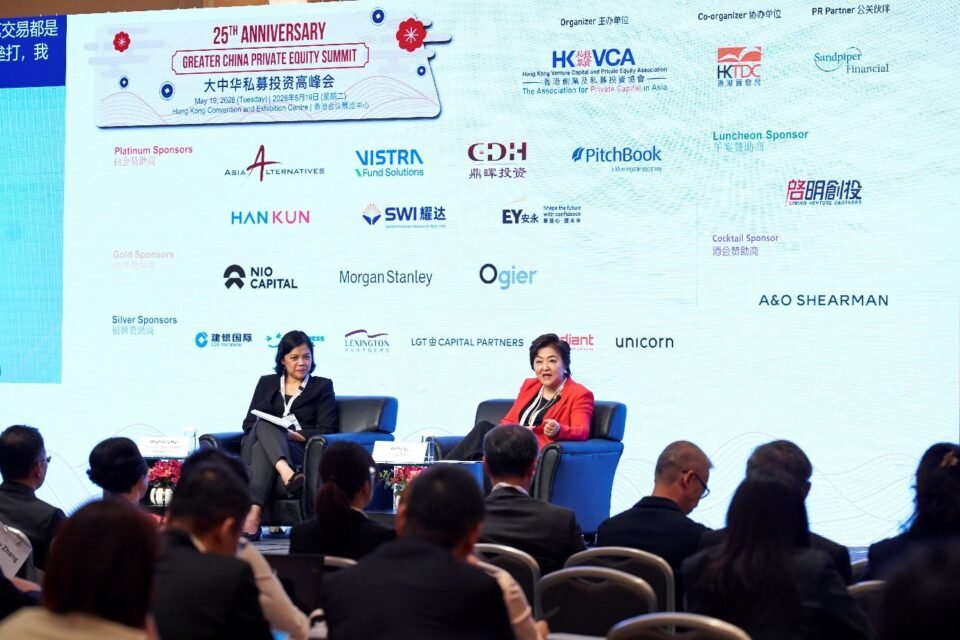
Kathy Xu, the legendary founder of China-focused Capital Today, revealed her criteria for finding great founders behind successful companies–from bottled water and online gaming to today’s AI champions–during an industry conference in Hong Kong on Tuesday.
Xu, widely recognised as “queen of venture capital (VC)” in China, pulled back the curtain on how she evaluates founders across different market cycles, from JD.com and NetEase in the Internet era to current AI darlings such as Moonshot AI and ByteDance.
Among her most famous early-stage deals was an initial $10-million investment in JD.com in 2007, as the Chinese e-commerce giant’s first institutional backer. Her continuous capital support for JD.com over the years yielded a historical paper return of over 100-150x the original capital.
With over three decades of experience in VC investments in China and $4 billion under management, Xu found great founders from China often share some key common traits.
It is important for founders to have the “killer instinct,” said Xu during a fireside chat at the HKVCA Greater China Private Equity Summit 2026. “They see what others cannot see,” she said, as she recalled investing in the now Chinese beverage conglomerate Hangzhou Wahaha Group back in the 1990s, when few people in China drank bottled water.
Zong Qinghou, who had founded Wahaha in 1987, foresaw the popularity of bottled water and actually spent six months marketing it on TV before a single production line was built. Still a privately held company, Wahaha posted a 40% surge in 2024 revenue to reach 70 billion yuan ($10.3 billion).
In another example, when Capital Today-backed NetEase Inc’s US stocks crashed from $5 to $0.6 in the two years between 2000-2002 amid the dot-com bubble burst, its founder William Ding navigated the crisis by initiating internal investigations and restating financials. Ding held his vision and carried on building NetEase’s online gaming business, which led to his comeback in 2003 as the first Internet and gaming billionaire in China.
“Killer instinct, fast learning, ambition, and long-term patience” are the shared traits of successful founders from the dot-com boom, said Xu.
“In China, no matter what you do, if you do it well, there will be hundreds and thousands of copycats. The only barrier to entry is get big fast.”
As for great retail founders–be it one from China or the ones who started Walmart, Costco, and Starbucks in the US–they are always “detail-oriented,” “hands-on,” and “nice to their employees,” said Xu.
“They are very mean and lean, because the [average] net profit margin in retail is like 3%.” If the founder spends extravagantly, the net profit margin will disappear, she said.
Based on these key founder traits, she invested in Yifeng Pharmacy Chain in 2008 and Manner Coffee in 2018.
The former, which went public on the Shanghai Stock Exchange in 2015, is now one of the biggest pharmaceutical retail enterprises in China with over 14,800 stores and franchised outlets. Manner Coffee, with over 2,000 self-run stores across China, is said to be seeking an initial public offering (IPO) in Hong Kong this year, targeting a market cap of up to $3 billion.
“It’s good to meet dozens of founders from the same industry. You meet all the trees, and then you will have a forest in heart,” said Xu.
“The biggest risk in venture capital is not market volatility or China-US relations, it’s that you don’t understand the business well.”
Started as an English literature major and accidental CPA, Xu launched Capital Today in 2005—the same year when HongShan and Hillhouse Investment were founded—to help Chinese entrepreneurs build top brands and sustainable businesses.
Her fund mandate now spans retail chains, consumer brands, AI, robotics, and full self-driving (FSD).
Turning to the AI boom in China, Xu argued that AI founders are a new species, “half-human, half-AI,” as how she put it.
Founders of agentic AI startups in China all work super long hours with only 4-5 hours of sleep. Often operating their companies under an ultra-slim structure, they would fire 50,000 yuan (over $7,350)/month staff and instead hire “superhumans” who can command a few dozens of agents at 200,000 yuan ($29,410)/month, said Xu. There are cases where the agentic AI startup would target a milestone of achieving 10 million daily active users (DAUs) with fewer than 20 team members.
In an era where AI agents may replace middle managers and even some R&D staff, her criteria for the right AI founders have sharpened. In her view, the typical AI founder from China is someone born in the 90-95s, equipped with top-tier scientific acumen and technical expertise–someone who sleeps little, commands an army of AI agents, and acts fast to replace humans when an AI agent does a better job.
Xu saw these traits among AI founders from Capital Today’s portfolio companies, such as Moonshot AI and Hong Kong-listed Zhipu AI, or Z.ai, whose founding teams have deep connections to the prestigious Tsinghua University in China.
“This is the time for scientists to make money.”
After the firm’s first AI investments in early 2023, Capital Today in November last year acquired a minority stake in Zhang Yimin-led ByteDance Inc through a hyper-competitive secondary share auction. It paid about $300 million for the stake, pushing ByteDance’s implied valuation to $480 billion.
Why ByteDance? The company has the “full stack,” i.e., chips, data centres, LLMs, and AI agents, Xu explained. “In the US, it’s Google. In China, it’s ByteDance–and Alibaba, but to a lesser extent.”
With its Doubao AI chatbot apps reaching 155 million weekly active users in late December–nearly twice the user size of its nearest rival DeepSeek in China, according to QuestMobile data–ByteDance sits at the centre of AI token generation.
“If a company is not at the centre of token generation, even if it’s a dominant industry player, its growth is limited to 10-15%,” said Xu. “[AI] recommendation engine is a great, money-making business… and ByteDance is the only Chinese company with enough cash to compete against Google globally.”