
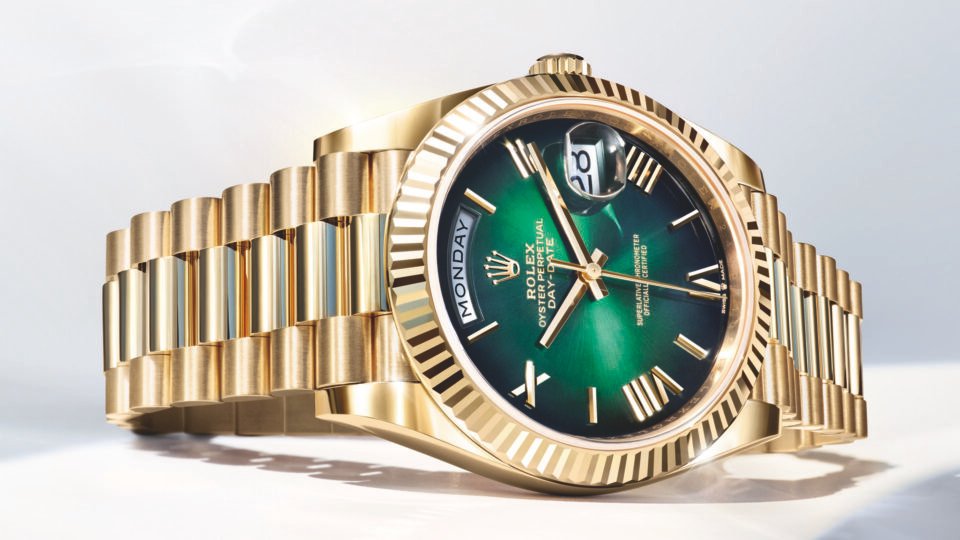
Rolex has increased prices for a second time this year, but only gold watches among the basket of references tracked by WatchPro are affected.
An average hike of 5% has been imposed, taking the price of a Rolex Daytona Cosmograph in 18ct white gold, ref. 126509, up 5.1% from £47,000 in January to £49,400 today.
A 40mm 18ct white gold Day-Date, ref. 228239, is up 4.9% from £43,100 to £45,200 and a Yacht Master, ref. 126655, in Everose gold on a black rubber strap has a 5.0% bump from £29,950 to £31,450.
Inexplicably, the gold on gold 41mm Submariner Date’s price is unchanged at £43,600.
None of the steel models tracked by WatchPro has seen a price rise in June but bi-colour gold and steel pieces are up by around 2.5%.
Two years ago, gold was trading at around $2,000-$2,100 in the first half of 2024.
By April 2025 it had broken through $3,300 per ounce, and briefly topped $5,500 in the autumn before settling at around $4,500 this year.
Over the same two year period, the Swiss franc has strengthened by around 8% against the British pound, making it more expensive for importers.
Rolex limited price rises in the UK last year to low single digits for steel watches and around 7% for gold watches.
In January this year, Rolex added another 4% to the price of steel watches and 6.5% for gold.
With this month’s additional 5%, the price of a gold on gold Rolex Daytona is now 28% higher than two years’ ago, Yacht Masters and Day-Dates are up 20% and the Submariner Date has risen by 14%.
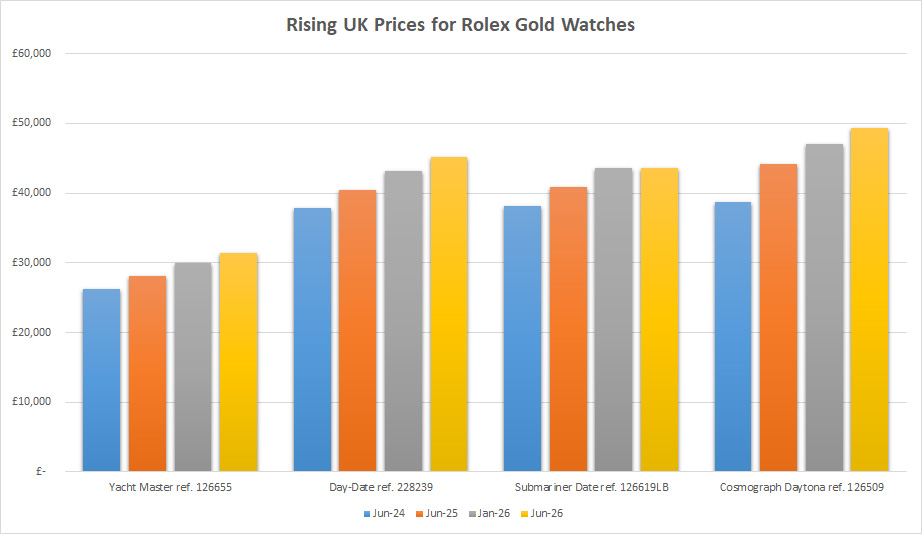
The difference in these price increases is, perhaps, explained by the relative desirability of the models, with demand for chunky Subs cooling at a time when less imposing watches are more popular.
How much does the cost of gold add to the price of a Rolex?
Rolex has unrivalled pricing power for a manufacturer making over one million watches per year and authorised dealers speaking with WatchPro yesterday said they are seeing no drop off in demand for precious metal pieces as they have become more expensive.
The rising price of gold is adding dramatically to the manufacturing cost of watches.
Rolex does not break down the cost of components such as cases and bracelets, but WatchPro calculates that a Day-Date “President” uses 178 grams (6.3 ounces) of 18ct gold, or 133.7 grams (4.7 ounces) of pure 24ct gold.
In June 2024, that amount of 24ct gold would have cost $10,928 (£8,600), by June 2026, this would have risen to $21,033 (£15,600).
The retail price of the Day-Date has risen by £7,400, just £400 more than the change in cost for the gold.
Unlike most watchmakers, Rolex controls almost every stage of gold production in-house.
Since 2002, the company has operated its own foundry at its manufacturing complex in Plan-les-Ouates, allowing it to cast and process the precious metals used in its watches rather than relying entirely on external suppliers.
Rolex purchases gold from approved sources and melts it in-house before creating the proprietary alloys used across its collections.
The foundry produces the brand’s 18ct yellow gold, white gold and Everose gold, Rolex’s patented pink-gold alloy introduced in 2005.
By controlling the entire process, Rolex can monitor purity, colour consistency and metallurgical quality to extremely tight tolerances.
The gold is smelted and alloyed before being cast into bars, which are then transformed into cases, bracelets, bezels and other components within Rolex’s manufacturing network.
This vertical integration gives Rolex greater control over quality and supply while insulating the company from some of the volatility that affects brands dependent on third-party suppliers.
It also allows Rolex to maintain consistent finishing and colour across every precious-metal watch it produces.