
Real estate agents are a specific kind of person. They got into this business because they like people. They want to be in homes, in cars, at kitchen tables. The best ones are relationship machines. What they are not, by nature, is desk workers.
And what they need is tools that work the way they do.
BoldTrail is the most robust platform in the industry. It’s built to scale a real estate business from a single agent to thousands. Deep data, rich automation, behavioral tracking, lead intelligence across every touchpoint. The brokerages and teams that use it well have an enormous advantage. But even the best platform in the industry only works if agents are actually in it. And the reality is that when agents are in the field, in motion, between showings — the full weight of a desktop’s worth of data and decisions isn’t what they need in that moment. They need to know one thing: What’s most important right now?
That’s the gap we set out to close.
The moment an agent is between showings with three texts to return and a lead who just called, they’re going to work from their phone, from memory, from instinct, and some things are going to fall through the cracks. That’s not a character flaw. It’s just how agents work in the field. According to Inman survey data, the average agent takes over 15 hours to respond to a new lead. In a business where the window closes in minutes, that gap is costly.
So the question we kept coming back to was: What would it look like to build something for the way agents actually move through their day?
The answer isn’t all the data. It’s the right slice of it, right now.
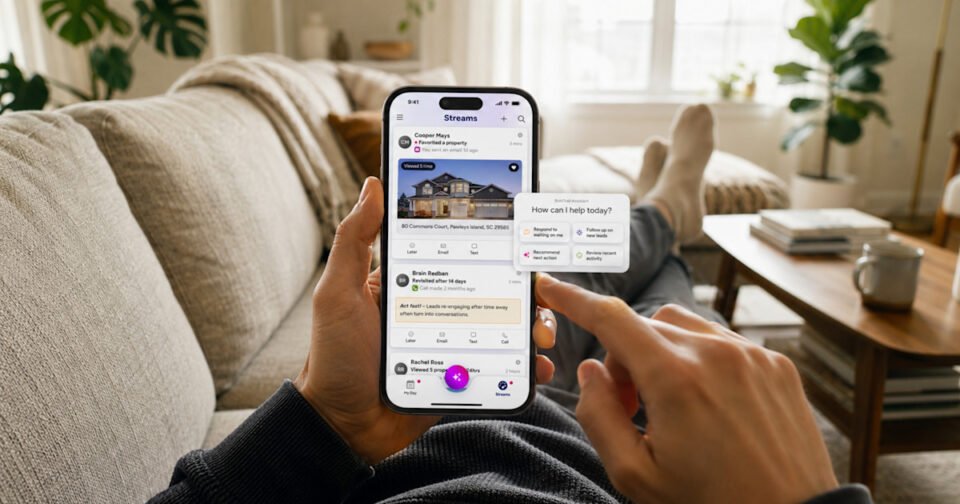
Enter Streams: More conversations. Higher productivity. Agents who actually use it.
I love this metaphor that my product team has been using: BoldTrail is the engine — all the power and intelligence running underneath. The orchestration layer where logic and data come together. Streams is the intelligent co-pilot.
Not a readout. Not a condensed version of the engine. A co-pilot that’s already read every signal before you even think to ask — the lead who favorited a property, the call you haven’t returned, the prospect who came back to the same listing after two weeks of silence. It doesn’t just surface that information. It tells you what it means and what to do about it. Right now, while you’re in the car between showings.
Ask “Who should I call today?” and it gives you names and context. Ask “Do I have any leads I should be following up with?” and it’s already done the thinking. With a word, you’re moving. No clicks, no scrolling, no logging back into a desktop to figure out where you left off.
When a call ends, the AI summarizes it, updates your CRM and drafts the follow-up text. The logging, the note-taking, the “I’ll update the CRM later” that never happens — it just goes away.
The proof.
The results have been pretty clear. Since its launch, Streams has hit 12,000 downloads in roughly two months, and agents are logging in twice a day on average — including agents who were only opening their CRM weekly or monthly before. In an industry where tools are often downloaded and never opened again, this is a totally different story.
Beyond downloads, agents using Streams send 2.6x more texts and make 3 to 10 times more calls than their non-Streams peers. Across every segment, highly engaged agents, mid-tier and lower-engaged agents who weren’t following up as consistently, productivity is up. For lower-engaged agents specifically, Streams is making them 2 to 6 times more productive. And agents have logged over 15,000 AI Assistant interactions in the first nine weeks alone. The tool is getting used, and it’s moving the needle across the board.
One beta user said it in a way that’s stuck with me: “My dream is to do as much of my job as possible without being tied to a computer. If this lets me actually work mobile, that’s a career-changer.”
That’s exactly what we are solving.
And we’re not done building. There’s a lot more coming to the Streams ecosystem, capabilities that are going to expand what agents can do from their phone in a pretty significant way. I’ll have more to say about that soon.
But what I want people to take away right now is this: If your agents aren’t using your CRM the way you hoped, the answer probably isn’t more training. It’s giving them a tool that fits how they actually work. That tool exists now.
To learn more visit BoldTrail.com/ai-advantage.