
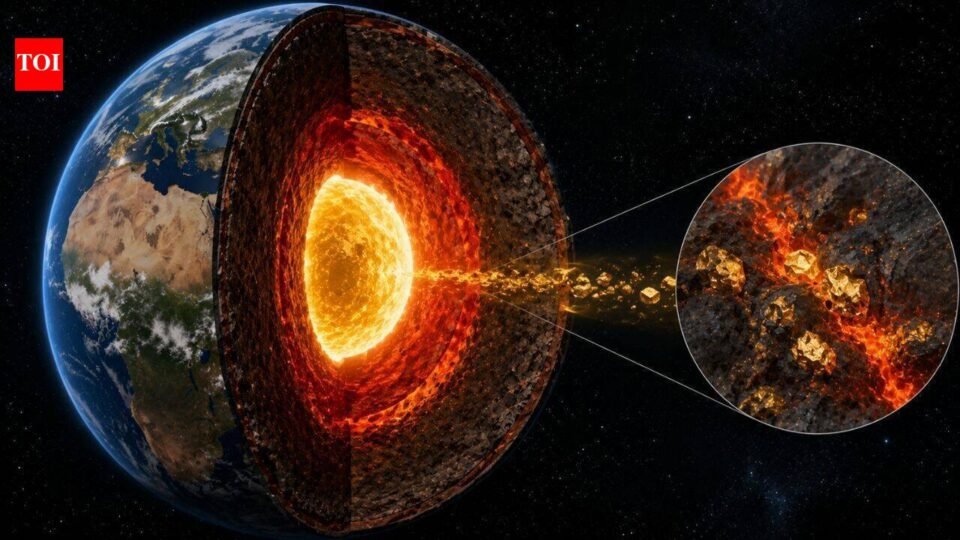
Earth’s core holds far more gold than anyone can reach. More than 99.999 per cent of the planet’s stores of gold and other precious metals lie buried under 3,000 kilometres of solid rock, locked away within the metallic core and far beyond the reach of humankind. For decades, geologists assumed this vast reserve was permanently sealed off from the rocky mantle above it, with no realistic pathway connecting the two. That assumption has now been challenged. Researchers at the University of Göttingen have found traces of the precious metal ruthenium in volcanic rocks from Hawaii that could only have originated in the core. According to the study published in the journal Nature in 2025 titled ‘Ru and W isotope systematics in ocean island basalts reveals core leakage’, the first clear isotopic evidence that material is genuinely crossing the core-mantle boundary, rather than simply being theorised about.
Why Earth’s core and mantle have different ruthenium isotopes
Compared with Earth’s rocky mantle, the metallic core contains a slightly higher abundance of a particular ruthenium isotope, known as 100Ru. This difference exists because part of the ruthenium that became locked into the core alongside gold and other precious metals when the planet formed, roughly 4.5 billion years ago, came from a different source than the small amount of ruthenium present in the mantle today. The mantle’s modern ruthenium budget was largely replenished later, through the addition of meteoritic material after the core had already finished forming, and that later material had a distinct isotopic fingerprint. As a result, the core and the mantle should carry subtly different ruthenium signatures if any exchange between the two ever took place.These isotopic differences are extremely small, and for a long time they were simply too fine to detect with the analytical tools available. According to the press release from the University of Göttingen, improved chemical purification and a redesigned distillation setup for isolating ruthenium from rock samples, that made it possible to resolve them with sufficient precision. The team, led by Nils Messling with senior author Matthias Willbold, examined ruthenium and tungsten isotope data from basalts and picrites collected in Hawaii, including material from Kilauea, Kama’ehuakanaloa and Kauai, alongside comparison samples from Baffin Island, Réunion and the Galápagos. Basalts and picrites from Hawaii consistently showed higher ε100Ru values than the surrounding upper mantle, and when this was combined with unradiogenic tungsten isotope ratios in the same rocks, the pattern was found to be diagnostic of a core contribution to their mantle source. Samples linked to the Réunion and Galápagos plumes, by contrast, were not clearly distinguishable from the composition of the modern upper mantle, and the Baffin Island average also remained unresolved from ordinary mantle values, showing that this signature is not present everywhere in equal strength.
How scientists confirmed that material from Earth’s core is reaching the mantle
The discovery came as a surprise even to the scientists directly involved in the analysis. Dr Nils Messling, of the university’s Department of Geochemistry and Isotope Geology, recalled that when the first results came in, the team realised they had literally struck gold, since their data confirmed that material from the core, including gold and other precious metals, is leaking into the Earth’s mantle above. The university’s account frames this as the first solid confirmation of a process that geologists had long suspected on theoretical grounds but had never previously been able to prove using direct chemical evidence from erupted rock.The scale of material movement involved is far larger than the faint ruthenium signal alone might suggest. Professor Matthias Willbold noted that the findings not only show the core is less isolated than previously assumed, but also demonstrate that huge volumes of super-heated mantle material, amounting to several hundred quadrillion metric tonnes of rock, originate at the core-mantle boundary and rise all the way to the surface to form ocean islands such as Hawaii. Messling has also stated that whether this leaking process has been active throughout Earth’s history, or is something that varies over geological time, remains an open question that the current findings cannot answer on their own.
Why this discovery does not mean Earth’s gold can be mined
The discovery does not translate into a new or accessible source of gold. Any core contribution reaching Hawaiian lava is minute by the time it appears in erupted rock, having been diluted through mixing with several other mantle reservoirs along the way. It establishes neither a uniform global leak affecting all mantle plumes equally, nor a fixed rate at which this exchange has occurred through geological time, since several of the plume sources tested, including those linked to Réunion and the Galápagos, showed no clearly resolvable core signature at all. This suggests the process may be uneven, or may simply be easier to detect in some volcanic systems than in others. Even with these limitations, the research is being treated as a significant step forward for understanding the deep Earth.