

Vietnam Aviation Law strengthens aircraft finance protections and opens clearer routes for airport investment, leasing, aviation services, and technology.
On 10 December 2025, Vietnam’s National Assembly adopted the Law on Civil Aviation of Vietnam No. 130/2025/QH15 (the 2025 Aviation Law), replacing the 2006 legislation. The Law took effect on 1 July 2026 and provides clearer legal foundations for aircraft financing, non-state airport investment, and cross-border aircraft operations.
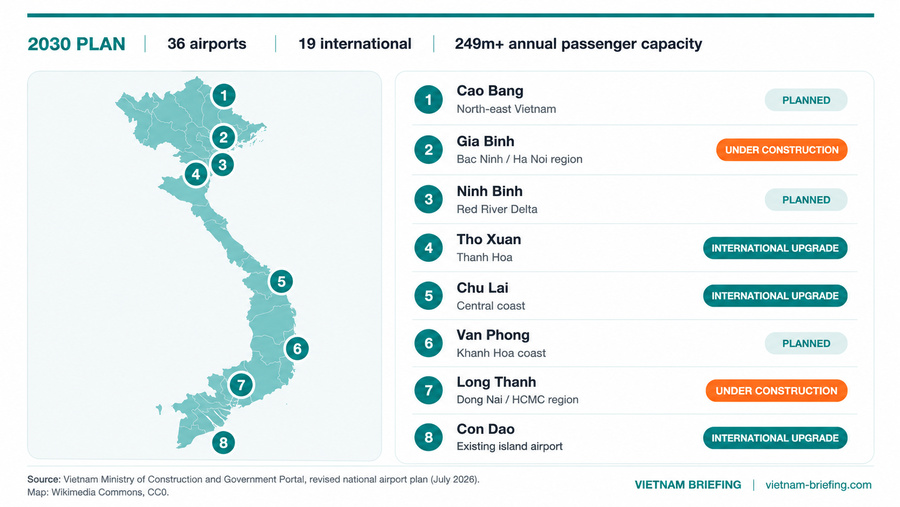
As part of a wider push to modernise its aviation sector, Vietnam has also revised its national airport plan. The plan targets a network of 36 airports with combined annual capacity of more than 249 million passengers by 2030 and an estimated investment requirement of VND 577.572 trillion (approximately US$22.2 billion).
The Civil Aviation Authority of Vietnam (CAAV) has estimated that Vietnam’s aviation market handled 83.5 million passengers and 1.5 million tonnes of cargo in 2025, up 10.7 per cent and 18.5 per cent year on year, respectively, demonstrating a growing industry with increasing opportunities for foreign investors.
The reforms define the routes available to foreign participants, including:
- Creditor remedies for aircraft finance;
- Public-private partnership (PPP) or business-investment models for airports;
- Service and infrastructure arrangements at airports; and
- Minority ownership in Vietnamese commercial airlines under the applicable licensing and ownership rules.
Explore Aviation Opportunities
Get business intelligence support to assess Vietnam’s aviation market, investment opportunities, and regulatory landscape.
Stronger protections for aircraft lessors and financiers
The 2025 Aviation Law strengthens the legal basis for creditor remedies by expressly recognising Irrevocable Deregistration and Export Request Authorisations (IDERAs) in primary legislation.
Article 21 of the 2025 Aviation Law allows CAAV to revoke an aircraft’s registration and airworthiness certificates and deregister it without prior approval from a Vietnamese court when implementing specified remedies for a registered IDERA holder. Article 15 also provides that an export certificate of airworthiness is not required when an aircraft is exported from Vietnam, unless an applicant requests one to satisfy the importing jurisdiction’s requirements.
To be noted is that Article 21 addresses deregistration, export, and inter-agency assistance; it does not itself prescribe the handover of possession or technical records or the settlement of local liabilities.
Vietnam’s Cape Town declarations preserve certain non-consensual interests and rights to arrest or detain aircraft for unpaid taxes, fees, or qualifying public services. Lessors and financiers should combine an IDERA with a Vietnam-specific enforcement plan covering these issues.
A clearer route for private airport investment
New regulatory framework
The 2025 Aviation Law provides a clearer statutory framework for attracting non-state capital into Vietnam’s airports:
- Article 5 – Investment principles: Promotes freedom of business, fair competition, protection of foreign investors’ lawful interests, and diversified investment forms.
- Article 30 – Investment forms and infrastructure: Allows investment through public-private partnerships or business investment, subject to market-access and investor-selection rules. Investors may also develop dual-use works and improve public airport assets without transferring land-use or asset ownership.
- Article 31 – Investment conditions and asset transfer: Requires consultation with the Ministry of National Defence and Ministry of Public Security before determining the investment form. For business-investment projects, aviation infrastructure assets must generally be transferred to the State at the end of the project term, with compensation based on their carrying value.
- Articles 33–34 – Operations and services: Allow airport enterprises to operate facilities, appoint operators, provide aviation and related services, and transfer certain service and infrastructure-use rights, creating opportunities for strategic investors, technology providers, and service operators.
National airport plan
Alongside these legal reforms, Vietnam’s revised national airport plan expands the country’s infrastructure pipeline
Compared with the 2023 plan’s 14 international airports, the revised plan lists 19 and adds Cao Bang, Gia Binh, Ninh Binh, Van Phong, and Con Dao to the international-airport network.
Foreign participation is already present in airport services with Saigon Cargo Service Corporation (SCSC) operating an international cargo terminal at Tan Son Nhat International Airport, reporting that foreign shareholders hold about 10 per cent of the company and that the terminal represents an investment of approximately US$50 million.
Aircraft operations, wet leasing, and ownership
Decree No. 208/2026/ND-CP introduces clearer requirements for fleet planning, aircraft leasing, and foreign ownership:
- Fleet planning: Article 27 requires Vietnamese air transport enterprises to notify the CAAV of annual fleet plans by 1 December of the preceding year and submit their first five-year plans within 60 days of the Decree taking effect. Amendments must be notified within 30 days.
- Aircraft leasing and acquisition: Article 28 requires CAAV approval before leased or purchased aircraft enter civil aviation operations. Delivery schedules should therefore account for both fleet-plan notifications and transaction approvals.
- Wet leasing: Article 26 permits AOC-holding airlines to wet lease up to 10 aircraft, with each aircraft leased from a foreign operator for no more than 12 consecutive months. This provides a temporary capacity solution for seasonal demand, maintenance, delivery delays, or other short-term gaps.
- Foreign operators: Article 41 of Decree No. 223/2026/ND-CP requires foreign operators conducting scheduled commercial air transport in Vietnam to obtain a foreign air operator certificate from the CAAV, following recognition of their home-state certificate.
- Foreign ownership: Article 7 of Decree No. 208 caps foreign ownership in Vietnamese commercial air transport enterprises at 34 per cent. At least one Vietnamese individual or entity must hold the largest interest; where that entity is foreign-invested, foreign capital may not exceed 49 per cent of its charter capital.
Opportunities in aviation services and technology
The 2025 Aviation Law identifies several areas as aviation-industry priorities, creating opportunities in:
- Manufacturing and MRO: Aircraft and component manufacturing, maintenance, repair, and overhaul.
- Technology: Aviation software, automation, artificial intelligence, and specialised materials.
- Skills development: Specialist workforce training and development programmes.
- Sustainable aviation fuel (SAF): Article 5 provides a policy basis for tax, credit, and land incentives covering SAF research, production, import, distribution, use, and supporting infrastructure, subject to applicable eligibility requirements.
Vietnam’s SAF market is also developing alongside international decarbonisation requirements. Vietnam Airlines reported using around 2,200 tonnes of neat SAF in 2025, while Vietnam joined the voluntary phase of CORSIA from 1 January 2026. This creates potential opportunities across the SAF value chain, including production, import, certification, storage, blending, distribution, and airport refuelling infrastructure.
Businesses can approach the reforms across three timelines:
- Act now – strengthen financing and fleet readiness: Lessors and financiers should accurately register international interests and IDERAs and update lease and enforcement documentation. Airlines should align fleet plans and deliveries with aircraft-introduction approvals, wet-lease limits, foreign operator certificate recognition, ownership restrictions, and operating licences.
- Build a qualified pipeline – screen projects before committing capital: Verify project status, investor eligibility, market-access conditions, investor selection, land and public-asset arrangements, security approvals, concession rights, revenue allocation, and asset-transfer terms. Link MRO, technology, training, and cargo opportunities to clear procurement needs and viable local operating models.
- Update the business case – monitor project-specific rules: For SAF and other aviation projects, track eligibility for tax, credit, and land incentives, alongside fuel certification and CORSIA requirements. Update investment models as applicable measures and counterparties are confirmed.
Outlook for aviation investment in Vietnam
The 2025 Aviation Law strengthens Vietnam’s legal and operating framework for aircraft finance, airport participation, and aviation services. Commercial outcomes will turn on implementation across project approvals, licensing procedures, and creditor remedies.
Investors that combine the new legal protections with careful transaction structuring and early regulatory engagement will be best placed to benefit as Vietnam expands its airports and supporting aviation industries.
About Us
Vietnam Briefing is one of five regional publications under the Asia Briefing brand. It is supported by Dezan Shira & Associates, a pan-Asia, multi-disciplinary professional services firm that assists foreign investors throughout Asia, including through offices in Hanoi, Ho Chi Minh City, and Da Nang in Vietnam. Dezan Shira & Associates also maintains offices or has alliance partners assisting foreign investors in China, Hong Kong SAR, Indonesia, Singapore, Malaysia, Mongolia, Dubai (UAE), Japan, South Korea, Nepal, The Philippines, Sri Lanka, Thailand, Italy, Germany, Bangladesh, Australia, United States, and United Kingdom and Ireland.