
Synopsis: The pact outlines a strategy to improve public spending and find new ways to mobilise investment capital, addressing Cambodia’s core economic and business development goals.
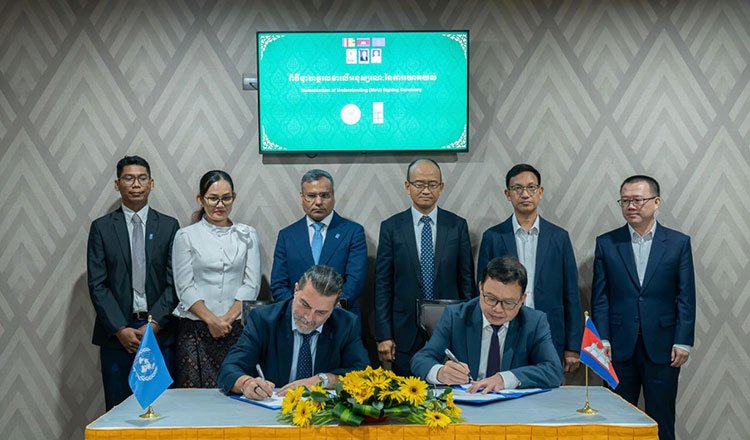
The Ministry of Economy and Finance (MEF) and United Nations Development Programme (UNDP) Wednesday signed a partnership agreement to support Cambodia’s development priorities and advance inclusive growth with a jointly-mobilised financing framework.
Ministry of Economy and Finance Secretary of State Ros Seilava and UNDP Cambodia Resident Representative Enrico Gaveglia presided over a signing ceremony on Wednesday at the Sun & Moon Riverside Hotel in Phnom Penh, which outlined areas of cooperation to facilitate the graduation from Least Developed Country (LDC) status in 2029, according to a Thursday news release from the UNDP.
The areas of cooperation include public financial management; private financing and investment; innovative financing solutions; strategic policy analysis and advisory; foresight and innovation; and social protection.
The pact marks the continued collaboration between Cambodia and the development arm of the UN, outlining key sectors where the parties will leverage financing improvements to boost livelihoods and raise incomes as the country advances towards higher-income status.
Gaveglia told Khmer Times in an emailed statement on Sunday that the LDC graduation represented a structural transition in Cambodia’s development model; established export sectors will be pressured by reduced preferential status, but opportunities will also arise to accelerate modernisation and diversification.
“UNDP is ready to work with MEF to strengthen the governance of this transition, including through economic diversification, deeper regional economic integration and stronger social protection, ensuring that Cambodia’s next phase of development is both more competitive and more inclusive,” Gaveglia said.
He added that the UNDP is utilising a future-ready governance approach to make strategic “big bets” on high-potential sectors, assessing their competitiveness and inclusive growth, while tackling the policy, institutional, investment and implementation constraints holding them back.
“Cambodia does not lack strategies. The challenge now is delivery: anticipating risks, prioritising opportunities, coordinating institutions and sustaining implementation,” he said.
The agreement outlines a plan to enhance budget formulation and the utilisation of public resources to more effectively address Cambodia’s development needs, which includes identifying ways to increase investment capital to support economic and business development.
With that, diverse financing mechanisms to support the country’s development priorities will be essential, utilising policy analysis and foresight to prepare for and respond to future challenges.
Furthermore, social protection systems to assist vulnerable populations will be boosted, promoting inclusive access to opportunities and social protection services.
UN Resident Coordinator Vladanka Andreeva, representatives of the European Union Delegation to Cambodia and officials from the Ministries of Planning, Mines and Energy, Civil Service, Interior, Rural Development and Foreign Affairs and International Cooperation, among others, attended the event.
Discussions centred on Cambodia’s preparations for its graduation from LDC status in 2029 and its longer-term ambition of achieving high-income status by 2050, as outlined in Vision 2050 and the Pentagonal Strategy.
The consultation forms part of the UNDP’s Building Opportunities for Leadership in Development (BOLD) programme under its regional Project Vision initiative.
Through BOLD, UNDP works with governments to apply strategic foresight and policy expertise to identify opportunities for long-term transformation and translate development priorities into practical solutions.