
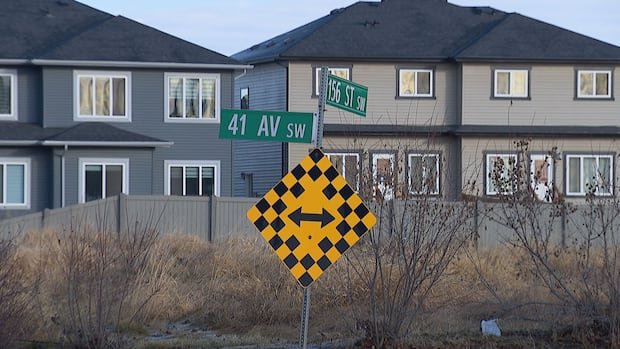
A collection of Edmonton organizations that advocate for real estate and development interests want city council to move swiftly to authorize planning for the lands south of 41st Avenue S.W.
The lands were annexed from Leduc County in 2019 and identified in Edmonton’s City Plan to accommodate future growth.
BILD Edmonton Metro (Building Industry and Land Development in the Edmonton Metropolitan Region) has joined with the Edmonton Chamber of Commerce and CREDA (Commercial Real Estate Development Association) Edmonton Region to make the pitch through a campaign launched on Thursday, saying they want city council to look at the matter in early 2027.
The call comes as city council considers Edmonton’s proposed 2027-2030 budget, including a proposed 4.9 per cent municipal property tax increase for 2027.
“As council considers the city’s budget and financial pressures, we need to look not only at where we can reduce costs, but also very importantly how Edmonton can generate more future revenue and economic activity,” Kalen Anderson, BILD Edmonton Metro’s CEO, said during a news conference held in Chappelle Gardens, on the southwestern outskirts of Edmonton.
“The lands [south of 41st Avenue] officially became part of Edmonton, effective Jan. 1, 2019. Yet the land inside the city’s boundary is not just automatically planned, serviced or ready to be built on because an annexation has occurred.
“Planning, infrastructure and completing approvals for an entirely new district of the city can take upwards of a decade.”

BILD Edmonton Metro CEO Kalen Anderson said she believes expanding the city will pay for itself. (Craig Ryan/CBC News)
BILD Edmonton Metro argues that expanding the city will pay for itself, citing its 2025 Urban Growth Case Study that found that newer Edmonton areas like Heritage Valley and Windermere generated more than $163 million in municipal property tax revenue in 2024, excluding provincial education taxes.
“At full buildout, the two areas are projected to accommodate approximately 171,000 residents and generate approximately $309 million annually in municipal property tax revenue, before the costs of providing services,” BILD Edmonton Metro said in a news release.
Anderson said she believes the two areas will also be “generating a $60-million annual surplus, which can be used to fund any number of other city services citywide.”
‘The costs start adding up for taxpayers’
Jacob Dawang is with Grow Together Edmonton, a group that advocates for increased density in existing neighbourhoods.
He said while there can be a significant tax infusion when a neighbourhood is created, those costs will ultimately add up.
“It’s really when it comes to the renewal cycles, the first, the second and the ongoing operational cost,” he told CBC News. “That’s where the bill comes due, and that’s where we see that the costs start adding up for taxpayers.
“When you build a road, it’s not just build and forget. It’s 25 years down the road when you have to renew it for the first time, …50 years down the road when you have to reconstruct it, that bill starts adding up, and that’s not looking at the alternatives.”
Further complicating matters, Dawang said, is the Alberta government’s recent directive to temporarily force Edmonton to restrict the growth of infill development and review its approach to infill going forward.
“The City Plan, which had years of engagement, said that with a population of two million, we are going to be building 50 per cent outwards and 50 per cent inwards,” he said.
“But the province’s latest moves to reverse [parts of] the zoning [bylaw] have completely thrown a wrench in that.”
Premier Danielle Smith previously said by asking Edmonton city council to repeal its zoning bylaw, her government is responding to residents who have complained about the character of their communities changing.
Councillor says moving outwards not sustainable
Ward Ipiihkoohkanipiaohtsi Coun. Jon Morgan, whose ward encompasses the lands south of 41st Avenue S.W., said he believes it’s important to take a holistic approach to growing Edmonton and its infrastructure.
“What we’re experiencing down there right now is a lot of pressure on that road network,” he told CBC News.
“We have people that are going into the farmlands south of 41st Avenue S.W. right now, trying to find ways in and out of the city, … creating a lot of challenges for the residents that live down that … [far] south.”

Ward Ipiihkoohkanipiaohtsi Coun. Jon Morgan, whose ward encompasses the lands south of 41st Avenue S.W., said he believes it is important to take a holistic approach to growing Edmonton and its infrastructure. (Tristan Mottershead/CBC News)
To tackle those challenges, Morgan said he believes it is important to combine different strategies.
“We have a lot of strategies around that: infill, creating density within the core, looking at Blatchford, looking at ways we can help build up the downtown as well,” he said.
“Part of our strategy to increase density where there’s already services in our established neighbourhoods is to make sure that we are sustainable long term as a city, and so, unfortunately, to keep moving outwards is not a sustainable path.”
Morgan said city council will review authorizing planning for the lands south of 41st Avenue S.W. in the first quarter of 2027.