

By Faisal Rashid Bhat
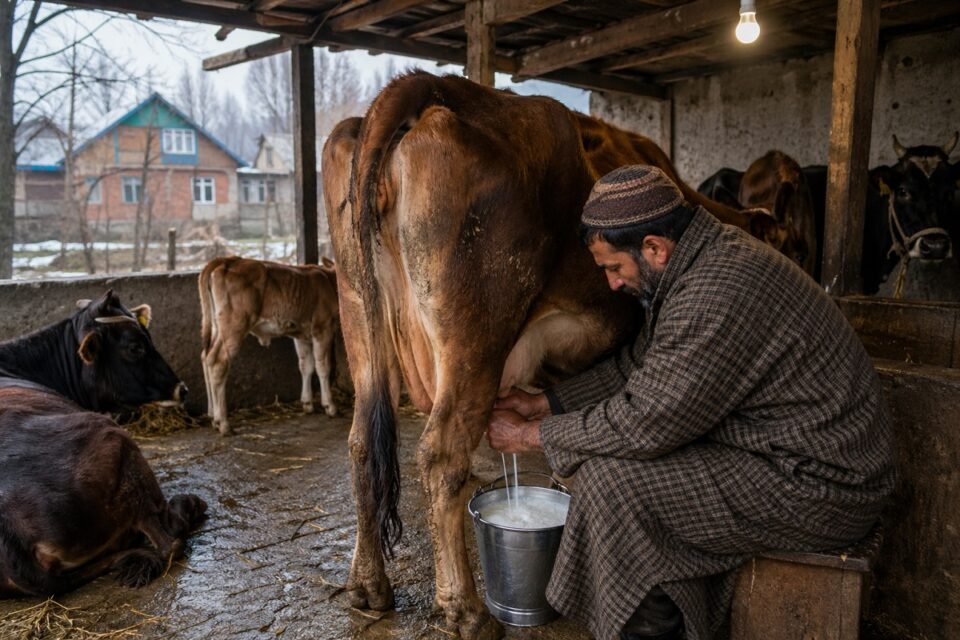
A pale bulb swings above a narrow shed on the edge of a village in south Kashmir’s Pulwama district. Steam rises from fresh dung on the floor. Metal buckets clatter against concrete as 42-year-old dairy farmer Ghulam Mohammad bends beside a brown Jersey cow and begins the morning milking.
Morning mist still grips the fields outside. His hands move quickly through work he learned as a child, work his father performed before him.
A tractor rattles somewhere in the dark, dogs bark near the road, and milk foams into the bucket in thick white streams.
“Every morning begins like this,” he said, stopping to scatter hay before another cow. “The animals eat before anyone in my family does.”
The shed holds seven cattle: two produce milk, one calf was born last winter, and another animal has stopped yielding after illness.
Each cow represents years of expense and constant attention. Veterinary visits, concentrated feed, fodder, medicines, shed repairs and winter heating absorb nearly every rupee that enters the household.
The dairy farmer’s earnings remain painfully thin.
Five litres of milk require nearly ₹165 in daily input costs, according to estimates shared by several dairy farmers in Tral and neighbouring villages. Concentrated feed alone consumes around ₹100. Green fodder and dry hay add another ₹60. Calcium and mineral supplements push the figure higher. Local buyers pay ₹40 per litre on most days, sometimes ₹45 when demand rises during wedding season or winter shortages.
Five litres sold at ₹40 bring ₹200. The farmer keeps roughly ₹35 after expenses.
A half-litre plastic bottle of packaged water in Srinagar often sells for ₹20.
The comparison surfaces repeatedly in discussions with dairy farmers across the valley. Many describe it with a mixture of disbelief and exhaustion.
Milk demands years of investment before a cow produces a return. Water arrives packaged, transported and chilled. Consumers purchase both daily, but markets value them very differently.
“This work fills every hour of your day,” said Abdul Rashid, a dairy farmer in nearby village who recently sold three cows after mounting debt. “People bargain over milk like it has little worth.”
Kashmir’s dairy sector supports thousands of rural households, especially in Pulwama, Budgam, Baramulla and Anantnag districts, where small family-run operations dominate production. Government figures estimate that the region still imports substantial quantities of milk and dairy products from outside Jammu and Kashmir to meet local demand. Agricultural economists say declining local production could deepen that dependence in the coming years.
Signs of strain already appear in villages where cattle sheds once stood full.
Young men who grew up feeding livestock now search for government jobs, drive taxis or leave for Gulf countries. Dairy farming gives long hours and narrow returns. Families who once kept six or seven cows now manage one or two.
Several farmers interviewed in Pulwama described borrowing money during winter months when fodder prices rise sharply and milk yields decline.
“The younger generation watches the numbers,” said Dr. Bashir Ahmad, a veterinary officer in South Kashmir. “They understand how much labour goes into one litre of milk. Many decide very early that they want another future.”
That calculation threatens more than household incomes.
Milk collection centers depend on regular rural supply. Local processing plants require raw milk from village producers to remain viable. Rural transport workers, fodder sellers, veterinary suppliers and seasonal labourers all rely on the dairy economy in varying degrees.
Agricultural researchers at Sher-e-Kashmir University of Agricultural Sciences and Technology have repeatedly pointed to dairy farming as a critical pillar of Kashmir’s rural economy because it provides year-round income in areas where crop cultivation remains seasonal.
Villages in the valley still revolve around milk in countless ways. Morning tea simmers in nearly every home before sunrise. Wedding feasts depend heavily on curd, ghee and cottage cheese. Religious gatherings and shrines distribute milk-based offerings throughout the year. Families purchase dairy products daily even when other household expenses tighten.
Farmers say the cultural importance of milk rarely translates into fair prices.
“Middlemen often collect milk directly from villages and transport it to urban markets where retail prices rise significantly,” says Khurshid Bhat, a dairy farmer from Tral. “Small producers possess little bargaining power because most operate independently and sell limited quantities.”
Several farmers in Pulwama said cooperative systems remain weak or inconsistent compared with states such as Gujarat, where organized dairy networks transformed village economies over decades.
Economists and agricultural planners point toward several possible interventions.
“Government-backed procurement systems could establish minimum support prices for milk during periods of market instability,” says Niyaz Malik, an executive in Srinagar-based milk distribution firm. “Expanded cold storage infrastructure would reduce spoilage losses that hit small farmers hardest during summer months. Mobile-based platforms linking consumers directly with village producers could reduce dependence on intermediaries.”
Officials within Jammu and Kashmir’s animal husbandry department have promoted breed improvement programs and fodder development schemes in recent years. Farmers acknowledge those efforts while describing a larger problem rooted in pricing.
“Production has improved,” said Mushtaq Ahmad, who owns four cows near Tral town. “Income has not improved.”
Morning light spreads slowly through the Pulwama village as schoolchildren begin walking along the road outside Ghulam Mohammad’s home. A milk can waits near the gate for collection. His wife washes feeding troughs while he prepares fodder for the afternoon cycle that will begin within hours.
The work leaves little room for rest.
His father spent four decades tending cattle in the same shed. Family photographs hang inside the house nearby, faded by damp winters and wood smoke.
One image shows a younger version of him standing beside a cow decorated with garlands during a village fair long ago.
He studies the animals carefully before leaving for breakfast. One cow nudges his shoulder impatiently, another lowers its head into fresh hay.
“These animals feed families,” he said. “People remember that only when the milk stops coming.”
- The writer hails from Tral, and is a published author.