
NEW SMYRNA BEACH, Fla. — The state of Florida produces more sugar than anywhere else in the country. The industry got its start in Florida in the late 1700s with early investors attracted to the state’s favorable climate and soil for planting and growing sugarcane.
“Historians believe that sugarcane originated in New Guinea thousands and thousands of years ago, but it eventually made its way along human migration routes from Asia to India to Europe, and then finally making its way to the Caribbean and Florida,” said DeBary Hall Historic Site Manager Tracy Mestre who has been teaching history to communities in Volusia County for nearly 25-years.
“Of course, the hot, humid climate here was perfect for growing those sugary stocks, and Florida has quite a history in the sugar industry with many of the mills being located right here in Volusia County,” Mestre continued.
Early investors believed Florida was the best place to set up plantations, but the industry relied entirely on enslaved people, forcing them to work in brutal, dangerous conditions.
“It was a long, arduous process with slaves spending hours in the field laboring and tending to these sugar cane stalks all year long — doing dangerous and physical work,” said Lisa Perez, the Education Coordinator for DeBary Hall Historic Site in Volusia County.
The Coquina Sugar Factory, part of the Cruger-dePeyster Plantation spanning 17-acres in New Smyrna Beach, was founded in 1800 and relied on forced labor for the nearly year-long process to turn sugarcane stalks into thick molasses and raw crystals.
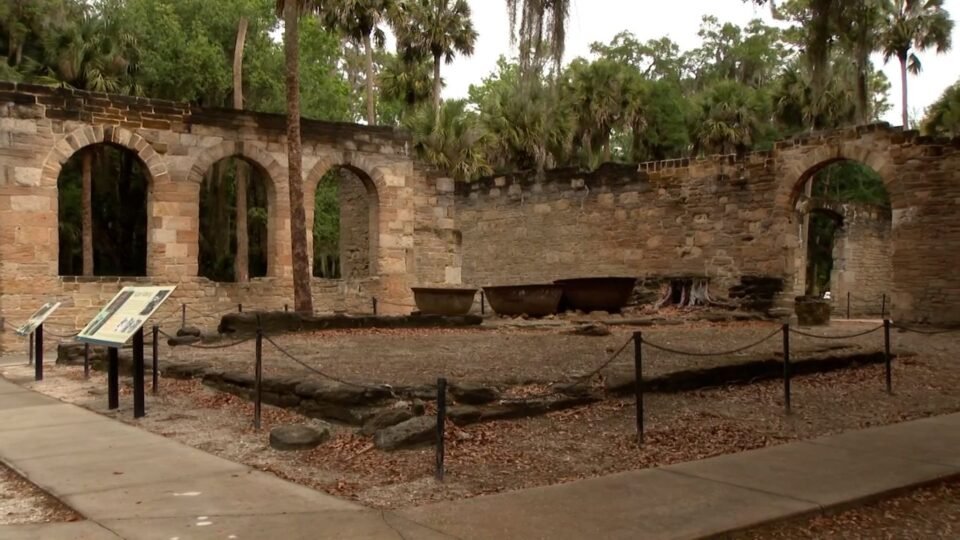
“A plantation would have to grow at least seven tons of sugar cane to yield one ton of sugar, so it was a lot of work for a very small result,” Perez continued while describing the process in front of the remnants of three cast iron kettles at the Sugar Mill Ruins.
“There are fires that are constantly being burned both with the cane crushing machine and here at these giant kettles. So, tending to those fires and keeping them going in Florida in this heat, and then lifting huge ladles that held eight gallons of liquid, which is equivalent to 85-pounds, along with planting, weeding and making sure that those sugar cane stocks have space,” said Perez.
Built on the backs of slaves, the operation failed five years after its founding in the Second Seminole War in 1835.
“The Cruger-dePeyster Mill did not get an opportunity to produce a lot of sugar, or pay back its investors, because in 1835, it was attacked and burned to the ground,” said Mestre.
Burned and broken, the coquina stone walls are still standing on the scarred grounds of the site, a silent testimony to the historical significance of the battle over territory.
“New Smyrna goes up in flames as the Native Americans set out to destroy the sugar industry, which they very rapidly did, and bring an end to Florida’s plantation era, which kicks off the Second Seminole War here in Florida in 1835,” said New Smyrna Museum of History Executive Director Greg Holbrook.
The war was triggered by two U.S. treaties that would force the Seminoles to abandon their Florida lands and move west.
“Chief Osceola, probably the one that we know the best, decides that is not going to be the case. They are not going to be moved west. Tensions are building as the clock runs out on the treaty’s three-year time frame that expires around December of 1835, and we believe it was either Christmas Eve or Christmas Day when New Smyrna was attacked here,” Holbrook continued.
Now known as the Sugar Mill Ruins, visitors take in the weight of what happened in New Smyrna Beach while observing and reading about the history.
“This New Smyrna area has been a magnet for the fascinated for a long time. People who just wanted to see and wanted to explore some of the old parts of Florida,” said Holbrook.
Educational markers detailing the history of the plantation and sugar production are installed throughout the historic site.
“It has become a favorite subject of painters and photographers and writers over the years,” Mestre continued.
Located off Mission Drive in New Smyrna Beach, the Sugar Mill Ruins historic site is open to the public seven days a week from sunrise to sunset with free admission.