
After years of hesitation, institutional and private wealth investors are returning to Asian alternative funds, broadening their strategies, demanding bespoke structures, more liquidity and pushing managers to build out permanent infrastructure across the region.
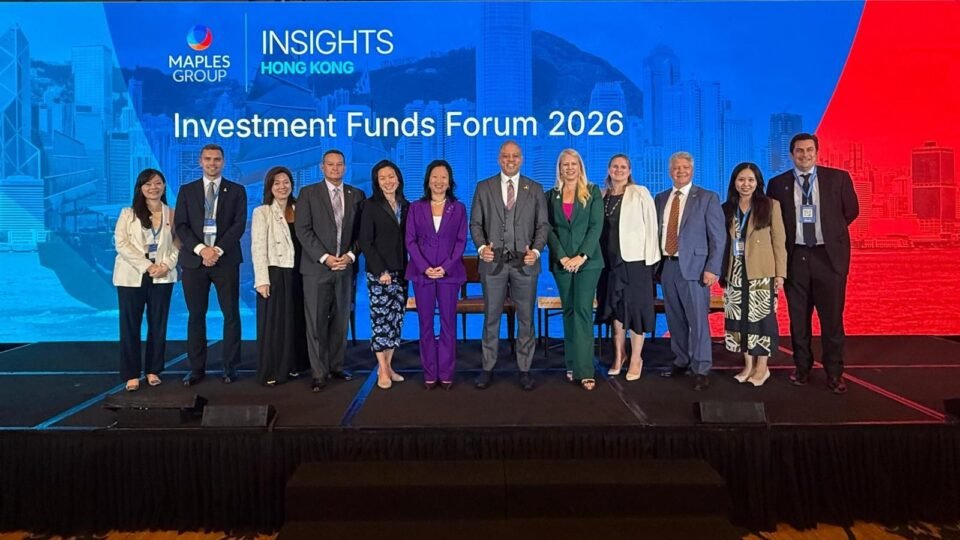
That was the message from practitioners at the Maples Group’s Hong Kong Investment Fund Forum on 7 May 2026. The forum brought together practitioners, fund managers, prime brokers, private wealth specialists and policymakers to assess where Asia’s investment funds industry stands and where it is heading.
Cayman Finance Director and Head of Funds and Capital Markets, Samantha Widmer, who attended the event said: “The Hong Kong Forum highlights that the Cayman Islands and the Asia-Pacific funds ecosystem are far more closely connected than geography might imply. As investment across Asia continues to expand in both scale and sophistication, the partnership between Cayman’s legal and regulatory framework and the managers, investors and service providers operating throughout the region is set to deepen even further.”
A renewed appetite for Asian alternative funds
It is believed that limited partners are approaching the region with greater purpose than in previous cycles. After a challenging stretch, Asian hedge funds recorded their first net inflows since 2022 in the first quarter of 2025, a turning point that has since translated into measurable momentum. Investors who had maintained a holding pattern are now actively re-engaging, and some who had exited the region entirely are looking to return. The key shift is in how investors want to access Asia. The traditional preference for long-biased, equity-focused exposures is giving way to demand for absolute return strategies, cross-asset approaches and even macro.
In private credit, the picture is similarly encouraging. There has been renewed interest from both US and European pension funds, as well as Asian insurers, seeking to diversify away from credit concentrations in their home markets. Increasingly, investors are looking not just for Asian credit exposure, but specifically for strategies covering defined sub-regions such as Japan and Australia. Mid-market lending to founder- and family-owned businesses, companies with decades of operating history, was highlighted as a particularly attractive pocket of the market, offering both healthy credit profiles and a meaningful yield premium.
Asia remains at an earlier stage in the credit cycle than Europe, and particularly the United States, where roughly 60–70% of private credit investments are currently concentrated. In relative terms, the US market is far more mature, with Europe sitting somewhere in between, while Asia is still in the early phases of development.
This gap in market maturity underscores a compelling structural opportunity for managers willing to commit the time and expertise, as Asia’s private credit landscape continues to evolve and deepen.
Meanwhile, private wealth appetite for alternatives has evolved significantly, with investors increasingly seeking structures that offer a clearer path to liquidity than traditional decade-long lockups with a more defined horizon for accessing their capital.
On Asia generally, in recent years global investors outside Asia have been primarily structuring their Asia exposure through Asian sleeves of global funds rather than dedicated Asia vehicles managed by Asia-based managers. That is now changing, with US and European investors returning to the region and expressing interest in dedicated Asia strategies and Asia-based managers.

Terms and structures
The evolving balance of power between managers and their investors is more nuanced for emerging managers when it comes to negotiating terms. While Asian hedge funds with strong performance records can command terms, early-stage managers are increasingly price takers.
Founder share classes, offering discounted management fees in exchange for longer lockups, remain a common tool to incentivise anchor allocators. Crucially, liquidity terms have come under far greater scrutiny than they were five years ago, when one-year and two-year hard lock structures could still attract institutional capital. Today, allocators closely examine whether the liquidity profile of a fund’s share class is genuinely matched by the liquidity of its underlying assets.
Separately managed accounts continue to be a feature of the landscape, giving larger allocators greater transparency and capital efficiency. Discussions cautioned managers to approach side-letter negotiations and most-favoured-nation clauses with care. The leverage that delivers a concession today can become a constraint on capital-raising years down the line. The discipline of thinking five years ahead, not just on service provider selection but on the terms being agreed with allocators, was a recurring theme.
Managers across strategies are also adapting to investor demands for greater transparency and more bespoke structures, though the practical responses vary considerably by fund type. For high-frequency, multi-strategy funds running thousands of positions daily, a full SMA is operationally impractical and fund-level risk reporting serves as the functional substitute. In private credit, where the asset-liability mismatch between investor liquidity expectations and underlying loan tenors is most acute, managers are proceeding cautiously. For single-asset co-investment vehicles, transparency is inherent but the obligation shifts to timely and honest valuation disclosure, particularly when portfolio companies raise new rounds or face impairment.
Private wealth has emerged as a growing channel for alternative fund managers. In the institutional world, manager quality accounts for the vast majority of the decision. In the private wealth space, roughly half the battle is reporting and valuation quality, marketing materials and operational support. Managers seeking to access this channel need dedicated resources with the largest fielding teams of between five and ten people in Asia at the smaller end, and up to twenty or thirty for the biggest platforms.
The growth of curated evergreen products offering exposure to multiple underlying funds through a single vehicle is reshaping how private wealth clients access alternatives. Cayman Islands fund structures feature prominently in this channel alongside Delaware and Luxembourg vehicles, reflecting the Cayman Islands’ established role as the default domicile for alternative fund managers operating across the region.


The expanding footprint: satellite offices and talent
More broadly, international managers are rapidly establishing or extending their physical presence in Asia. Where expansion into the region once meant adding a research outpost to a global platform, some managers, including newly launched funds, are now treating Asia not as a satellite but as a core part of their trading book and business. Strategies trading 40 to 50 per cent of their book in Asian markets need traders and analysts on the ground.
Hong Kong remains the dominant hub for hedge fund activity, though Singapore has established its own distinct role, particularly for managers with quantitative or South East Asia and South Asia strategies. Australia has seen rapid expansion, with some offices growing from a handful of employees to more than 100 in a short span. Japan presents a more measured picture, with research offices proliferating but fewer full dealing licences obtained in recent years.
Talent is a key factor in those expansions. For managers setting up a satellite office, identifying the right senior management, the responsible officers who will carry regulatory accountability, is the foundational challenge.
On the retention side, the competitive landscape for investment talent is intensifying. Compensation structures are growing more sophisticated: upfront guarantees, deferred compensation buyouts and profit-and-loss share arrangements with performance-linked slope accelerators are all in active use. Hong Kong is understood to be considering legislation that would extend carried interest tax concessions, currently applicable to private equity, to performance fees and potentially income attributable to fund performance in hedge funds. If enacted, that change could reshape employment structures across the industry.
Non-compensation benefits are also playing an increasingly meaningful role, particularly for younger talent. Employee development programmes, external speaker series, wellness provisions, philanthropy matching and flexible working arrangements featured among the tools managers are deploying to differentiate themselves in a competitive hiring market. Providing senior staff with optionality around where they are based, across the growing number of Asian office locations, was also cited as a meaningful factor in retaining portfolio managers weighing their options across platforms.
Artificial intelligence: from tool to infrastructure
Artificial intelligence is transforming every function of the investment management business. By 2026, the market is saying that any hedge fund that is not deploying some form of AI across its trade lifecycle will be firmly behind the competitive curve.
On the investment side, AI is compressing the research process, a function that historically consumed 60 to 70 per cent of a portfolio manager’s time, and enabling risk and stress-testing scenarios that previously took days to be completed in minutes. In portfolio construction, particularly for more systematic strategies, AI is beginning to serve as a genuine replacement for certain analytical functions rather than merely augmenting them.
The gains on the non-investment side of the business are, if anything, more immediately measurable. Triparty reconciliations across prime brokers, administrators and internal books, historically a significant operational burden, are being automated with meaningful time savings. Compliance surveillance, which was previously conducted on a sample basis, is increasingly becoming a continuous activity through the application of generative AI tools.
A practical challenge for managers, and one increasingly reflected in hiring requirements, is the protection of the proprietary AI infrastructure being built in-house. Centralised prompt libraries, curated internal databases and in-house testing protocols are becoming genuine IP assets, and managers are beginning to treat them as such.
Regulatory frameworks are beginning to keep pace. Both Hong Kong and Singapore have introduced AI governance guidance, requiring managers to have formal AI policies in place and imposing heightened review standards for AI used in investment decision-making. The market views the regulators’ approach as usefully front-footed without being prescriptive, though the full implications of evolving use cases remain to be worked through.