
(Bloomberg) — To see how Asian hedge funds got blindsided by the Iran war, look no further than Trivest Advisors Ltd.
Most Read from Bloomberg
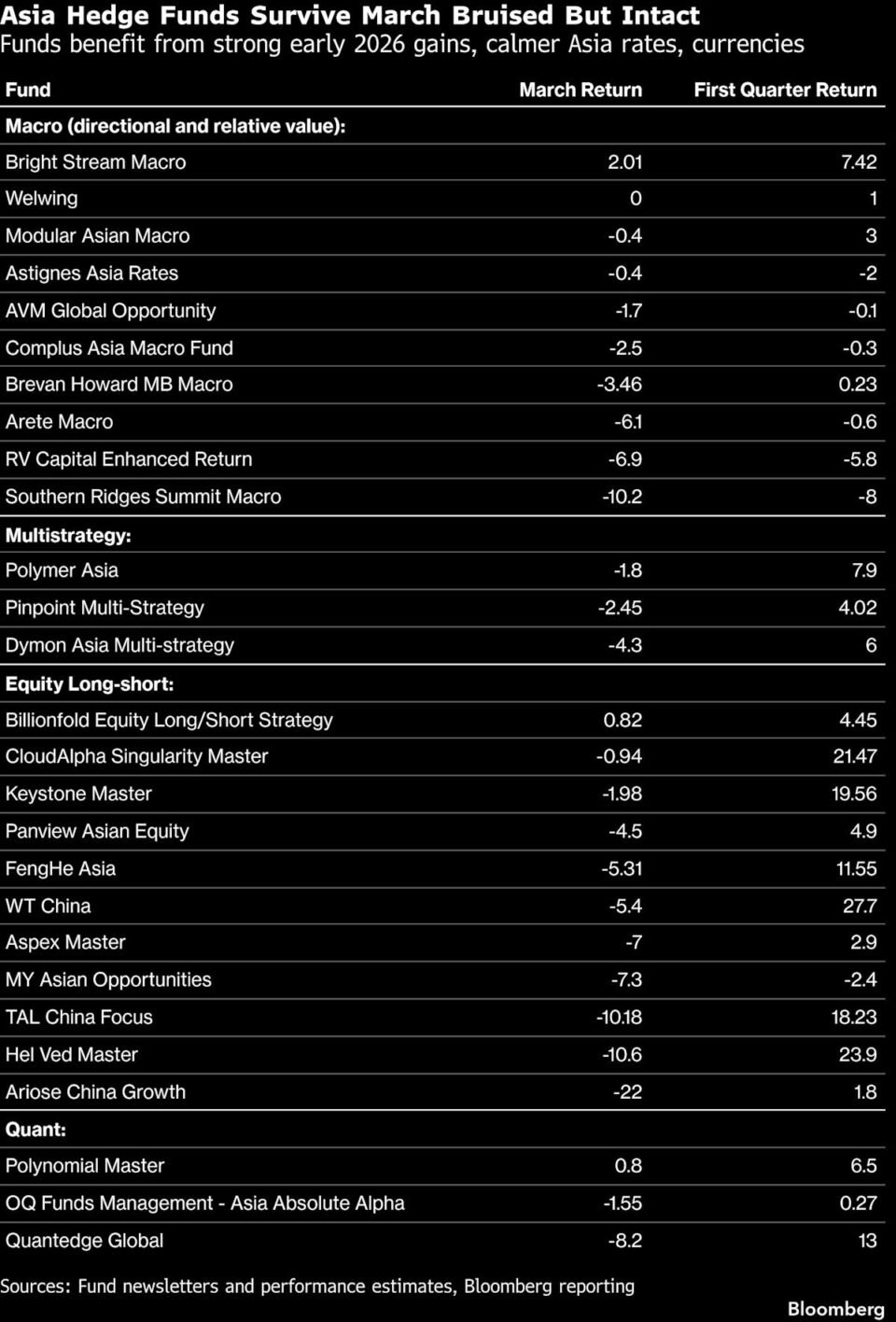
Through its almost 16 years of existence, the firm’s $5.4 billion TAL China Focus Fund has weathered the country’s stock market routs, geopolitical spats and handling of the pandemic — only to have its worst ever monthly loss in March, slumping 10.2%.
March “is likely to go down in history as one of the most challenging months for investors,” Trivest said in an update to clients. “Global markets have gone through an awfully painful pattern where risk-on and risk-off trades turned very wrong within hours as news of war escalation or ceasefire negotiations changed constantly.”
It wasn’t alone. Mohit Khurana’s $1.65 billion Southern Ridges Summit Macro Fund also tumbled 10.2%, the most since its October 2022 inception, it told investors. That was more than twice its August 2024 loss, the only other month in which it declined more than 1.5%. Hermes Li’s more than $14.5 billion Aspex hedge fund retreated 7% in March, said people with knowledge of the matter.
To varying degrees, most funds managed out of Asia were in the red in March, as the US-Israeli war against Iran escalated. The median stock hedge funds trading across the region or focusing on specific geographies lost anywhere from 4.5% to 6.2% during the month, while the median macro funds tapping broad trends across asset classes slid 6.9%, UBS Group AG prime brokers said in a note.
But the picture wasn’t all bad. For the most part, funds in Asia held up better than global peers during the month and the first quarter, having stayed out of the worst-hit wagers on European rates, with stronger performances in the first two months of the year as a cushion.
And with the ceasefire, Asian stock-picking hedge funds tracked by Goldman Sachs Group Inc. have already rebounded 8.9% this month through April 9, the bank said in a note. That erased much of the March fall and gave them on average a 15% return this year. The MSCI Asia Pacific Index of shares slid 13.4% in March, but has since recouped most of those losses, even as investors grapple with ongoing confusion over the state of the conflict.
March saw popular rates, currencies, equities and commodities wagers upended after the war disrupted oil and gas supplies and stoked fears of inflation and an economic slowdown. Stock investors shifted toward energy and utility companies, as the prospects of tighter financial conditions clouded the outlook for previously red-hot technology bets.