
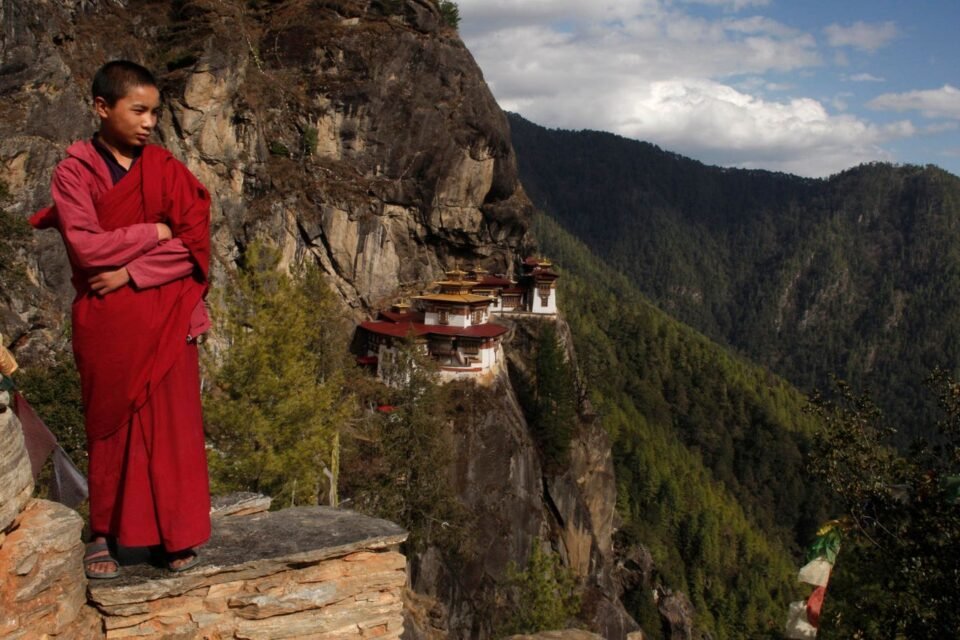

PARO, BHUTAN – APRIL 3: Dorji,17, takes in the views after walking from the Taktshang monastery (also known as Tiger’s Nest ) April 3, 2008 outside of Paro, Bhutan. Dorji is one of a handful of monks living at one of the most sacred monasteries in Bhutan, a two hour walk from the road, at around 3,000 metres high. Mahayana Buddhism is the state religion, although in the southern areas many citizens openly practice Hinduism. Monks join the monastery at six to nine years of age and according to tradition many families will send one son into the monkhood. They learn to read chhokey, the language of the ancient sacred texts, as well as Dzongkha and English. A new era of democracy is being ushered into the tiny Himalayan nation after the country held a successful national elections ending a century of rule by absolute monarchy. (Photo by Paula Bronstein/Getty Images)
Getty Images
“For things that you don’t know how to do, you choose to avoid.”
That is how Zheng YD explains why crypto companies keep getting debanked. YD runs DK Bank, the only licensed bank inside Bhutan’s new Gelephu Mindfulness City. He has built it to do the thing other banks avoid.
“Crypto is quite an underserved segment in terms of banking services,” YD said on the On The Margin podcast. “And there’s a reason for being so, because it started from a decentralized kind of protocol, it’s anonymous, so the banking industry doesn’t really know how to do the risk management of the crypto industries and a lot of them still don’t know.”
DK Bank is jointly regulated by Bhutan’s Royal Monetary Authority. It sits at the center of an unlikely experiment. Bhutan is a Himalayan kingdom of under a million people, better known for measuring gross national happiness than GDP. Gelephu Mindfulness City, or GMC, is a special administrative region in the south of the country, and its backers say it runs on its own rules.
“We have executive, legislative, judicial autonomy from the rest of Bhutan,” said Jigdrel Singay, who sits on the board of the Gelephu Mindfulness City Authority and helps lead its fintech push. He calls the model “two system, one country.”
The market he is chasing is large and unserved. “South Asia, which has about two billion people, does not have a financial services jurisdiction, a gateway so to speak,” Singay said. He wants GMC to be for South Asia what Hong Kong is to China, or Singapore to Southeast Asia.
A bank that holds dollars and stablecoins in one account
DK Bank’s pitch is narrow. Most banks that call themselves crypto-friendly only tolerate the cash side of a crypto business, YD says. The digital assets have to live somewhere else.
“All they say is I’m not going to stop banking you because you are a crypto business. But all your crypto flows don’t come to the bank,” YD said. “We want to be different. We want to integrate fiat and crypto together. We want to provide you a multi-currency account and custodian services for crypto. So we want you to manage your USDT, USDC, just like you manage your US dollar and pound and euro. In one bank account.”
According to materials shared by the project, that account spans nine currencies and includes bitcoin-backed lending and fiat-to-crypto on and off-ramps. The hard part is the plumbing. A traditional bank runs on “batch processing nine to five weekdays,” YD said, and “crypto is 24/7 real time.” Running both at once is, in his words, “a tough technology upgrade that we need to do.”
The other hard part is keeping the bad actors out, and YD is careful not to pretend they do not exist. “Now we are not saying the entire, there’s no bad guy in the crypto industry. Obviously any industry will have a certain percentage of bad blood,” he said. “So GMCA and DK Bank, we’re working together, we’ll try to be able to screen out those people at the initial stage.” That screening runs after onboarding too. “We’re not looking at just the off-chain flows, we also look at on-chain flows. We scan the wallet, we look at your incoming transactions, outgoing transactions, who you send to,” he said.
He thinks the whole bet is worth it because of where he expects money to go. “We believe the world financial services are gradually migrating from off-chain to on-chain,” YD said. “We want to be the most ready bank to prepare for that revolution to happen.”
Borrowing Singapore’s law, fast-tracking the license
GMC did not write its own rulebook. “In terms of corporate governance matters, we’ve adopted Singapore common law. And for financial services regime, we’ve adopted Abu Dhabi Global Markets,” Singay said. “And why these two is because we felt that these are best in class and it’s also highly recognizable by global investors.” Firms already licensed in Singapore, ADGM or Hong Kong can use a fast-track pathway instead of starting over.
The worry with any shortcut is what it lets in. Singay says the speed is procedural. “The accelerated process does not equate to reducing oversight,” he said. Companies that want the tax treatment, which the project describes as up to zero percent corporate tax, have to prove they are real. “We don’t want empty offices and businesses just incorporating here,” Singay said. “They have to be able to demonstrate certain principles, proving economic substance. For example, they have to hire local Bhutanese, they have to set up a physical office, and they have to demonstrate that they’re spending money to run their day to day operations.” Key positions, he added, have to pass the regulator’s “fit and proper tests.”
Why small countries are building this now
Bhutan is not the only small state reaching this conclusion. Xin Yan, chief executive of the sovereign-infrastructure firm Sign, spent two years moving from selling to crypto users to selling to governments, and he names Bhutan among the states he works with.
“Government is actually the gatekeeper of the real world,” Xin said on the On The Margin podcast. “They gatekeep all the users, all the data, and all the assets.” He says they are also unsentimental about it. “Government are very practical. They wouldn’t get high because you talk about Bitcoin crypto,” he said. “They need their problem to be solved and that’s all.” The problem he points to is dependence. “US and China build infrastructures for most of the countries,” Xin said. “There’s only two countries doing this. So like if there’s two countries don’t like you, they can remove everything from you.”
Neo, who runs the Swiss-regulated on-chain neobank UR, is blunt about how shallow most of this can be. “Everyone’s taking the easy way out in Web 3, Web 2 world today. Easy USDC stable coins, you issue a card, suddenly you’re NEO Bank and you can spend, and it’s very cool,” he said on the same podcast. “But structurally at its core, nothing’s really changing.”
In Neo’s own bank, the regulator reads the chain, not the paperwork. “That’s how FINMA audits, regulates the entity,” he said of Switzerland’s financial watchdog. “They read the blockchain to see different wallet addresses, how much money is in as it’s moved over the quarter. And that’s how they say, okay, you’re free to operate in the next quarter.” YD says DK does its own version of this, watching on-chain wallet flows next to fiat to “keep the entire jurisdiction safe.”
Mining since 2018, and hedging the bitcoin bet
This did not start overnight. Bhutan has mined bitcoin with hydropower for years. Singay dates it to 2018, and YD describes “nationwide Bitcoin mining since 2019,” adding that “the country has been familiar with the ecosystem long before maybe many jurisdictions have been even aware of such things like Bitcoin.” Singay calls it patience. “Our record speaks for ourselves,” he said. “We were early pioneers in the space.”
Neither man wants to bet the country on one asset. Asked whether Bhutan would launch a token like a Trump-branded coin, Singay pointed instead to what he calls the institutional stack: mining, custody, asset management, prime brokerage. “The retail speculative side is something that maybe we, GMC at least, will not actively engage in,” he said.
YD, asked what happens if bitcoin falls and never recovers, answers like the banker he is. “As a banker you always think the other side of the coin on the risk management side. So anything technically is possible,” he said. “So yeah, Bitcoin can go down tremendously and what will happen?” His insurance is to not depend on it. “A blockchain is a technology. Bitcoin is an application of blockchain,” he said. “We are very big on Bitcoin, but we will also want to be big on other things on the blockchain,” naming stablecoins and real-world asset tokenization.
Then there is the timeline. The international airport Singay calls “super critical” for bringing the world to Gelephu, master-planned by Bjarke Ingels’ studio BIG and, Singay says, set to be managed by Singapore’s Changi, is not due until December 2029. The digital-nomad visa for young remote workers is, in YD’s words, “still in testing phase.” For now the greenfield city, with its promise of harmony with nature, zero income tax for foreigners and rents YD pegs at “four or five hundred US dollars a month,” is mostly a master plan and a bank.
Whether the bank matters turns on a bigger question, one other operators in the space are already answering for themselves. Wojciech Kaszycki, founder of the digital-asset firm Mobilum, makes the broad case for sovereign crypto infrastructure. “I believe that every country should have its own digital asset treasury company,” he said on the On The Margin podcast.
YD, a foreigner himself, makes the softer version of the case with a small story. “When I first go to Bhutan, the country has only one traffic light in the capital city,” he said. “It has only one traffic light, not because the city is not crowded. The city has plenty of cars, but it doesn’t need traffic lights to divert traffic because people are so socially active and very, very polite. So you go one car the other way and there’s no honking, nothing. Everybody waits patiently if there’s a jam. And I think in this more and more chaotic world, this kind of mindset is very, very much needed globally.” Bhutan mined its first bitcoin while most governments ignored the technology. Now it wants to run the bank too.