

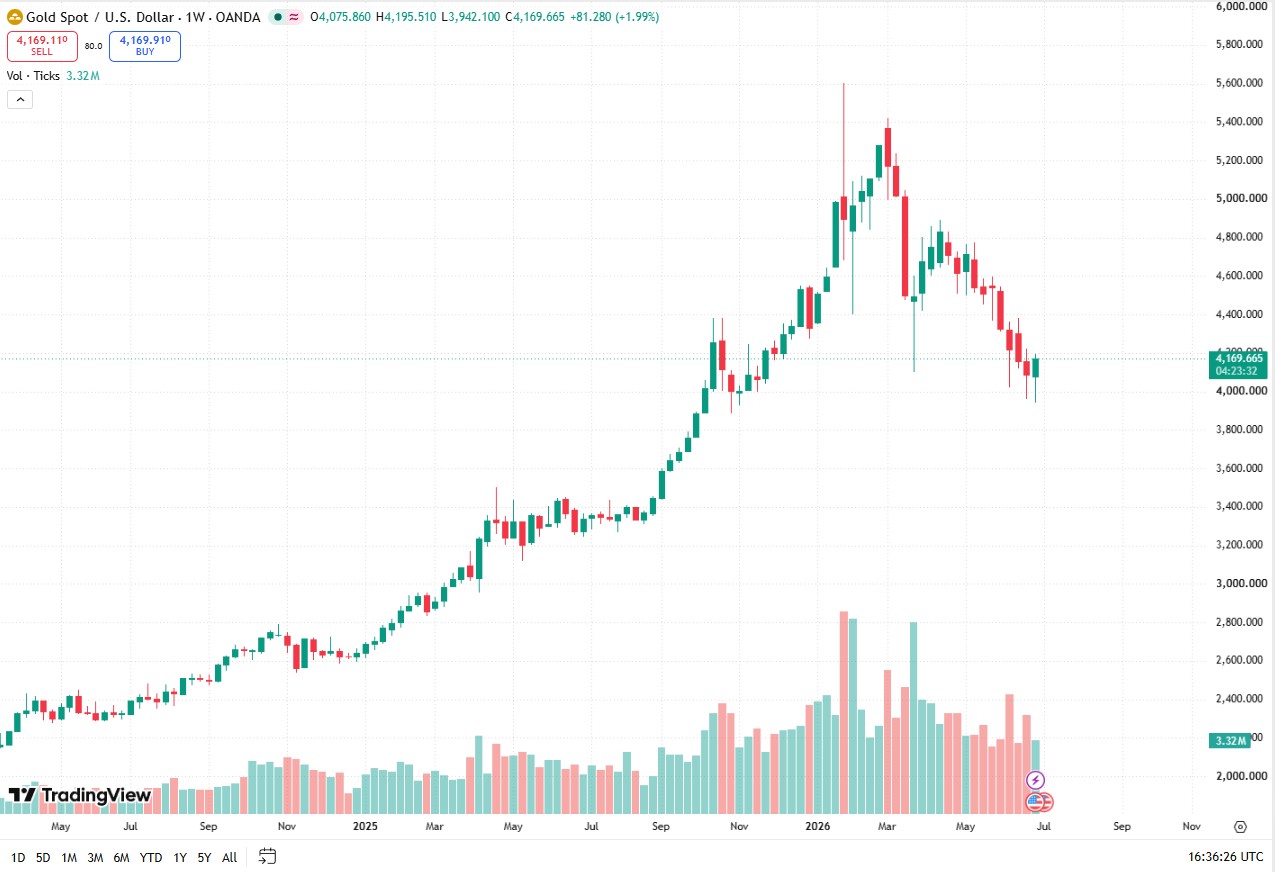
Tradingkey – Following the release of the U.S. non-farm payroll data for June, gold prices ( XAUUSD) strengthened once again, rising to as high as $4,195.48 and nearing the $4,200 mark, on track to record its first weekly gain in nearly a month.
Overall gold prices have trended softer so far this year. With inflation concerns lingering and the U.S. dollar remaining strong, coupled with major global central banks turning hawkish after the U.S.-Iran conflict, a combination of negative factors has significantly weakened market demand for gold as a traditional safe-haven asset.
The current rise in gold prices was primarily driven by two labor market reports that fell short of expectations. Data showed that U.S. non-farm payrolls increased by 57,000 in June, significantly below the market expectation of 113,000. Similarly, the ADP report also missed expectations, showing that private sector employment grew by 98,000 in June, below the market forecast of 118,000 and marking the smallest increase since March.
The two employment reports, both weaker than market expectations, have fueled concerns over a cooling labor market.
According to CME FedWatch data, prior to the release of the non-farm payroll report, the market priced in an approximately 65% probability of a rate hike in September, which dropped to around 50% after the report was published.
Market analysis suggests that the weaker-than-expected non-farm payroll data has significantly narrowed the tail risk of the Federal Reserve releasing further hawkish signals. If subsequent U.S. fundamental data continues to drive real interest rates lower and limit the upside for the U.S. dollar index, gold prices are expected to sustain their current rebound. For gold to embark on a more sustainable rally, a further significant decline in U.S. real interest rates, stabilization in demand from gold ETFs and other investors, and less hawkish rhetoric from the Federal Reserve would be required.
Gold-concept stocks refer to shares issued by listed companies whose core businesses are related to the gold industry chain. Their business scope covers physical industrial stages such as gold exploration, mining, smelting, processing, and terminal retail, as well as derivative sectors like gold investment and gold-related financial services. The earnings elasticity and stock price movements of companies in this sector typically show a significant positive correlation with spot gold prices.
|
Name |
Ticker |
Market Cap ($ Billion) |
Core Business & Features |
|
Newmont |
1,036 |
One of the world’s largest gold producers and a leading US domestic player. It also produces copper, with assets spanning North America, South America, Australia, and Africa, leading the industry in production and reserves. |
|
|
Agnico Eagle |
769 |
A top Canadian gold miner focusing on low political risk jurisdictions (Canada, Finland, Mexico), characterized by stable operations and excellent cost control. |
|
|
Barrick Mining |
640 |
A leading global gold producer, standing alongside Newmont as one of the industry’s giants, with operations spanning North America, South America, Africa, and Australia, owning multiple world-class gold mines. |
|
|
AngloGold Ashanti |
428 |
Core mines include Obuasi in Ghana and Geita in Tanzania, with assets distributed across Africa, the Americas, and Australia, making it a leading multinational gold producer. |
|
|
Gold Fields |
317 |
Core mines are located in South Africa, Ghana, Australia, Peru, and Chile. |
|
|
Kinross Gold |
295 |
Core operations are located in the United States, Brazil, Mauritania (Africa), Chile, and Canada. |
Gold-related ETFs are divided into gold ETFs and gold miners ETFs. The difference between the two is that the former tracks physical gold bars or gold futures, closely mirroring gold price movements, with mainstream products pegged to the London gold fixing price. The latter tracks the stock prices of gold mining companies; although its returns are positively correlated with gold prices, they are also influenced by multiple factors such as corporate operations and market sentiment. Consequently, its volatility is much higher than that of gold ETFs, offering higher elasticity during gold price uptrends and sharper drawdowns during downturns.
|
Category |
Ticker / Full Name |
AUM ($ Billion) |
Total Expense Ratio |
YTD Decline |
|
Gold ETF |
(SPDR Gold Shares) |
1329.91 |
0.40% |
5.06% |
|
(iShares Gold Trust) |
614.72 |
0.25% |
4.97% |
|
|
(SPDR Gold MiniShares Trust) |
279.1 |
0.10% |
4.90% |
|
|
Gold Miners ETF |
(VanEck Gold Miners ETF) |
236.97 |
0.51% |
8.52% |
|
(VanEck Junior Gold Miners ETF) |
73.88 |
0.52% |
9.09% |
|
|
(Direxion Daily Gold Miners Index Bull 2X Shares) |
9.29 |
1.18% |
31.25% |
As shown in the table above, the year-to-date declines of Gold ETFs over the past 26 weeks are all smaller than those of Gold Miners ETFs, which is broadly in line with the trend of gold prices (gold fell 3.77% during the period).
[Source: TradingView]
In terms of target audience, Gold ETFs are suitable for conservative investors seeking long-term gold allocation primarily to hedge against inflation and avert risk; Gold Miners ETFs are more suitable for short-to-medium-term traders with high risk tolerance looking to capture highly elastic gains from rising gold prices, and are not suitable for those who simply seek long-term gold allocation.
Gold prices have experienced volatile adjustments recently, leading to a noticeable divergence in how major global institutions assess its future trajectory.
The core views of major institutions are as follows:
UBS: In the short term, gold prices are highly likely to fluctuate repeatedly within the $3,850 to $4,000 per ounce range. The bank pointed out that the continuous rise in real U.S. Treasury yields and the sustained strength of the U.S. dollar will continue to weaken the attractiveness of precious metals allocations, suppressing the strength of any rebound in gold prices. However, it remains optimistic about the medium-to-long-term trend of gold, forecasting that the gold price is expected to rise to $5,200 per ounce over the next 12 months. It notes that the current low point is a suitable window for investors with insufficient gold allocations to increase their holdings in batches.
Citi: The bank set its 3-month gold target price at $4,500, viewing the previous decline as a “price reset” rather than the end of the bull market, and maintained its bullish 6-to-12-month forecast of $5,000.
Deutsche Bank: The bank forecasts gold prices to be $4,300 per ounce in the third quarter, with a fourth-quarter target price of $4,800 per ounce. While the target prices remain above current levels—indicating that gold prices are still expected to rise—the bullish momentum has weakened compared to before. Meanwhile, the bank warned of downside risks, noting that if the Federal Reserve raises interest rates three to four times, gold prices could fall to $3,800 per ounce.
Goldman Sachs: The bank expects gold prices to reach $4,900 per ounce by the end of 2026, explicitly stating that the gold bull market is not yet over and that there is still room for further gains. Long-term structural supporting factors combined with cyclical market trends will jointly drive the rally. In the short term, the Federal Reserve’s hawkish stance has diluted currency depreciation concerns, and combined with rising rate hike expectations, this will suppress interest-rate-sensitive gold ETF buying, constituting a cyclical headwind. However, these negative factors are expected to be at least partially alleviated over time.
World Gold Council: Gold prices are not without opportunities to re-enter an upward channel, but this will require clear and sufficiently strong positive catalysts. The core focus lies in three areas: either a continuous deterioration in the economic or geopolitical situation sparks safe-haven sentiment; market rate cut expectations completely reverse while rate hike expectations cool down significantly; or long-term allocation capital continuously enters the market to provide structural support.
Overall, in the short term, the market is generally under pressure from rising U.S. Treasury yields and a strong U.S. dollar, with most institutions judging that gold prices will remain range-bound. In the medium to long term, structural support from central bank gold purchases and allocation demand remains intact, and most institutions still maintain bullish expectations; however, some have significantly revised down their target prices, indicating that the market consensus on the pace and room for growth has somewhat loosened. For gold prices to re-enter an upward channel, they will require three types of clear, positive catalysts: safe-haven sentiment, a shift in policy expectations, or inflows of long-term capital.
This content was translated using AI and reviewed for clarity. It is for informational purposes only.