
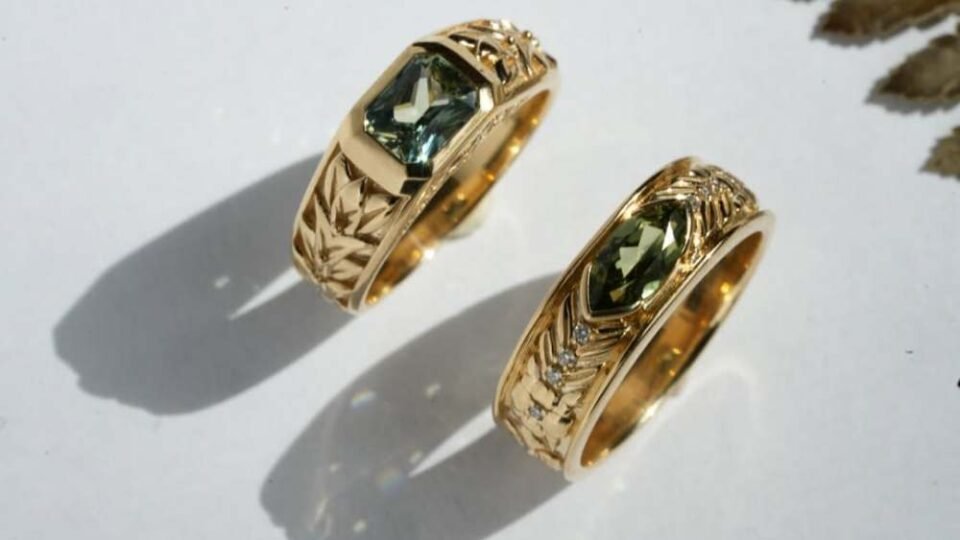
Modern engagement rings are breaking free from tradition. From colorful gemstones and chunky gold bands to east-west settings and sculptural silhouettes, couples are moving away from the conventional one-size-fits-all engagement ring in favor of unique designs that reflect personal style and identity.
While the shift has been amplified by the rise of lab-grown diamonds and celebrity influence, many of the aesthetics now gaining traction in the mainstream bridal market were being explored years earlier by queer couples and queer-owned jewelry brands operating outside traditional industry norms.
What was once a niche approach to engagement rings — defined by fluidity, experimentation and a rejection of preset rules — has become increasingly visible across the category. As personalization becomes a central driver, elements long associated with queer design perspectives, from gender-neutral silhouettes to alternative center stones, are now moving into the wider commercial market.
For queer jewelers working in the space, the shift reflects a reality that has long existed for queer consumers.

Venus The Vulcan Ring featuring a chunky yellow gold ribbed band.
“The fine jewelry space is historically very traditional, and trends move much more slowly than they do in the apparel world,” said Ashley McGinty, founder and designer of Chouette Designs. “However, the queer consumer is usually at the forefront of those trends.”
For many queer couples, engagement rings were never bound by the same expectations that have traditionally shaped the bridal jewelry market. Rather than following a predetermined formula of a solitaire diamond and a simple wedding band, LGBTQIA+ consumers often approached the process with a different set of questions: Should both partners wear engagement rings? Should the design feel masculine, feminine or neither? Does it reflect the wearer’s identity and style?
“The industry ran on a narrow script for a long time,” Kris Harvey, founder and creative director of Kris Averi, said to WWD. “Queer couples come to the table without that pre-written script, so the whole process becomes intentional rather than inherited.”

Kris Averi Salt and Pepper Diamond Signet
Courtesy Kris Averi
That freedom has helped fuel demand for more innovative designs. McGinty said many of the styles now gaining broader visibility — salt-and-pepper diamonds, hexagon and kite-cut stones, Montana sapphires and heavier gold settings — were already in demand with her clients years before appearing in larger retail assortments. “Things my customers were asking for when we launched in 2021 are now slowly finding their way into bigger box stores,” she said.
As queer-owned jewelry brands continue to gain visibility, their influence is extending throughout the broader market. Brands such as Venus, which coordinates engagement rings for lesbian couples, and trans-owned jeweler Automic Gold, known for gender-free designs created by nonbinary designers, have helped expand definitions of engagement jewelry beyond traditional masculine-feminine codes. While their approaches differ, both prioritize design driven by the wearer rather than preset conventions.
The same shift is evident in the growing popularity of alternative center stones. While sapphires, emeralds and rubies have long dominated the colored gemstone category, consumers are turning to spinel, alexandrite, tourmaline and parti sapphires.
Above all, customization has become the most defining force in engagement jewelry. Rather than selecting from preset styles, many clients now co-create rings from scratch. Nearly every commission for Harvey involves some level of personalization, from unusual stone cuts and mixed metals to heirloom redesigns and hidden symbolic details.
The result is jewelry that feels meaningful rather than formulaic. Hidden birthstones, sentimental engravings, inherited gemstones and custom motifs have become popular as couples seek pieces that function less as status symbols and more as personal heirlooms.
Gender-neutral designs have emerged as one of the category’s fastest-growing segments, with consumers embracing wider bands, signet-inspired silhouettes, bezel settings and designs that blend traditionally masculine and feminine elements. Many shoppers are also moving beyond the classic round brilliant diamond in favor of geometric cuts, elongated shapes and unconventional settings.
Nature-inspired designs are gaining momentum as well. Harvey points to growing interest in floral motifs, vines, leaves, celestial imagery and Gothic-romantic details such as cathedral-inspired settings and thorn-like elements. Hand engraving and ornate craftsmanship have also become more desirable as consumers gravitate toward pieces that feel handmade and deeply personal.

Chouette’s Margaux Ring and a floral motif band.
Courtesy Chouette Designs
For both designers, the growing popularity of these styles underscores a larger industry evolution. What was once considered alternative is becoming the norm, and individuality is increasingly replacing convention as the guiding principle of engagement ring design.
“I’d argue that queer designers and couples are the ones pushing the industry to be more creative, more unique and more inclusive,” McGinty said. “Queer people give others permission to express themselves more freely. We aren’t labeling our jewelry by gender; we just select what we like and what feels good to wear.”
As engagement ring shoppers continue to prioritize self-expression over tradition, designers expect customization, alternative stones and gender-fluid aesthetics to gain even more traction. The future engagement ring may not be defined by a specific stone shape or setting, but by how closely it reflects the person wearing it.
“When you’ve had to fight to be yourself, you don’t want a ring that looks like everyone else’s,” Harvey said. “You want one that looks like your love.”
In many ways, that philosophy has become the defining force reshaping the engagement category — one that queer designers and consumers helped pioneer.