
mapping street vending reveals 78 urban typologies across india
Laari Futures emerges from Chaal Chaal Agency’s research project, Atlas of (In)Constant Infrastructures, which documented 78 street vending typologies across 12 Indian cities through maps and drawings. The research identified the vending cart as more than a vehicle or display surface, showing how it structures vendor occupation of the street, shapes customer interaction, and forms a temporary commercial edge within everyday urban space.
Building on this body of work, the design process revisits existing vending typologies to explore how their embedded logic can be extended without fixing or over-formalising them. This approach led to a community engagement process with women vendors from the Sathwara group in Bhuj, structured through co-mapping, co-design, and consensus-based development.
During this process, it was observed that vendors often rent the cart itself and pay separately for shade and lighting. When these additional costs become unaffordable, vending is sometimes carried out directly from the street surface. The cart therefore functions not only as a work tool, but also as part of a recurring operating cost that affects the economic stability of vending households.

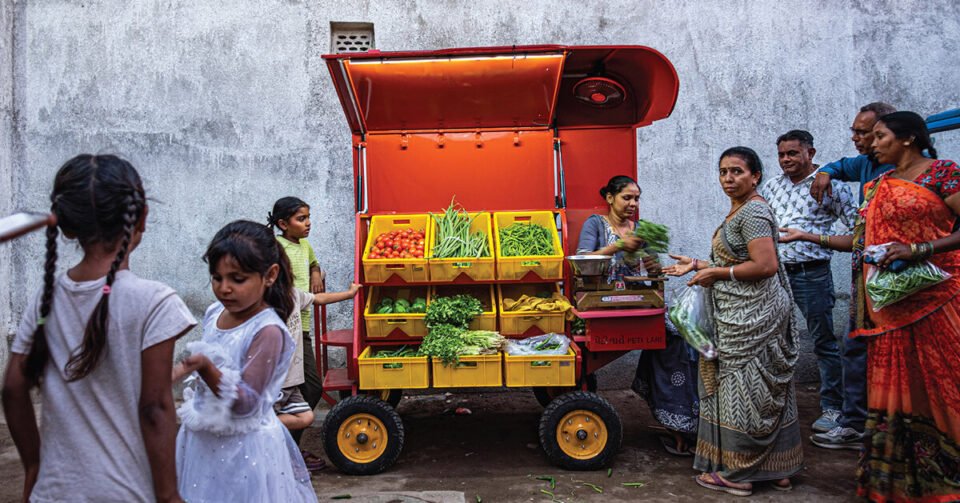
Gita Ben is setting up Peti Laari in the market of Ahmedabad, India | all images courtesy of Chaal Chaal Agency
mobile infrastructure shaped by everyday urban conditions
The initial outcomes of the project by Chaal Chaal Agency, Nano, Vachlo, and Motto, form a system of cart typologies that reconsider navigation, seating, shade, storage, and multi-level display. These prototypes extend the cart into a spatial device that structures relations between vendor, goods, customers, and street edge, without requiring fixed construction.
With support from the Ammodo Architecture Award for Local Scale, the project expands into fresh produce vending and the integration of small-scale technologies. Solar energy systems are introduced to power motorised misting units for produce preservation, reducing losses linked to heat exposure. The same system also supports lighting, phone charging, and fans to improve working conditions throughout the day.
Laari Futures does not position technology as an aesthetic feature, nor does it treat the vending cart as an object to be formalised. Instead, it places simple infrastructure at the scale of daily use, aiming to return time, comfort, and capacity to vendors while maintaining the mobility of the laari. The project proposes a form of urban infrastructure that remains mobile, resilient, and closely aligned with the spatial conditions of street life.

Kami ben selling vegetables from the Peti Laari in her residential neighbourhood

Gita Ben selling vegetables in the market

taking the carts home