
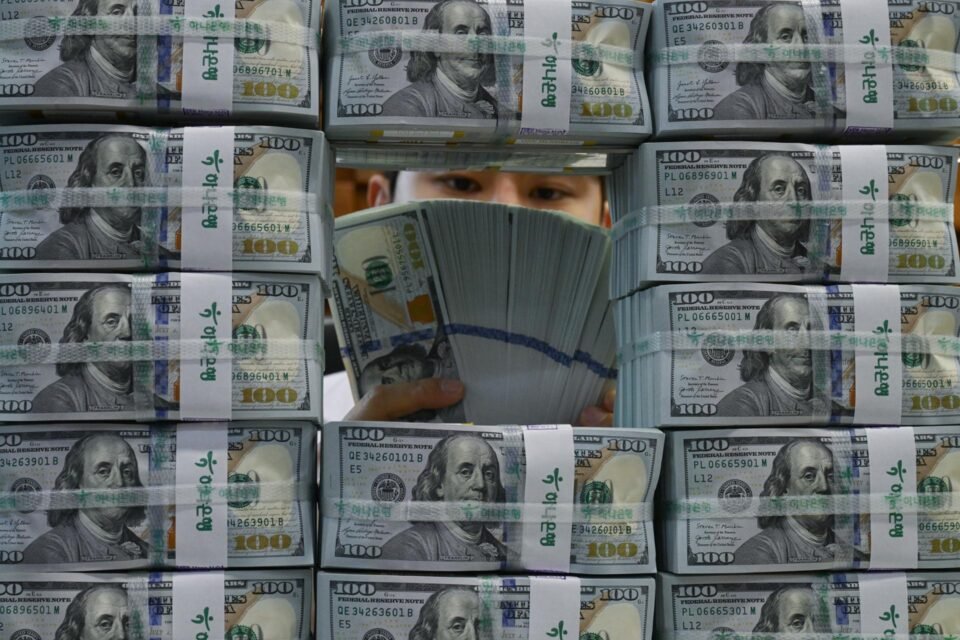

An employee arranges U.S. dollar banknotes at Hana Bank’s counterfeit detection center in central Seoul, March 23. Korea Times photo by Ha Sang-yoon
Korean interest rates are highly sensitive to movements in U.S. yields as markets anticipate a quick response by the Bank of Korea (BOK), pricing that expectation into Korean rates before the central bank actually makes a move, a new BOK study showed Sunday.
The finding helps explain why Korean bond yields tend to move closely with their U.S. counterparts even when the two economies seem to be heading in different directions.
That sensitivity has become increasingly pronounced over the past two decades. A Bloomberg analysis earlier this year found Korean government bonds to be the most sensitive among emerging Asian markets to shifts in the U.S. Treasury yield curve.
The BOK researchers found that global inflation shocks were the single largest contributor, accounting for 41 percent of the co-movement, both in the direction and the level of volatility. The link strengthened sharply after the 2008 global financial crisis and again during the global inflation shock that began in 2021.
This can make it harder for the BOK to calibrate monetary policy solely based on economic conditions at home. Higher long-term yields can also feed through to borrowing costs for domestic households and businesses.
What is more revealing is how those external shocks are transmitted into Korean interest rates. The answer, the study suggests, lies largely in market expectations about monetary policy.
When global inflation pushes U.S. rates higher, markets anticipate a similar response from the BOK and price that move into Korean yields before the central bank actually changes its policy rate.
In other words, investors’ expectations for the central bank’s future policy path play a pivotal role in transmitting external shocks to Korean long-term yields, rather than their sudden reassessment of the riskiness of Korean bonds.
That distinction matters for the central bank. If markets are already pricing in a domestic policy response to movements in U.S. rates, the BOK may be able to moderate some of that spillover through clearer communication about its policy outlook.
“Our suggestion is not to insulate Korean rates from global shocks altogether. Rather, more stable communication could help manage the expectations channel and moderate the degree to which external moves are transmitted into Korean rates,” said Lee Hyung-suk, an associate research fellow at the BOK’s Economic Research Institute.
Lee stressed communication with financial markets as a way to manage the expectations channel and, in turn, moderate the degree to which Korean and U.S. long-term yields move together.