
By Mikaela Smith — Guest Columnist
I’ve often formed close friendships with those moving through the same phase of life.
School, sports teams, and summers at Heritage Pool come to mind. But here in The Gambia, age no longer corresponds with shared activities: My peer group in my village are married with multiple children. The school here goes to ninth grade. Beyond that, girls who want to continue their education and work must leave the village.
At first, I wondered how I would make friends other than my host mother. The loneliness of being the only foreigner in a wildly different culture can be overwhelming. The women my age were busy taking care of their families and gardens, and the gap between our responsibilities felt vast. The tree planting and nutrition initiatives we discussed seemed like heaping more onto their already full plates.
Peace Corps places volunteers with a host family, a gateway into living and working alongside the community. My host mother is one of my closest friends — at night, we usually lie outside and chat. We cook together and practice English phrases (“lunch is ready”) and Mandinka body parts (“n singo,” my foot). The more time we spend together, the less our communication is limited by our range of linguistic expression.

With little definition between life and work, most of the socializing in my village occurs amidst domestic tasks. Women who run businesses often do so selling food or goods out of their compound, all while they care for children and juggle cooking and cleaning. There is no day off from preparing meals or fetching water and firewood. The continuous nature of essential tasks necessitates collective effort. We walk to the garden in groups for safety — the journey is far in the hot sun — and cows and horses roam the bush.
One of the most communal social events among women involves sharing the responsibility of child rearing. Here, you will see a mother scold someone else’s child, wipe their nose, or give them a chore as if they are their own.
Birth of a friendship
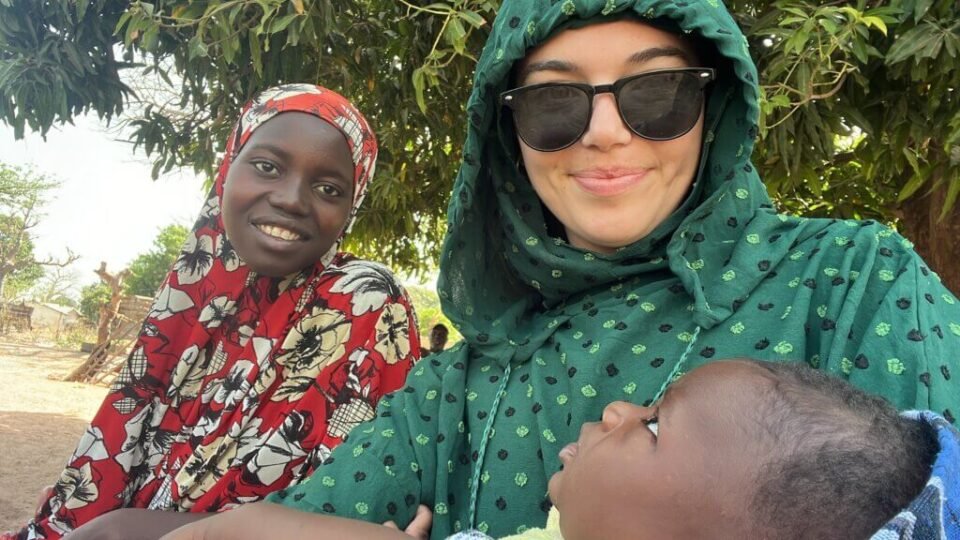
My friend Binta is close to my age but has three kids. Our friendship took shape after her most recent child was born. I would visit her in the mornings and hold baby Yunkuba while she swept the compound.
Any gap in connection with women my own age is filled by my little host cousins Mariama, Auntie, Sally, Khadijatou, Nyma, and Fatoumatta. Still in primary school, they are some of my most critical laundry helpers and have shown me how to properly wring out socks and find joy in untangling a massive garden hose.
My host cousins embody the simplicity with which children view the world, free from assumptions and stereotypes. They enjoy teaching me tasks they’ve performed their whole lives — ones that reinforce that we are far more similar than different.

Parallels to Concord
These friendships in my village remind me of moments cooking with my grandmother after school, familiar faces at Sally Ann’s, and neighbors dropping off treats around the holidays. My host father and I recently visited a friend of his, and she sent us home with a bag of shelled peanuts and ripe mangoes. It reminded me of leaving a friend’s house in Concord with fresh chicken eggs.
The women of my village now pass me their children with the same trust and understanding I built with families over years of babysitting and swim coaching in Concord. They show up for my community tree plantings, and they make sure I have eaten. Often, while I’m washing my clothes by the communal tap, they will stop to lather a few items and move them to the next pan of water before walking on to fetch their own water. These actions reinforce my place in their community; they are here to share in my work and my day. My experience here has highlighted the small actions and care that anchor our relationships.
Evening walks for firewood, where we strategically balance the wood atop our heads, can be arduous. The walk home is often paused for a critical telling of a story or sharing of gossip, despite the heavy sticks carried on our heads. Raising children, peeling peanuts, and cooking with women young and old has shown me how the fabric of my community is knit with small moments of camaraderie and showing up for each other that surpass age and background.
Mikaela Smith is a class of 2017 graduate of Concord-Carlisle High School. She began her 15-month Peace Corps service in The Gambia as a food security and nutrition facilitator in early October 2025. Views expressed are her own.
