
image:
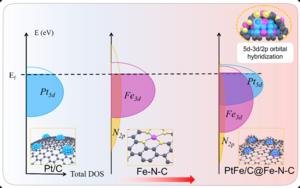
Fe-N-C interfacial engineering on commercial Pt/C catalysts, via unique 5d-3d/2p orbital hybridization, enables a breakthrough in fuel cell durability and performance. The engineered PtFe/C@Fe-N-C catalyst maintains 97.3% of its activity after 30,000 accelerated stress cycles. This exceptional stability and its high mass activity decisively surpass both the performance of pristine Pt/C and the U.S. Department of Energy’s 2025 technical targets.
Credit: Chinese Journal of Catalysis
Hydrogen fuel cells, which cleanly generate electricity, are held back by the high cost and gradual degradation of their platinum-based catalysts. The harsh acidic environment inside a fuel cell causes platinum nanoparticles to dissolve and clump together, leading to a steady decline in power output.
Recently, a research team led by Prof. Lishan Peng and Prof. Qingjun Chen from the University of Science and Technology of China revealed how a novel Fe-N-C protective layer dramatically enhances the stability of platinum-based fuel cell catalysts through a unique interfacial electronic effect. They elucidate the critical role of 5d-3d/2p orbital hybridization in anchoring platinum atoms and optimizing catalytic activity. The results were published in the Chinese Journal of Catalysis (10.1016/S1872-2067(26)64985-6).
This “core-shell” design, named PtFe/C@Fe-N-C, functions like microscopic armor. The Fe-N-C shell physically shields the precious platinum core from the corrosive conditions. More importantly, it creates a powerful electronic interaction at the interface. Advanced analyses confirmed a strong hybridization between the platinum core’s orbitals and those of iron and nitrogen in the shell. This“5d-3d/2p orbital hybridization”not only optimizes the catalyst’s surface for the key oxygen reduction reaction but also makes it much harder for platinum and iron atoms to dissolve away.
The performance results are transformative. In laboratory tests, the catalyst showed negligible activity loss after 30,000 accelerated aging cycles. In a practical H2-O2 fuel cell, it achieved a peak power density of 2.03 W cm-2 and a mass activity of 0.75 A mgPt-1. Critically, after 30,000 operating cycles, its activity decayed by only 2.7%. This far outperforms a commercial platinum-carbon catalyst, which suffered a 54% decay, and exceeds the activity and durability targets set by the U.S. Department of Energy for 2025.
This work provides a clear and effective strategy for designing next-generation catalysts. By dramatically extending the catalyst’s operational life, this innovation is a crucial step towards reducing the long-term costs of fuel cells, accelerating their adoption for clean transportation and power.
About the journal
Chinese Journal of Catalysis is co-sponsored by Dalian Institute of Chemical Physics, Chinese Academy of Sciences and Chinese Chemical Society, and it is currently published by Elsevier group. This monthly journal publishes in English timely contributions of original and rigorously reviewed manuscripts covering all areas of catalysis. The journal publishes Reviews, Accounts, Communications, Articles, Highlights, Perspectives, and Viewpoints of highly scientific values that help understanding and defining of new concepts in both fundamental issues and practical applications of catalysis.Chinese Journal of Catalysisranks among the top six journals in Applied Chemistry with a current SCI impact factor of 17.7.
At Elsevierhttp://www.journals.elsevier.com/chinese-journal-of-catalysis
Manuscript submissionhttps://mc03.manuscriptcentral.com/cjcatal
Journal
Chinese Journal of Catalysis
Article Title
Enhancing the stability of Pt/C catalysts for oxygen reduction reaction in PEMFCs via Fe-N-C-mediated 5d-3d/2p orbital hybridization
Article Publication Date
30-Mar-2026
Disclaimer: AAAS and EurekAlert! are not responsible for the accuracy of news releases posted to EurekAlert! by contributing institutions or for the use of any information through the EurekAlert system.