
There was a time when “precious” in watchmaking meant gold, platinum, and little else. That definition feels increasingly outdated.
At Watches and Wonders 2026, some of the most compelling watches were defined not by complications or design, but by the metals they were made from — materials more commonly associated with nuclear reactors, aerospace engineering, or advanced medical science.
They are difficult to source, harder to machine, and often unforgiving in finishing. However, they bring something else: density, tactility, and a kind of presence that conventional materials struggle to match.
TANTALUM: DENSE AND DEMANDING
Tantalum (Ta, atomic number 73) is one of those metals that watchmakers respect before they even attempt to use it. Discovered in 1802, it is exceptionally dense, highly corrosion-resistant, and almost chemically inert.
It forms a natural oxide layer when exposed to air, protecting it from degradation without ever tarnishing. In practical terms, that makes it incredibly stable — one of the reasons it is widely used in medical implants and high-performance electronics.
For watchmaking, those same qualities make it notoriously difficult to work with. It is both hard and ductile, meaning it resists cutting yet can deform under pressure. Its melting point, close to 3,000 deg C, adds further complexity. Finishing tantalum demands patience, specialised tools, and slower production timelines.
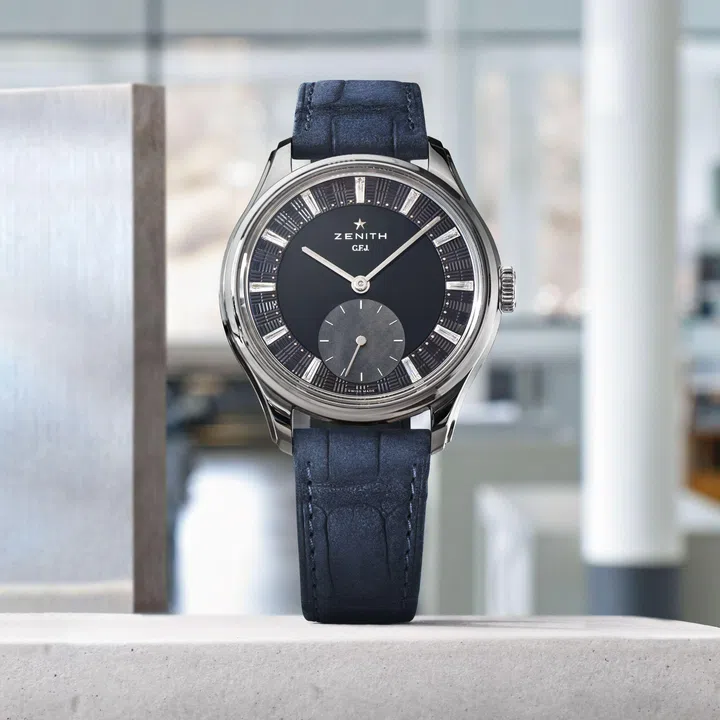
Zenith G.F.J in tantalum. (Photo: Zenith)
Zenith’s G.F.J. in tantalum takes the metal in a classical direction, with a 39.5mm case housing the reborn Calibre 135, one of the most-awarded chronometer movements in history. Here, it is re-engineered with a 72-hour power reserve and, of course, regulated to chronometer standards.
What stands out is the material’s presence. Tantalum’s blue-grey tone gives the watch a subdued, almost architectural quality that is neither glossy nor matte, but deeply metallic. The metal is paired with a restrained dial composition that combines a black onyx centre, grey mother-of-pearl seconds hand, and baguette-cut diamond indexes.
The density translates directly to the wrist, lending the watch a reassuring weight. As Zenith notes, the material requires “absolute control in fabrication”, with slow tolerances and meticulous finishing at every stage.
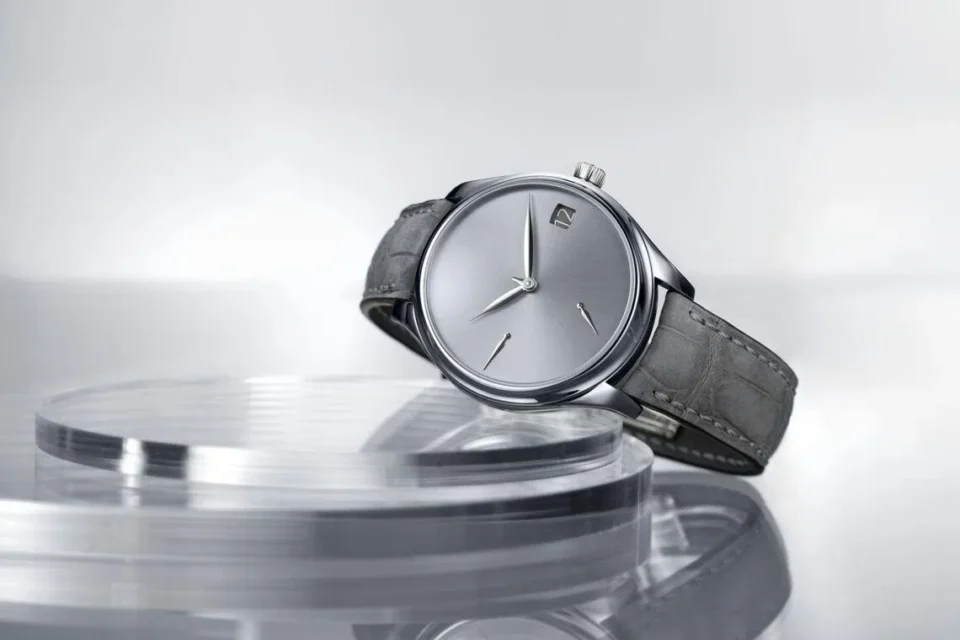
H. Moser & Cie. approaches tantalum from a more minimalist angle. Its 42mm Endeavour Perpetual Calendar Concept Tantalum uses the metal not just for the case, but also for the dial, machined from a solid plate with a brushed sunburst finish.
There is no lacquer or coating to soften it. The dial shifts subtly in the light, revealing the metal’s natural bluish reflections. It feels raw, almost elemental — proof that the material itself can carry the entire aesthetic, even as the HMC 800 hand-wound movement beneath delivers a seven-day power reserve with an intuitive perpetual calendar display reduced to its essentials.
If tantalum is in demand, hafnium (Hf, atomic number 72) is even more so. It is one of the rarest metals used in watchmaking, not because it is unknown, but because it is rarely found in isolation.
Instead, it exists in small concentrations — typically between one and four per cent — within zirconium ores, making extraction both complex and limited. Global production is measured in only tens of tonnes each year.
Its properties explain why it is worth the effort. Hafnium is highly corrosion-resistant and stable under extreme conditions. Historically, it has been used in neutron control systems for nuclear reactors, as well as in aerospace and advanced industrial applications where reliability is critical.
Panerai’s Submersible Navy SEALs Afniotech Experience PAM01089 introduces the metal in a serious way. The case is made from Afniotech, a material comprising more than 95 per cent hafnium — an unprecedented move at this scale in watchmaking.
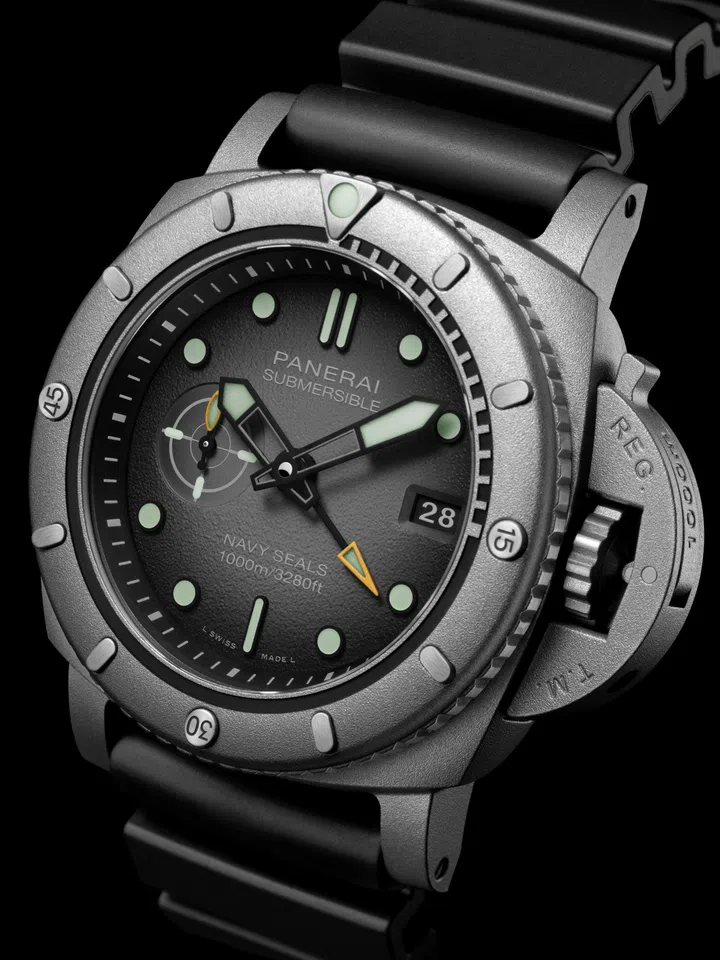
Panerai Submersible Navy SEALs Afniotech Experience PAM01089. (Photo: Panerai)
The watch itself remains firmly rooted in Panerai’s tool-watch DNA. At an imposing 47mm, with a sand-blasted finish, the case takes on a muted silver-grey tone with subtle bluish nuances, paired with a shaded anthracite dial and high-contrast Super-LumiNova markings in green and blue for underwater legibility.
It is definitely dense, at about 70 per cent heavier than stainless steel, while offering comparable hardness, and houses the automatic P.9010/GMT calibre with a three-day power reserve and dual-time functionality.
More importantly, the material aligns with the watch’s purpose. Built for extreme underwater use, with water resistance up to 1,000m, hafnium’s corrosion resistance and structural stability make practical sense. Even machining it required significant adaptation, including advanced five-axis equipment, frequent tool changes, and extended production time.
Osmium (Os, atomic number 76) sits in a category of its own. Often described as the rarest metal on earth, it is also one of the densest. Unlike tantalum or hafnium, its role in watchmaking — for now — is primarily visual rather than structural.
Hublot has been working with crystallised osmium for several years, but its latest use in the Spirit of Big Bang Impact Sapphire brings it to the fore. In its raw form, osmium is volatile and difficult to handle.
Once stabilised through crystallisation, however, it reveals a distinctive crystalline surface with a natural bluish shimmer.
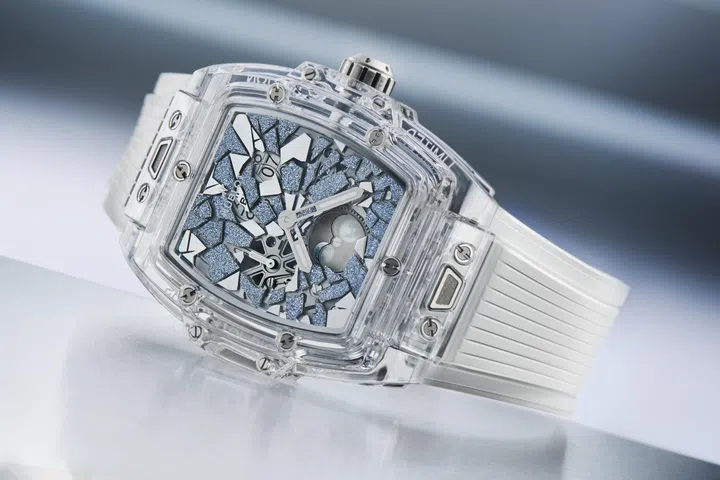
Hublot Spirit of Big Bang Impact Sapphire. (Photo: Hublot)
For this watch, which is powered by the HUB1770 skeletonised automatic calibre with a moonphase display and big date, osmium is used on the dial as fragmented, faceted elements that interact with light in a way few materials can.
The shards are set against a sapphire base, alternating with rhodium-plated appliques, creating a layered, almost cosmic effect within the 42mm tonneau case.
For this watch, osmium is used on the dial as fragmented, faceted elements that interact with light in a way few materials can. The shards are set against a sapphire base, alternating with rhodium-plated appliques, creating a layered, almost cosmic effect.
Hublot describes it as a material that, once crystallised, reveals a unique visual character unlike that of any other metal. And indeed, the impression, in person, is magnificent.
This sits alongside another technical milestone: the brand’s first-ever setting of diamonds directly into sapphire, extending the fragmented motif from dial to bezel.
Each stone is individually accommodated, with laser-machined channels cut into the sapphire before it is secured within gold structures, a process that demands extreme precision given the material’s hardness.