
Rational design of cooperative host-guest architecture
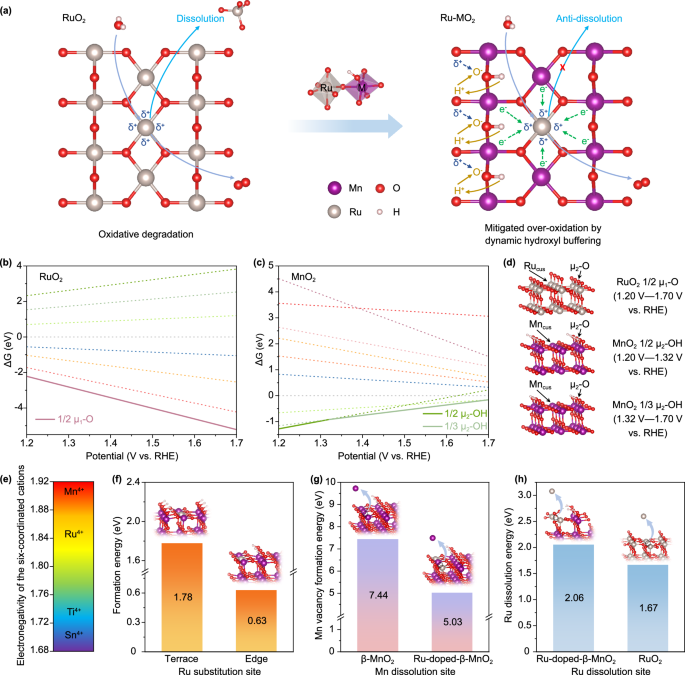
To undermine the intrinsic paradox of hyperactive but unstable Ru(>IV) species, we conceptualized a cooperative host-guest architecture wherein isolated Ru atoms are embedded within an active and isostructural host lattice (Fig. 1a). Specifically, the host fuls two critical functions, including dynamically buffering Ru sites against oxidative dissolution and structurally inducing the formation of active high valence states. We employed a two-step density functional theory (DFT) screening to translate this conceptual framework into a material, first identifying the optimal host and subsequently defining the local Ru coordination environments.

a Schematic illustrating the cooperative stabilization concept. b Surface Pourbaix diagrams for RuO2. c Surface Pourbaix diagrams for β-MnO2. Note that here focuses on the key surface states, while all calculated surface states are provided in the Supplementary Information. d Free energy diagrams of possible surface states for RuO2 and MnO2. e Pauling electronegativity of cations in candidate rutile hosts versus that of Ru(IV). f Calculated formation energies for Ru substitution at edge versus terrace sites within β-MnO2. g Formation energy of an edge Mn vacancy in β-MnO2 and that of a Mn vacancy adjacent to a substituted Ru atom. h Calculated dissolution energy of surface Ru atom on RuO2 (110) compared with an edge Ru-doped β-MnO2.
An ideal host should have the capacity for both dynamic charge buffering and electronic stabilization of high valence Ru species. To ensure atomic-level integration and effective host-guest interactions with RuO2, three isostructural rutile-phase oxides (TiO2, SnO2 and β-MnO2) with thermodynamically stable (110) surfaces were selected as representative models (Supplementary Data 1)16,17,18. Inspired by pseudocapacitance principles19,20,21, we hypothesized that host surface hydroxyls could buffer oxidative equivalents via rapid and reversible dehydrogenation (M-OH → M = O + H+ + e−). This synchronous proton-electron release maintains local electroneutrality, thereby preventing the over-oxidation of active Ru centers. To validate this buffering capacity, we calculated surface Pourbaix diagrams to analyze potential-dependent protonation/deprotonation behaviors, using RuO2 surface as a reference (Figs. 1b–d, S1 and S2)22,23. As seen, RuO2 exhibited a static deprotonated surface (1/2 μ1-O) across the relevant potential window (1.20–1.70 V), demonstrating the lack of intrinsic buffering capability. Conversely, all three host candidates maintained hydroxylated surfaces. Notably, β-MnO2 exhibited a two-step deprotonation initiated at a low potential of 1.32 V, indicating a highly responsive surface capable of mediating dynamic charge transfer.
While all candidates satisfied the buffering prerequisite, the decisive criterion was the host’s electronic modulation of the Ru dopant, governed by cation electronegativity (Fig. 1e). Mn4+ has the highest electronegativity (1.92 vs. 1.84 for Ru4+) and was predicted to withdraw electrons from Ru24. Bader charge analysis quantified that the charge on a Ru atom embedded in β-MnO2 increased to +1.89 |e| (compared to +1.79 |e| in bulk RuO2), implying an elevated oxidation state primed for catalysis (Fig. S3). In contrast, TiO2 and SnO2 featured less electronegative cations and induced negligible electronic perturbation. Consequently, the synergy of dynamic buffering and electronic pre-oxidation capabilities established β-MnO2 as the optimal host.
With β-MnO2 selected, we evaluated the thermodynamic stability of Ru substitution at two dominant surface sites, including basal terraces and low-coordination edges. The calculations revealed a strong thermodynamic preference (0.63 eV) for Ru substitution at edge sites compared to terrace sites (1.78 eV), pointing to a self-organizing atomic arrangement (Figs. 1f, S4)22. While creating an initial Mn vacancy at the edge is energetically costly (7.44 eV), the substitution of a single Ru atom dramatically altered the local energetic landscape, lowering the energy required to remove an adjacent Mn atom to 5.03 eV (Figs. 1g, S5). This reduction in vacancy formation energy facilitates sequential Ru incorporation along the edge sites, thereby providing a thermodynamic driving force for the assembly of atomically precise Ru-O-Mn motifs. We further calculated the Ru dissolution energy to quantify the stability of this architecture. The value for a Ru atom in this confined and hydroxyl-covered edge site was 2.06 eV, which is substantially higher than the 1.67 eV for a Ru atom on RuO2 (110) (Figs. 1h, S6). While these DFT insights are based on computational models that may not fully capture operational conditions, they consistently indicate that the specific Ru-O-Mn edge motifs have good potential to provide the necessary structure for the robust retention of active species.
Synthesis and structural characterization
Guided by the theoretical prediction of thermodynamic preference for Ru substitution at edge sites, we synthesized a series of RuxMn1-xO2 catalysts (where x = 0.01, 0.03, 0.05, and 0.08) using a modified site-selective ion-exchange method25 (Fig. 2a). Powder X-ray diffraction (XRD) patterns verified that all catalysts retained the pure β-MnO2 phase. A systematic shift of the (110) peak to lower angles confirmed the isomorphous substitution of smaller Mn(IV) ions by larger Ru(IV) ions (Fig. 2b)26. Crucially, the optimal Ru0.03Mn0.97O2 catalyst exhibited no phase-separated RuO2, corroborating the atomic-level incorporation of Ru. This substitution-induced local lattice distortion was further evidenced by systematic shifts in the Mn-O vibrational modes in Raman and FT-IR spectra (Fig. S7).

a Schematic of the synthesis procedure. b XRD patterns of the RuxMn1-xO2 series and β-MnO2. The left panel shows the full diffraction patterns, while the right panel displays an enlarged view of the {110} peak. c AC-HAADF-STEM image of Ru0.03Mn0.97O2. d Corresponding EDS elemental mapping. e Intensity profiles along the selected regions in (c). The top and bottom panels display the profiles corresponding to the red and green dashed rectangles in (c), respectively. f Ru K-edge Fourier-transformed EXAFS spectra of Ru0.03Mn0.97O2, RuO2, and Ru foil. g Normalized Ru K-edge XANES spectra of Ru0.03Mn0.97O2, RuO2, and Ru foil. The inset shows a magnified view of the main absorption edge (highlighted by the dashed box). h Mn 3 s XPS spectra of Ru0.03Mn0.97O2 and β-MnO2.
The overall morphology of the catalyst was first examined by scanning electron microscopy (SEM) (Fig. S8), revealing that the β-MnO2 support possesses a characteristic nanorod structure with average dimensions of approximately 1.17 ± 0.2 μm in length and 100 ± 30 nm in diameter. Aberration-corrected high-angle annular dark-field scanning transmission electron microscopy (AC-HAADF-STEM) provided direct visual evidence of the cooperative host-guest architecture. Atomically dispersed Ru atoms were clearly resolved as bright Z-contrast spots, preferentially populating the low-coordination edge sites of the β-MnO2 nanorods to form atomically precise Ru-O-Mn edge chains (Figs. 2c, d, S9). The measured Ru-Ru spacings of 2.9 Å and 3.4 Å matched the Mn-Mn periodicities in the host lattice, confirming that Ru atoms directly replaced Mn within the one-dimensional octahedral chains (Fig. 2e). The selective substitution of Ru at the edge sites of β-MnO2 nanorods is governed by a synergy of thermodynamic and electrostatic driving forces during the ion-exchange process. From a thermodynamic perspective, the edge regions of the nanorods possess a higher density of unsaturated metal sites compared to the basal planes. These sites exhibit higher chemical reactivity, confirmed by the lower energy barrier for Ru substitution (Fig. 1d, e)27. More crucially, the electrostatic driving force plays a decisive role in this site-selectivity. As directly visualized by Kelvin probe force microscopy (KPFM) (Fig. S10), the edges of the β-MnO2 nanorods exhibit a higher local surface potential compared to the basal surfaces. This intensified local electric field creates a strong electrostatic attraction for the positively charged Ru precursor cations, effectively guiding them to preferentially anchor and exchange at the edge positions28. This synergistic mechanism ensures the robust and site-selective anchoring of Ru at the host edges, which is instrumental in forming the highly active Ru-O-Mn edge-chain architecture.
X-ray absorption spectroscopy (XAS) substantiated the formation of Ru-O-Mn coordination, the linkage within the edge chains (Figs. 2f, S11). The extended X-ray absorption fine structure (EXAFS) spectrum of Ru0.03Mn0.97O2 was dominated by a Ru-O-Mn scattering path at 2.36 Å, while the characteristic Ru-O-Ru signal of RuO2 located at 3.1 Å was absent29,30. Such structural consistency, originating from the isostructural nature of β-MnO2 and RuO2, underscores the formation of a robust embedded Ru-O-Mn architecture that effectively anchors the Ru active sites against migration or detachment. This atomic arrangement enabled the predicted interfacial charge transfer, which was confirmed by both X-ray absorption near-edge structure (XANES) and X-ray photoelectron spectroscopy (XPS). Specifically, the strong inductive effect exerted by the electronegative Mn4+ host via Ru-O-Mn bridges leads to a significant reduction in electron density at the Ru centers. A positive shift of Ru K-edge and Ru 3p3/2 binding energy (~0.9 eV) confirmed the structural induction of intrinsic high valence Ru(>IV) species31 (Figs. 2g, S12 and S13). Meanwhile, this electron withdrawal from Ru was balanced by a partial reduction of the Mn host to an average oxidation state of +3.14 (Figs. 2h, S14–S16). The accumulation of Mn(III) species promoted the formation of surface oxygen vacancies (Figs. S17, S18), which acted as Lewis acid sites to trigger water dissociation32,33. Consequently, this process spontaneously anchored a dense protective hydroxyl layer, priming the surface for the subsequent dynamic charge buffering.
Acidic OER performance and PEMWE validation
We first evaluated the acidic OER performance using a rotating disk electrode (RDE) setup. Polarization curves revealed that the Ru0.03Mn0.97O2 catalyst exhibited substantial activity, requiring an overpotential of only 232 mV to achieve 10 mA cm−2 (Figs. 3a, S19 and S20), which compared favorably both β-MnO2 and commercial RuO2. The corresponding non-iR-corrected voltammograms are provided in Fig. S19b. The contribution from carbon black was confirmed to be negligible (Fig. S21). This performance is attributed to the high intrinsic activity, as evidenced by a turnover frequency (TOF) of 1.81 s−1 and a mass activity of 6858 A gRu−1 at 1.50 V vs. RHE. This represents a 223-fold enhancement over commercial RuO2, demonstrating a competitive performance among recently reported acidic OER catalysts (Figs. S22, S23 and Table S1). The Faradaic efficiency (FE) for OER was further quantified via the rotating ring-disk electrode (RRDE) method34,35, confirming that the observed anodic current originates almost entirely from oxygen evolution rather than side reactions (Fig. S24).

a iR-corrected OER polarization curves in 0.1 M HClO4 (compensated using the measured cell resistance of 22.51 ± 0.52 Ω). All LSV curves were collected at a scan rate of 5 mV s−1 with a rotating speed of 1600 rpm and measured at room temperature (25 °C). b Long-term chronopotentiometry stability test at 20 mA cm−2. Inset: Comparison of the stability number (S-number). Post-reaction AC-HAADF-STEM image of the catalyst. c Polarization curves of a PEMWE device at 80 °C (without iR-compensation). d Long-term stability test of a PEMWE device employing the Ru0.03Mn0.97O2 anode at 1 A cm−2. The inset displays a schematic diagram of the assembled PEMWE device configuration used for the test.
Crucially, this substantial enhancement in activity did not come at the expense of stability. In a 1750-h chronopotentiometry test at 20 mA cm−2, it exhibited negligible activity degradation, whereas commercial RuO2 failed within 70 h (Figs. 3d, S25). Post-test analysis detected minimal dissolution of Ru (0.43%) and Mn (1.02%). Consequently, the catalyst achieved a stability number (S-number) of 4.37 × 10⁸, exceeding the RuO2 benchmark by over three orders of magnitude. Post-mortem HRTEM confirmed that the Ru-O-Mn edge chains remained well-preserved after prolonged operation (Figs. 3d, S26).
We further validated the practical viability of this architecture in a PEMWE assembled via the Catalyst Coated Substrate (CCS) method36,37. Remarkably, our catalyst enabled the device to reach an industrial-scale current density of 3 A cm−2 at a cell voltage of 1.96 V (80 °C). This performance surpassed commercial RuO2 and IrO2 benchmarks while reducing precious metal usage by 80% (Fig. 3e). Furthermore, the electrolyzer sustained continuous operation for over 1000 h at 1 A cm−2 without significant voltage increase (Fig. 3f). This performance and stability are highly competitive compared to recently reported results (Table S2). This combination of robust durability, high mass activity, and minimal precious metal loading establishes a viable pathway toward cost-competitive green hydrogen production.
Mechanistic origin of the enhanced activity
To elucidate the mechanistic origin of the enhanced activity, we combined in situ spectroscopy with kinetic analysis. In situ Raman spectra revealed the formation of oxygenated intermediates on Ru0.03Mn0.97O2. While the peak at 668 cm−1 corresponds to the bulk metal-oxygen (M-O) vibration, the feature at 575 cm−1 is specifically assigned to the Ru-O* intermediate (Fig. 4a)38,39,40,41. This assignment is supported by the absence of the corresponding peak for β-MnO2, which effectively rules out the possibility of Mn-O* species (Fig. S27). Furthermore, the feature is validated by a significant redshift from 575 to 542 cm−1 upon 18O-labeling, whereas negligible shifts are observed in D-labeled electrolytes. Consistently, in situ differential electrochemical mass spectrometry (DEMS) performed on the 18O-labeled catalyst in normal electrolyte revealed negligible formation of 34O2 or 36O2, indicating that lattice oxygen does not participate in O2 evolution (Fig. S28). Notably, unlike β-MnO2, which exhibits a distinct MnO4− signal at ~839 cm−1 at potential above 1.7 V vs. RHE, no such peak was detected for Ru0.03Mn0.97O2 throughout the entire OER process. These results supported an adsorbate evolution mechanism (AEM), consistent with the structural robustness of Ru0.03Mn0.97O2 during OER, as the exclusion of lattice oxygen participation effectively prevents the formation of oxygen vacancies that typically trigger structural reorganization and metal dissolution42.

a In situ Raman for Ru0.03Mn0.97O2 under different OER potentials. The top and middle sub-panels display the spectra acquired at 1.6 V in 18O-labeled and D-labeled HClO4 electrolytes, respectively. The bottom sub-panel shows the potential-dependent in situ Raman spectra recorded from OCP to 1.8 V. b Schematic illustration of the Tafel slope isotope effect. c Tafel slope and transfer coefficient α plotted against log(J) derived from the polarization curves in H and D electrolytes. d OER polarization curves of Ru0.03Mn0.97O2 in HClO4 electrolyte from pH 0.4 to 1.3 on the RHE scale. The inset is the proton order estimated by ρRHE = (∂log(i)/∂pH), with ρRHE and i being the proton order and current density at a fixed potential of 1.50 V vs. RHE. e Surface Pourbaix diagrams for Ru0.03Mn0.97O2. f Schematic of the hydrogen-bond-assisted reaction pathway. g Corresponding Gibbs free energy diagrams for the OER. h LSR and derived volcano plot (η versus ΔG*O).
We further investigated the reaction kinetics of Ru0.03Mn0.97O2 using isotope-dependent Tafel analysis, focusing on how H/D substitution influences the apparent Tafel slope in H2O versus D2O (Fig. 4b). We observed pronounced isotope sensitivity, where the Tafel slope shifted significantly from 42 to 118 mV dec−1 upon replacing H2O with D2O (Figs. 4c, S29). Prior studies43,44,45 have shown that such isotope-dependent Tafel slopes arise only when the rate-determining step (RDS) involves a concerted proton-electron transfer (CPET) due to the modification of transfer coefficient (α). Accordingly, our isotope-dependent Tafel behavior supported a CPET-type RDS, possibly the *O + H2O → *OOH. This concerted pathway is kinetically advantageous as it couples proton and electron transfer to bypass high-energy charged intermediates, effectively lowering the activation barrier for rapid oxygen evolution46. Unlike RuO2, which typically shows near pH-invariant kinetics on the RHE scale47, Ru0.03Mn0.97O2 exhibited a fractional proton order of 0.68 (Figs. 4d, S30). Notably, the nearly constant ρRHE values (0.63-0.69) across the 1.46–1.50 V vs. RHE range confirm the mechanistic pathway remains invariant within this potential window. Given the concerted nature of RDS, the observed non-ideal pH dependence implies that the apparent kinetics were decoupled from the intrinsic CPET barrier. Instead, reaction rates were modulated by a pH-dependent surface pre-equilibrium, which regulated the hydroxyl coverage and reactivity of key oxygenated intermediates, including *OH, *O, and *OOH48,49,50. To experimentally capture these active surface hydroxyls, methanol probe experiments were further conducted. As shown in Fig. S31, Ru0.03Mn0.97O2 exhibits a significantly higher methanol oxidation (MOR) current density and a much earlier onset potential compared to RuO2. Given that MOR in acidic media is primarily triggered by the presence of reactive surface *OH, this result provides direct kinetic evidence that our host-guest architecture promotes a higher coverage of active hydroxyl species at the interface. This enriched *OH environment not only facilitates the chemical probe reaction but also acts as the key regulatory factor in optimizing the OER pathway.
To identify the origin of this pre-equilibrium, we computed the surface Pourbaix diagram for Ru0.03Mn0.97O2 using DFT calculations. Under OER conditions, a hydroxyl-rich surface termination (1/2 µ1-O + 1/6 µ2-OH) was predicted to be thermodynamically favored (Figs. 4e, S32 and S33). To show the dependence of activity trend with hydroxyl-rich termination, as shown in Fig. 4f, g, we compared the free-energy diagrams of three representative surfaces, including the hydroxylated and non-hydroxylated Ru0.03Mn0.97O2, and RuO2. Notably, all these surfaces exhibited the same linear scaling relation (LSR) between *OOH and *OH (ΔG*OOH = ΔG*OH + 2.9 eV), consistent with a hydrogen-bond-assisted reaction pathway51,52,53,54. Indeed, in situ ATR-FTIR spectra detected the distinct shoulder features at 1055/1065 cm−1 attributable to strengthened hydrogen-bonding interactions involving *OOH (Fig. S34). Crucially, this intercept value is significantly lower than the conventional universal scaling of ~3.2 eV, indicating that the conventional activity limitations are effectively circumvented. With the new intercept value fixed, the activity differences were primarily governed by the binding strength of *O. Specifically, the hydroxyl-rich termination tuned the binding strength of *O toward the Sabatier optimum, thereby balancing the two uphill steps (*OH → *O and *O → *OOH) and minimizing the theoretical overpotential to 0.25 V (Fig. 4h). Removing surface hydroxyls increased the overpotential to 0.52 V and shifted the RDS back to *OH deprotonation48,51,55. Moreover, this hydroxyl-assisted surface was energetically more favorable than that of RuO2 (0.68 V) and the alternative oxide pathway mechanism (OPM) (0.57–0.71 V, Fig. S35). Collectively, the surface hydroxyl species circumvent conventional LSR limitations by selectively stabilizing *OOH relative to *OH, while simultaneously tuning the O binding strength to the Sabatier optimum.
Mechanistic origin of stability
To elucidate the electronic origin of the catalyst’s resilience against oxidative stress, we tracked the surface state evolution using quasi in situ XPS techniques56. For the Ru0.03Mn0.97O2 catalyst, we monitored the spectral changes during a potential cycle from OCP to 1.5 V and back to OCP. The Ru 3 d peak remained invariant throughout this reversible cycle (Figs. 5a, S36a), indicating that the Ru centers maintained their stable valence state regardless of the potential stress. In contrast, the Mn host exhibited a dynamic and synchronized response involving both cation and anion sub-lattices (Fig. 5b, c). As the applied potential increased from OCP to 1.5 V, the Mn 2p peak progressively shifted to higher binding energies (Figs. 5b, S36b), reflecting the absorption of oxidative charge by the Mn host. This phenomenon identifies the MnO2 support as a redox-active charge reservoir, where the Mn sites undergo self-adaptive oxidation to sacrificially dissipate the mounting oxidative charge. Meanwhile, the O 1s spectra showed a synchronous positive shift in the lattice oxygen peak (Fig. 5c), mirroring the increased oxidation state of the metal centers. Crucially, despite this high oxidative stress, the characteristic peak of adsorbed hydroxyls not only remained prominent but exhibited a distinct potential-driven enrichment. According to quasi in situ XPS quantification, the hydroxyl content increased significantly from 21.59% at OCP to 32.75% at 1.3 V and reached a maximum of 36.97% at 1.5 V (Fig. S37). Even after returning to OCP, the hydroxyl coverage remained as high as 36.31%, confirming the robust retention of the protective hydroxyl-rich termination. Upon returning the potential to OCP, both the Mn 2p and O 1s peaks shifted back to their initial positions. This behavior was distinct from that of commercial RuO2 (Figs. 5d, S36c and S38). Under identical conditions, RuO2 showed a prominent and irreversible shift of the Ru 3d and 3p peaks to higher binding energies, demonstrating the rapid accumulation of unstable high valence Ru species that act as precursors to oxidative dissolution. Post-stability characterization further corroborated these in situ observations and revealed that both the Ru valence state and surface hydroxyl content in our catalyst remained virtually unchanged after prolonged operation (Figs. S39–S41). Specifically, the potential-driven enrichment ensures a high coverage of surface hydroxyl species anchored on the MnO2 host, which serves as the fundamental chemical reservoir for the catalyst’s stability. Crucially, the deprotonation of these host-carried hydroxyls acts as the primary mechanism for dynamically buffering the oxidative charge. Consequently, during the OER process, the MnO2 host adaptively absorbs the mounting oxidative charge through a synergistic dual-pathway. In addition to the self-adaptive valence state transitions of the Mn sites, the dynamic evolution of host-carried surface hydroxyls effectively shields the adjacent Ru active sites from detrimental over-oxidation and subsequent leaching.

a–c Quasi in situ XPS spectra of Ru0.03Mn0.97O2 for the a Ru 3d5/2, b Mn 2p3/2, and c O 1s regions during OER. d Quasi in situ XPS spectra of the Ru 3d5/2 region for RuO2 during OER. The detailed peak deconvolution curves for a, b, and d are provided in Supplementary Information. e Gibbs free energy diagrams for Ru dissolution from the surfaces of Ru0.03Mn0.97O2 and RuO2.
To elucidate the mechanistic link between the observed surface hydroxyls and the suppression of Ru oxidative dissolution, we employed DFT calculations to map the dissolution pathway and energetics (Fig. 5e). The dissolution of Ru-based oxides is typically governed by a multi-step process initiated by surface over-oxidation, followed by a critical structural reorganization of local RuO6 octahedron57. As the non-electrochemical distortion represents the kinetic bottleneck in the degradation pathway, we calculated the energy barrier for this specific event. For commercial RuO2, the barrier was moderate at 1.28 eV (Figs. 5e, S42). However, the barrier increased significantly to 2.78 eV for the hydroxylated Ru0.03Mn0.97O2 catalyst. Furthermore, we performed a control calculation on a model of our catalyst stripped of surface hydroxyls to isolate the specific contribution of hydroxyl-mediated charge buffering. This resulted in a barrier drop to only 1.19 eV. Crucially, the surface hydroxyls firmly coordinate to the Ru centers in Ru0.03Mn0.97O2, restricting the geometric distortion required for the release of soluble RuO4 species. As a result, the energy barrier for RuO4 dissolution in hydroxylated Ru0.03Mn0.97O2 is significantly elevated, exceeding that of its unhydroxylated counterpart by 1.04 eV (Fig. 5e). These computational insights indicate that static Ru-O-Mn motifs alone were insufficient to impart the observed stability, and instead, the dynamic charge buffering mediated by the surface hydroxyls effectively prevented the structural distortion and oxidative dissolution for our Ru0.03Mn0.97O2 catalyst.