
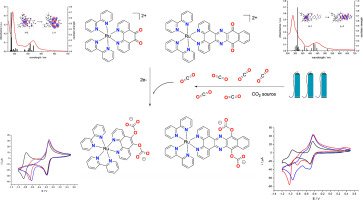
Carbon dioxide emissions have reached critical levels, making it necessary to develop efficient capture and storage strategies to mitigate its environmental impact. Electrochemical methods employing redox-active carriers offer a promising alternative to traditional technologies. In this study, we explore the potential of ruthenium(II) polypyridyl complexes with quinone functionalized ligands (Q), specifically [Ru(bpy)2(phendione)]2+ and [Ru(bpy)2(NQphen)]2+ (where phendione is 1,10-phenanthroline-5,6-dione; NQphen is benzo[i]dipyrido[3,2-a:2′,3′-c]phenazine-10,15-dione, and bpy is 2,2′-bipyridine) with regard to their electrochemical behavior towards CO2 capture. The electrochemical properties of these complexes were analyzed using cyclic voltammetry, focusing on the potentials associated with the formation of radical anions (Q/Q•-) and dianions (Q•−/Q2−), with the latter species being responsible for CO2 capture. The reduction potentials of the quinone units were determined to be −0.17 V and − 0.81 V vs Ag/AgCl for [Ru(bpy)2(phendione)]2+ and − 0.46 V and − 0.97 V vs Ag/AgCl for [Ru(bpy)2(NQphen)]2+. In the presence of CO2, average cathodic shifts of 220 mV were observed, indicating the formation of reversible adducts. Additionally, the CO2 binding constants (log K) for the adducts were determined, yielding values of 5.8 for [Ru(bpy)2(phendione)]2+ and 7.2 for [Ru(bpy)2(NQphen)]2+, suggesting that the CO2 affinity can be tuned through ligand modification. These results indicate that ruthenium(II) polypyridyl complexes functionalized with quinones possess favorable electrochemical well-defined electrochemical characteristics, including reversible redox processes and significant CO2 binding ability. for CO2 capture. This study highlights the potential of such systems to contribute to the development of efficient and reusable molecular technologies aimed at advancing sustainable carbon management.