
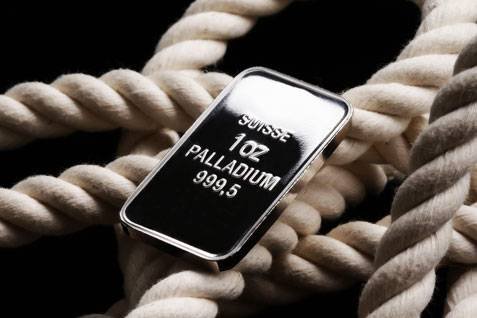
While markets have been focused on the recent sharp decline in gold prices, the broader precious metals sector has also experienced significant selling pressure, with platinum-group metals suffering some of the steepest losses, according to a report from Bank of America.
Both platinum and palladium recently fell to their lowest levels of the year amid continued pressure from the global economic slowdown and geopolitical tensions.
Global economic weakness and Middle East tensions weigh on platinum-group metals
Commodity analysts at the bank said the rally in platinum-group metals lost momentum since late January, largely due to gold’s price action and persistent economic headwinds linked to the conflict in the Middle East, which continue to weigh on industrial metals demand.
Despite the recent weakness, the bank maintained its positive long-term outlook for the sector, noting that it remains constructive on gold heading into the fourth quarter. A renewed gold rally could attract investors back into platinum-group metals and help support prices.
Spot platinum fell to around $1,711 per ounce, down more than 2% during the session, while palladium traded near $1,203 per ounce, up roughly 0.5%.
Since the sharp selloff on Friday, platinum has lost more than 9% of its value, while palladium has fallen over 6%.
Higher price targets despite weak industrial and jewelry demand
Despite current pressures, Bank of America still expects platinum to average around $3,000 per ounce by the fourth quarter of 2026 through the first half of 2027.
Palladium is expected to average around $2,200 per ounce during the final three months of the year.
Platinum-group metals delivered strong gains during 2025 as global trade tensions and threats of tariffs on precious metals created significant disruptions in physical market liquidity.
However, analysts noted that most of those concerns eased after tariff threats failed to translate into broad implementation.
According to the report, the absence of tariffs resulted in more than 200,000 ounces of platinum leaving NYMEX warehouses, roughly half of the inflows recorded during the second half of 2025.
Palladium, meanwhile, saw outflows in late January before flows reversed after the US Department of Commerce imposed final anti-dumping duties of 133% and countervailing duties of 109% on Russian palladium.
Structural shifts in demand
The bank also highlighted structural changes in demand for platinum-group metals.
Platinum is expected to record a modest supply deficit this year, while palladium is forecast to remain in a slight surplus.
Analysts pointed to China’s accelerating transition toward electric vehicles as a major source of market volatility, given the reduced demand for internal combustion engine vehicles that rely heavily on platinum-group metals in catalytic converters.
Electric vehicles are expected to account for roughly 40% of China’s light-vehicle production this year, surpassing conventional combustion-engine vehicles for the first time. Traditional vehicles are projected to represent 36% of production, while hybrids account for 24%.
Production of internal combustion vehicles in China has already fallen to approximately 14 million units in 2025, down from 21 million in 2020.
By contrast, the transition to electric vehicles remains slower in Europe and the United States, particularly after Washington scaled back some of its earlier electrification initiatives.
Weak jewelry demand in China
Demand for platinum jewelry has also slowed, especially in China, where elevated inventories accumulated during the manufacturing boom of mid-2025 continue to pressure the market.
Although some of those inventories have already been recycled, retailers still hold large stockpiles while consumer demand remains weak, raising the risk of a significant contraction in Chinese jewelry manufacturing volumes this year.
Energy costs threaten South African production
Despite uncertainty surrounding global demand, Bank of America believes supply-side risks could become increasingly important.
The bank noted that ongoing Middle East tensions, higher energy prices, and inflationary pressures could negatively affect production, particularly in South Africa, one of the world’s largest producers of platinum-group metals.
South Africa relies heavily on imported oil, has limited domestic production capacity, and faces ongoing refining constraints, leaving its mining sector highly exposed to rising fuel costs.
Diesel remains widely used across mining operations, transportation networks, and backup power generation, especially given the country’s persistent electricity shortages.
Diesel prices have surged since the conflict began, while state utility Eskom raised electricity tariffs by 8.76% beginning in April 2026, significantly increasing mining costs.
In this context, Sibanye-Stillwater reported a 13% year-over-year increase in unit operating costs during the first quarter, citing persistent inflationary pressures, including higher labor and energy expenses.
In trading on Wednesday, spot palladium rose 1.5% to $1,249 per ounce as of 16:14 GMT.