
Walking from my apartment in Hollywood to the Hollywood Palladium Friday night, the first sign of what I was walking into was the line already wrapped around Sunset Boulevard. We arrived at 5:50, ten minutes before doors, and were apparently late by Poppy-fan standards. People had been waiting for hours. Once the doors opened, they rushed inside to claim their spots against the barricade.
Poppy has always attracted an interesting audience. Before many listeners knew her primarily as a recording artist, her surreal, satirical YouTube presence introduced the Poppy character to a huge internet audience. Walking around the Palladium, I could still see traces of the alternative internet culture that grew up alongside her: black band T-shirts, fishnets, Converse, neon hair, heavy eyeliner and side parts. From where I stood, men and women seemed represented fairly evenly, while teenagers head-banged alongside millennials and older fans. At 24, I somehow found myself surrounded by elder emos, and occasionally feeling like one.
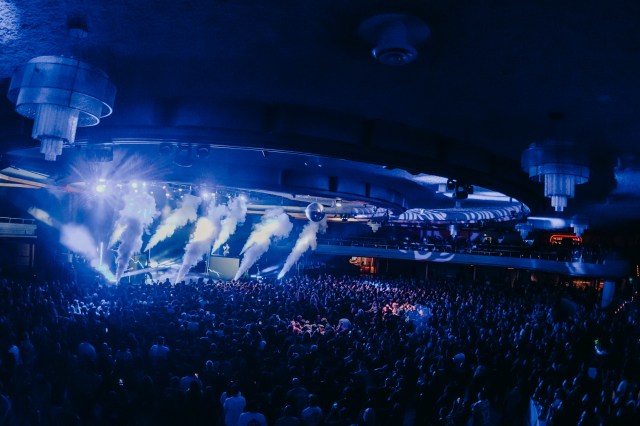
It was also my first time inside the Palladium, which looks remarkably like someone transformed an enormous retro roller rink into a concert venue. Chandeliers and a giant disco ball hang above an open standing floor wrapped by railings and balconies. By the beginning of the first set, that floor was already a sea of black shirts and nodding heads.
San Diego post-hardcore band Thousand Below opened under green lighting and sharp flashes of strobes, pairing melodic vocals with heavier bursts of screaming. Their sound landed somewhere between the pop-punk and emo I grew up with and the considerably heavier direction the rest of the night would take.
Then LANDMVRKS came out. I had never heard the French metalcore band before, and I will be listening to them again.
The Marseille group played with the kind of precision that makes heavy music feel athletic. Screams collided with melody, synths and rapid, almost rap-like vocal cadences before dropping into huge halftime breakdowns. At points, their sound reminded me of what might happen if Stromae crashed headfirst into System of a Down.
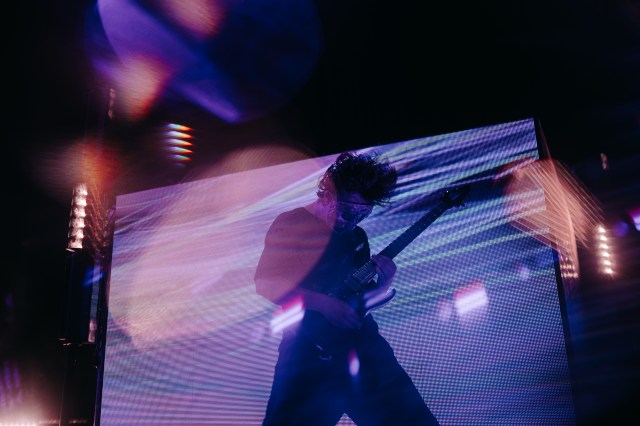
The entire band seemed in motion. Members traded positions and microphones, added their own screams and thrashed across the stage while vocalist Florent Salfati moved between screaming, melody and rhythmic delivery. When he told the floor to split during “Sulfur,” bodies cleared the center and crashed back together as crowd surfers moved overhead. By the end of their set, I had unexpectedly discovered both a band and a corner of French metal I hadn’t known I needed.
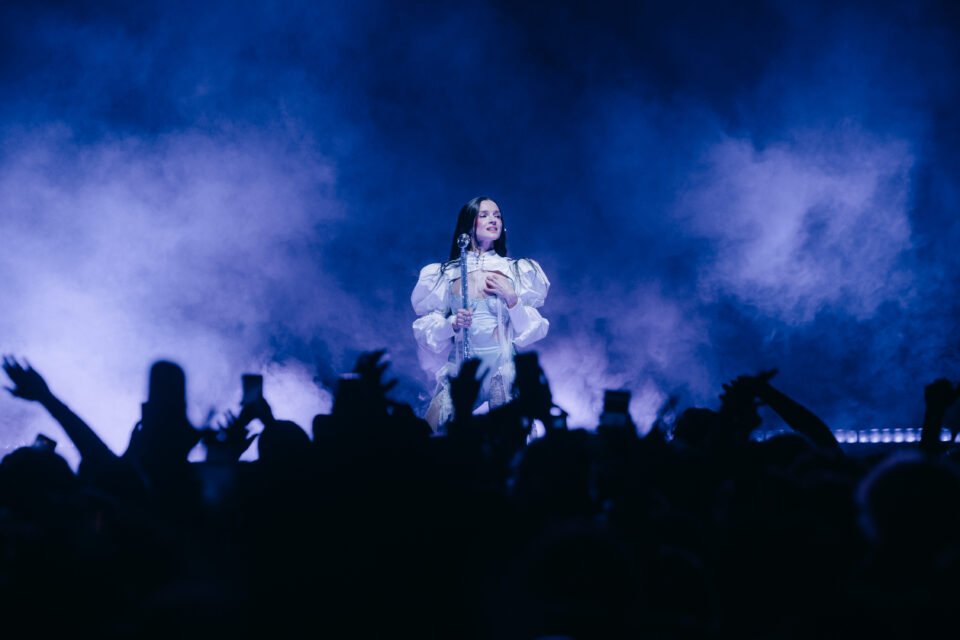
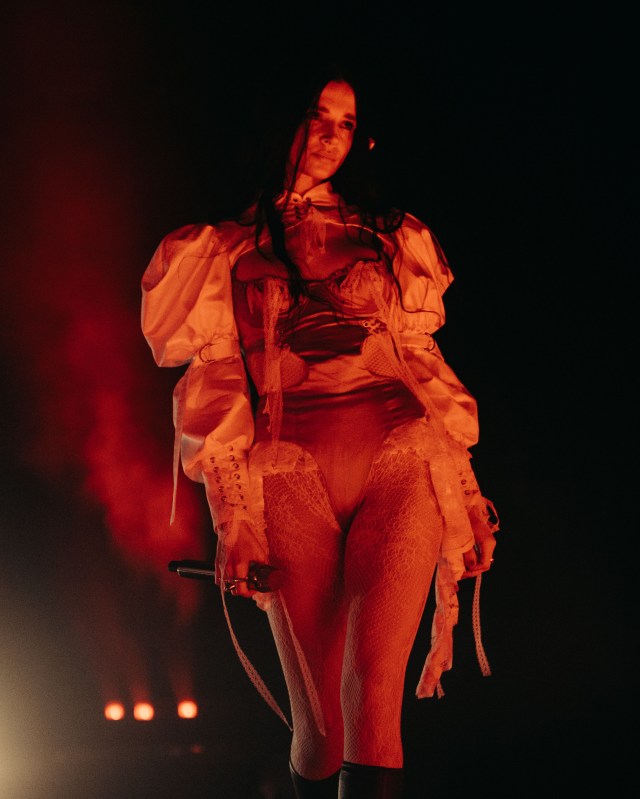
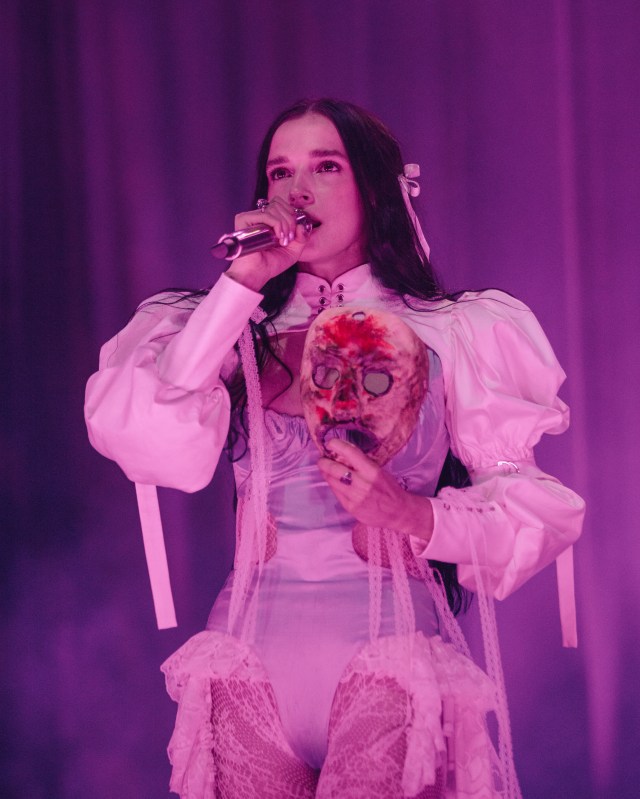
Around 9:10, smoke swallowed the stage as Poppy’s musicians emerged wearing expressionless masks. Poppy appeared between them, corseted and draped in white and blue, with puffed sleeves and an almost storybook femininity. She looked somewhere between Alice in Wonderland and a porcelain doll in a horror movie.
Then she screamed.
Poppy can SCREAM. I knew that from her recordings, but hearing it fill the Palladium was different. Her vocals were strong throughout the night, moving from airy whispers and clear melodic singing into full force screams over heavily distorted guitars and pounding drums. After two opening acts already rooted in screamed vocals and breakdowns, Poppy didn’t sound like a pop artist experimenting with somebody else’s genre. She sounded completely at home in it.
The band behind her was heavy in the most physical sense. Layers of distorted guitar and bass filled the room while the drums seemed to hit you in the chest. Additional backing vocals thickened the sound, but Poppy’s voice stayed clear at its center. There was weight to the arrangements without losing the melodies underneath them.
Poppy also spent a significant portion of the show playing guitar, switching between a metallic silver electric and a stark white acoustic. Watching her move between vocalist, guitarist and frontwoman made the musical evolution of Poppy much easier to understand in person. The character was still there, but the music itself was driving the show.
The “Constantly Nowhere Tour” comes behind her 2026 album Empty Hands, but the set moved through several stages of the heavier sound she has developed over the years. “Concrete” brought the strange sweetness and brutality of I Disagree into the room. “Scary Mask” arrived under psychedelic lighting before red strobes and underlighting turned the doll-like figure at center stage into something closer to the girl crawling out of the television in The Ring. “BLOODMONEY,” one of my personal highlights, had the room clapping along in unison.
The production kept changing the shape of the stage around her. Blue and white light disappeared into red strobes, smoke rolled across the musicians, and psychedelic patterns flashed behind Poppy. Ominous synth drones filled the spaces between songs before another distorted guitar cut through them. Poppy spoke surprisingly little during those transitions, but she didn’t need to. Any pause lasting more than a few seconds was swallowed by chants of “Poppy! Poppy!”
The audience clapped, screamed, head-banged and moshed throughout the set with remarkably little prompting. The middle of the Palladium stayed in motion while people only feet away could stand at the perimeter and simply watch. You could throw yourself into the pit or stay outside it without feeling disconnected from what was happening.
Some fans were apparently willing to endure more than others. Partway through the set, I watched a man cross a large stretch of the Palladium floor looking increasingly desperate. He passed the exit toward the bathrooms and instead made a beeline for the trash can directly beneath the railing where I was standing. After narrowly avoiding vomiting on everyone around him, he straightened himself out, announced, “I’m good,” and immediately ran back into the crowd.
Apparently, even nausea wasn’t worth missing Poppy.
What impressed me almost as much as the constant audience response was how quickly Poppy could raise the temperature of a crowd that had already been moshing all night. Near the end of the set, after keeping her stage banter minimal for most of the performance, she finally addressed the floor directly and told them to split. The reaction was immediate. A crowd that had already spent the night colliding snapped back to attention, bodies clearing the center before surging together again with renewed force. When Poppy finally called for more energy, the whole floor seemed to switch on at once.
As an artist myself, the performance clarified what has always interested me about Poppy. Her earliest internet work used artificiality, exaggerated femininity, control and discomfort as part of the art itself. Her music now occupies a very different space from the world in which many people first discovered her but seeing her live made those versions of Poppy feel much less separate.
Her creative range has expanded without erasing what was underneath it. The femininity, horror and theatricality are still there; now they sit alongside strong live vocals, heavily distorted guitars, crushing drums and a performer completely comfortable screaming at the center of it all.
By the end of the night, blue glitter and confetti were falling over a floor that had barely stopped moving for the last hour. She never played “I Disagree,” my favorite Poppy song, but I forgive her.
Walking home through Hollywood, I kept thinking about how easy it is to divide Poppy’s career into separate eras: internet personality, pop artist, alternative artist, metal artist. Seeing her live made those distinctions feel almost beside the point. Nothing about the performance felt like an artist trying to outrun an old version of herself. Instead, Poppy seems to keep finding new places to take the same creative instincts.
If you know Poppy primarily from one of those earlier eras, that might be the best reason to see her now. The “Constantly Nowhere Tour is heavy, strange and genuinely fun, with a live band that hits hard, vocals that are even better in the room and an audience willing to mosh for an hour, or apparently throw up in a trash can rather than miss a song.
After all the characters, genre shifts and transformations, maybe the simplest takeaway is also the most fitting.
She’s Poppy.